
Weston
The Meteorite That Established American Meteoritics
No reserve
Auction Closed
July 14, 07:13 PM GMT
Estimate
3,000 - 5,000 USD
Lot Details
Description
Weston — The Meteorite That Established American Meteoritics
Chondrite – H4
Fairfield County, Connecticut, USA (41° 16'N, 73° 16'W)
Witnessed Fall on December 14, 1807
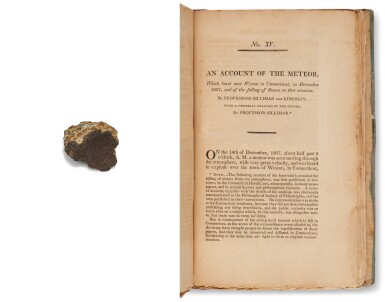
17 x 12 x 10 mm (⅝ x ½ x ⅜ inches). Approx. 4 grams (20 carats).
Included in the lot is the following book:
Memoirs of the Connecticut Academy of Arts and Sciences, 1st ed., vol. 1, Oliver Steele & Co., New Haven, CT, 1810.
This first edition copy of the Memoirs, vol. 1, includes Benjamin Silliman and James Kingsley's article, "An Account of the Meteor, Which burst over Weston in Connecticut, in December 1807, and of the falling of Stones on that occasion," which includes their scientific analysis and report of the eyewitness accounts of the Weston meteorite fall. This copy is also signed by Roger Minott Sherman (1773-1844), a prominent Connecticut attorney and jurist, as well as a member of the Connecticut Academy of Arts and Sciences. The Memoirs also includes lexicographer Noah Webster's famous treatise, "On the Supposed Change in the Temperature of Winter," a rebuttal to Thomas Jefferson's arguments for climate change.
THE METEORITE THAT ESTABLISHED AMERICAN METEORITICS
Weston fell to Earth on the morning of December 14, 1807, witnessed by numerous individuals across Vermont, Massachusetts, and Connecticut. As the first witnessed, recovered fall in the United States, coming shortly after the Wold Cottage fall in Yorkshire, England in 1795 and the L'Aigle fall in Normandy, France in 1803, Weston gave the world additional evidence of the extraterrestrial origin of meteorites, and gave American scientists and natural historians a chance to make their name in the new science of meteoritics.
The Weston fall was of such importance that the President at the time, Thomas Jefferson, was made aware of the fall at Weston, and found time to respond to one of the finders of a piece of the meteorite, Daniel Salmon, to let him know that some pieces of Weston were already in the hands of national legislators, but that it would be more useful if pieces were given to members of the Philosophical Society of Philadelphia (i.e., the American Philosophical Society) to investigate their origins.
It is believed that of the 350 pounds of Weston recovered after the fall, fewer than 50 pounds of material are currently accounted for, much of it in institutional collections around the world.
The witnessed fall, coupled with the rapid analysis of the meteorite by Yale scholars Silliman and Kingsley, ushered in the beginning of meteoritics in America, and also cemented Yale as a scientific powerhouse; indeed, Yale's Peabody Museum remains one of the world's most important centers for American meteoritics (not to mention other sciences, including paleontology).
REFERENCES: