French, Languedoc, probably Toulouse, circa 1480 - 1490
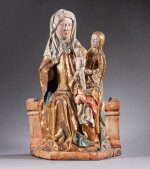
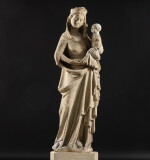
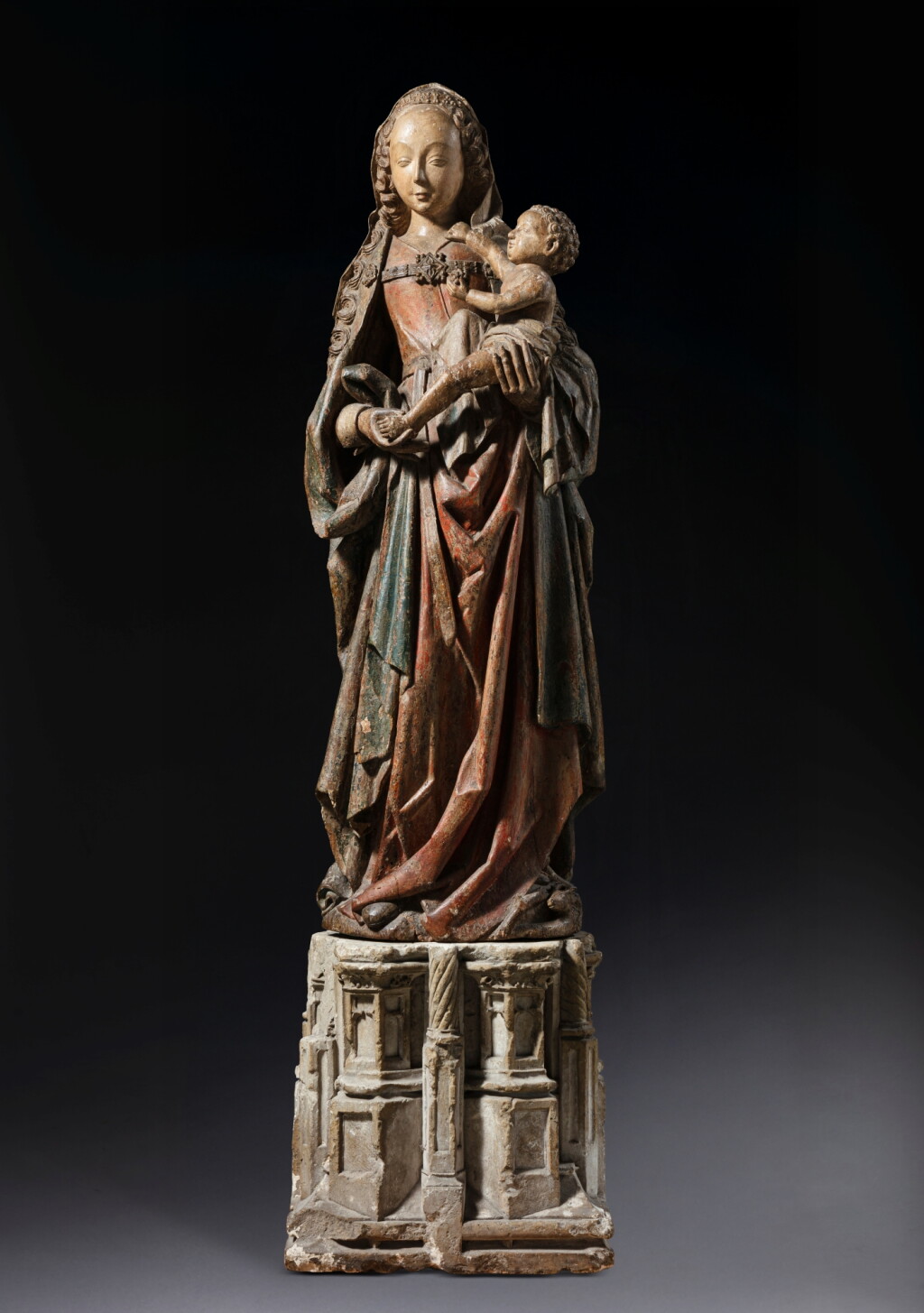
Virgin and Child
Estimate
50,000 - 70,000 EUR
Lot Details
Description
Languedoc, probably Toulouse, circa 1480 - 1490
Virgin and Child
polychromed wood with traces of gilding; the associated base in the form of a French 15th century limestone architectural fragment
Virgin: 135cm., 53⅛in.
base: 49 by 50 by 37cm., 19¼ by 19¾ by 14⅝in.
R. P. Daniel Belbèze, Moissac, circa 1930;
Dr Hulin, Musée du Rempart, Sarlat;
His sale, Mes M. Rheims, R.-G. Laurin, P. Rheims, Palais Galliera, Paris, 12 December 1966, lot 24 (sold for 180,000 frs hammer);
with Galerie Bresset, Paris;
From whom acquired in the 1970s, private collection, Belgium;
Thence by descent to the present owners, Private collection, Ghent.
J. Boccador, E. Bresset, Statuaire médiévale de collection, vol. II, 1972, p. 131, fig. 131.
In the second half of the 15th century, Languedoc experienced a remarkable artistic revival, marking the end of a devastating trilogy of plague, war and famine. Following the conclusion of the Hundred Years’ War in 1453, and then the terrible fire of 1463, which destroyed nearly two-thirds of Toulouse, this commercial city, situated at the crossroads between the Kingdom of France and the Iberian Peninsula, returned to prosperity. A new generation of artists arrived, drawn by growing demand from influential families such as the Bourbon and Amboise, wealthy merchants, powerful members of the clergy and lawyers. They would become the driving force behind a genuine renaissance of the arts in Languedoc. Among the sculptors active in the region in the mid-15th century were Jacques Morel (1390–1459), from Lyon and influenced by Burgundian art, and his pupil Pierre Viguier, whose influence extended across Rodez, Montpellier and Toulouse. Between 1492 and 1495, a sculptor of Brabantine origin, the Brussels-born Pierre Brucy, also known as Bracin, is mentioned on several occasions in the Montpellier registers.
The present Virgin is fully representative of the fusion that took place during this period between influences from northern Europe and a vernacular style characteristic of late Gothic Languedoc, distinguished by elegant silhouettes, a pronounced taste for ornamental detail and exceptionally gentle facial features. The Virgin’s elongated oval face, narrow mouth, long, slender nose, high and perfectly arched eyebrows, almond-shaped eyes and pronounced eyelids are entirely consistent with the Brabantine style of the final quarter of the 15th century, dominated by the outstanding Borman dynasty. The delicate features of the present Virgin may be compared with those of an oak Mary Magdalene, dating from around 1490–1500 and attributed to Jan I Borman (active circa 1460–1502) (Royal Museums of Art and History, Brussels, inv. 2992), as well as with the pose of an oak Virgin and Child, dating from around 1460–1470 and attributed to the same sculptor (M-Leven, Leuven, inv. C/363), and another example dating from around 1510, attributed to Jan III (Musée du Louvre, inv. RF 43).
While the Brabantine influence is striking, certain elements reveal a more specifically Languedocian heritage, notably the Virgin’s broad curls, whose exaggeratedly sinuous curves recall the manner of the Master of Rieux. Formerly attributed to Jacques Morel, Notre-Dame des Grâces (or Nostre Dame de Grasse) epitomises the exceptionally refined Toulouse sculpture of the final third of the 15th century (Musée des Augustins, Toulouse, inv. RA 788). Similarly, the meticulously rendered ornamental details on the present Virgin’s garments, such as the clasp fastening her mantle and the richly worked band securing her veil, translate into sculpture the splendour of Toulouse goldsmiths’ work. Its rich, partially preserved polychromy, meanwhile, is reminiscent of the vibrant colours of Languedocian illuminated manuscripts. Finally, a parallel may be drawn between the pose of the present Virgin and that of a Virgin in the church of Saint-Benoît at Bellegarde, in the Tarn. Although slightly later, dating from around 1510, the Bellegarde Virgin holds a raised fold of her mantle in the same manner, tucked beneath her right forearm. Two similar, long, flowing locks frame her face, while an abundance of ornamental details—including the mantle clasp, the richly decorated band adorning her head, and the rosary from which medals and a branch of coral are suspended—reveals a comparable fascination with precious detail.
First documented around 1930 in the collection of the Reverend Father Daniel Belbèze, prior of the Carmelite monastery in Rennes, who had recently acquired the Hôtellerie Sainte-Foy in Moissac, the present Virgin subsequently passed into the hands of Dr Hulin, a physician with a keen interest in the history, archaeology and heritage of the Périgord region. After exhibiting part of his collections at the Château de Reignac, he opened his Musée du Rempart in Sarlat, housed in the Tour du Bourreau. Following his death, the collection was dispersed in Paris on 12 December 1966. The present Virgin was then described as a Languedocian work dating from the late 15th or early 16th century and compared with works attributed to Pierre Brucy. When the sculpture was subsequently published by Jacqueline Boccador and Édouard Bresset, the authors confirmed its Languedocian origin and late 15th century date, but did not retain the attribution to this sculptor, of whose actual output very few works are known.
RELATED LITERATURE
A. Huysmans, La sculpture des Pays-Bas méridionaux et de la Principauté de Liège. XVe et XVIe siècles. Musées royaux d’Art et d’Histoire, Brussels, 2000, pp. 102-103;
M. Debaene (ed.), Borman. A Family of Northern Renaissance Sculptors, exh. cat. M - Museum Leuven, 2019, pp. 95 and 260;
B. de Chancel-Bardelot, Ch. Riou (ed.), Toulouse 1300-1400. L’éclat d’un gothique méridional, exh. cat. musée de Cluny musée national du Moyen Âge, Paris, 2022, pp.b162-175;
France vers 1500. Entre Moyen Âge et Renaissance, exh. cat. Grand Palais, Paris, 2010, pp. 208-12.
You May Also Like