Pietro Cipriani (circa 1679-1745), after the Antique Florence, circa 1723 - 1724
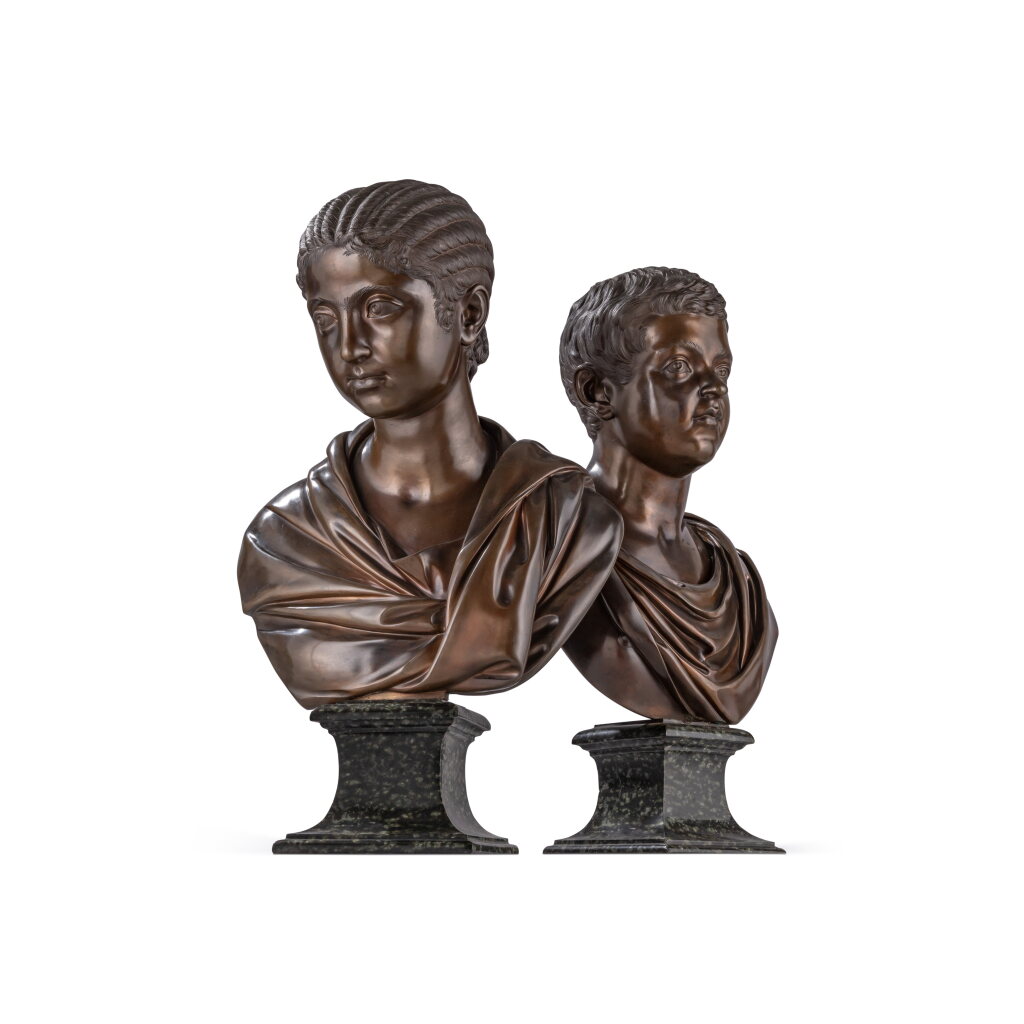
Busts of Geta and Plautilla
Estimate
200,000 - 300,000 EUR
Lot Details
Description
Pietro Cipriani (circa 1679 - 1745)
After the Antique
Florence, circa 1723 - 1724
Busts of Geta and Plautilla
bronze, on verde di Prato socles
bronzes: 47cm., 18½in. each
62cm., 24⅜in. each overall
(2)
Purchased by Thomas Parker, 1st Earl of Macclesfield, via his son, George Parker, Shirburn Castle;
By descent to Richard, 9th Earl of Macclesfield, Shirburn Castle;
By whom sold, Christie’s, London, 1 December 2005, lot 81;
With Tomasso Brothers Fine Art, Leeds, 2008;
With Ronald Phillips, London, 2012.
New York, Tomasso Brothers Fine Art at Williams Moretti Irving Gallery, 15 October – 1 November 2008.
E. Wright, Some Observations made in Travelling through France and Italy in Years 1720, and 1722, London, 1730 (2nd ed. 1764), p. 412;
T. P. Connor, ‘The Fruits of a Grand Tour – Edward Wright and Lord Parker in Italy, 1720-1722’, in Apollo, July 1998, pp. 23-30, Plautilla ill. fig. 5, p. 26;
Tomasso Brothers Fine Art, Scultura, exh. cat. Williams Moretti Irving Gallery, New York, 2008, pp. 112-113, no. 31.
The present busts of Plautilla and Geta are associated with the most ambitious commission received by Pietro Cipriani. They remained for nearly three centuries in one of the earliest and most distinguished sculpture galleries established in Great Britain during the first quarter of the 18th century. They are related to the wave of anticomania that compelled Grand Tour travellers to embark on a relentless quest for the finest casts after the most celebrated antique models. They also testify to Cipriani’s outstanding craftsmanship, which enabled him to rival his master, Massimiliano Soldani-Benzi (1656–1740), and are distinguished by a treatment of the surface that is both dazzling and highly individual.
Pietro Cipriani and the Macclesfield Bronzes
Passing through Florence during the winter of 1721–1722, George Parker (c. 1697–1764) marvelled at the treasures of the grand-ducal city, one of the highlights of his long formative journey through Italy. The young lord was also charged with prospecting on behalf of his father, Thomas Parker (1666–1732), 1st Earl of Macclesfield, in search of the finest and most faithful copies after the Antique for the sculpture gallery then being established at Shirburn Castle (Oxfordshire), which he had acquired in 1716. Parker was accompanied by his tutor, Edward Wright, whose notes, published in 1730 and again in 1764, recount the remarkable discoveries made during their journey and describe in detail the circumstances in which the present busts were eventually acquired by Lord Macclesfield.
In his notes, the tutor dwells on the description of the Uffizi and conveys the impact made upon visitors by the masterpieces of the Medici collections, assembled in the ‘glorious octagonal Room called the Tribuna, which looks like a little Temple inhabited by Goddesses’ (Wright, op. cit., p. 405). George initially commissioned two life-size bronzes after the Medici Venus and the Dancing Faun, the jewels of this sanctuary to the glory of the Ancients (inv. 1914, nos. 224 and 220). Between 1695 and 1702, Soldani had already successfully undertaken the casting of the first life-size examples after these models, a remarkable technical achievement at the time, which were promptly acquired by Johann Adam Andreas I, Prince of Liechtenstein (inv. nos. SK 537 and SK 541).
Lord Parker seems, however, to have been unaware of the precedents in the Liechtenstein collection. According to Wright, he was instead impressed by other examples produced in Soldani’s workshop, around 1709, for the gallery of the Duke of Marlborough at Blenheim: ‘These four capital statues [the Medici Venus, the Dancing Faun, the Arrotino and the group of the Wrestlers] were cast in copper (sic), exceeding well, by Signor Soldani, for the Duke of Marlborough, and are now at Blenheim’ (ibid., p. 412). The dazzling reflections of the rich translucent patina, characteristic of Florentine bronzes, which Soldani mastered to perfection, enhance the naturally orange-golden tones of the copper alloy and may here account for the author’s confusion.
Pietro Cipriani was entrusted with the execution of this prestigious commission, certainly on Soldani’s recommendation, as the latter was then occupied with the funerary monument of Fra Marcantonio Zondadari, Grand Master of the Order of St John of Malta. The two Florentine sculptors knew each other well, since the former was the latter’s principal collaborator, under whom he had acquired considerable experience. From the early 1720s, Cipriani began to establish his independence from his master and attracted a clientele of milordi, the Italian term used for British aristocrats undertaking the Grand Tour, among them Horace Walpole.
In his notes, Wright stresses the established reputation of the sculptor under consideration: ‘When my Lord Parker was at Florence, and greatly delighted with these statues, Signor Pietro Cipriani, an excellent artist, and formerly a scholar of Soldani, and his assistant in casting those statues for the Duke of Marlborough, undertook to make for him copies in copper of the Venus and the Faun, which he engaged should at least equal Soldani’s, and be the most exact that ever were made’ (ibid., p. 412). Thus, Cipriani offered the double advantage of having already become familiar with the two antique marbles during the production of the Marlborough examples, for which he had assisted Soldani, and of having access to the moulds for the latter, since they belonged to his master.
The sculptor proved fully equal to his promises; his two outstanding bronzes, which remained at Shirburn Castle until 2005 (Christie’s, London, 1 December 2005, lot 64), are now in the J. Paul Getty Museum (inv. nos. 2008.41.1 and 2008.41.2).
The particular case of Plautilla and Geta
Probably encouraged by the favourable reception of his first two bronzes by his patron, Cipriani then proposed, this time on his own initiative, two further bronzes after the Medici antiquities in the Uffizi: one after the bust of Plautilla (inv. 1914, no. 218), and the other after that of Geta, now identified as Diadumenian (inv. 1914, no. 226). As an attentive commentator on the Macclesfield collections, Wright states: ‘My Lord likewise had Casts made in Copper of the Busts of Plautilla and Geta, which are in the great Gallery there, and they are performed admirably well’ (ibid., p. 412). Unlike the Venus and the Faun, however, the sculptor did not have pre-existing moulds at his disposal.
On his return to England, George Parker confirmed in a letter dated 18 October 1724, addressed to the Florentine architect and intermediary Alessandro Galilei, who supervised the progress of Cipriani’s work, that his father wished to acquire the two bronzes of Plautilla and Geta—which he calls Antonious (Florence, Archivio di Stato, Archivio Galilei, V, inserto 1, fol. 138). He also confirmed that he had obtained the Grand Ducal permission for the making of the mould for the former and instructed Cipriani to obtain permission for the latter. In this invaluable document, George adds that any goodwill gesture in the 200 ducats asked for the two busts would be greatly appreciated, but that his father would purchase them regardless. We also learn that, once completed, the bronzes were to be transported to Livorno, from where they would be shipped to England.
As Parker’s letter indicates, the Grand Ducal authorities imposed strict conditions on making a mould directly from the Medici antiquities, with the aim of limiting their replication. Wright confirms this point with regard to Plautilla: ‘My Lord has not only the copper cast, but the very mould, which was made on purpose for him, with the leave of his Royal Highness; who insisted that the mould should not be left at Florence, for the cast to become common there, but should either be broken to pieces, or carried away by my Lord; his Lordship was not long in determining upon the later, and accordingly brought it into England’ (ibid., p. 412). The quality of the resulting cast depending upon the precision of the mould, Lord Parker’s efforts were therefore not in vain. Apart from a very slight difference in size, corresponding to the shrinkage of the metal, the present busts are remarkably faithful reproductions in bronze of the Uffizi prototypes.
To our knowledge, the Macclesfield moulds were reused by Cipriani only once, before leaving Florence. The second, and probably final, pair of busts produced from them was sold at Sotheby’s, in London, on 7 December 2021 (lot 74), and subsequently at Artcurial, Paris, on 25 November 2025 (lot 67). The Macclesfield examples are nevertheless distinguished by the exceptionally fine preservation of their subtle original patina.
As mentioned above, the casting in bronze of the busts of Geta and Plautilla resulted from Cipriani’s own initiative rather than from an initial commission. Instead of taking the easier course of proposing models for which he might have had access to pre-existing moulds, notably those belonging to Soldani, he chose these two 3rd-century A.D. marble busts depicting the young wife and brother of the despotic emperor Caracalla.
Publius Septimius Geta (AD 189–211), the younger son of Septimius Severus, successively became Caesar, then Augustus and co-emperor. He accompanied his father during the campaign in Britain, where he was entrusted with the administration of the province of York. Following the death of Septimius Severus in 211, he ruled jointly with Caracalla, who ordered his assassination a few months later. Fulvia Plautilla (d. 212 A.D.), daughter of the powerful praetorian prefect Gaius Fulvius Plautianus, was first exiled by Caracalla to Lipari and subsequently murdered on her husband’s orders. Originally conceived independently, these portraits of two figures from Severan history with common tragic destinies were only brought together as a pair under the reign of Cosimo III de’ Medici.
The choice of Geta may furthermore have held a particular resonance for the Earl of Macclesfield: the young Severan prince’s participation in the campaign in Britain may have had a special significance for this English collector with a keen interest in ancient history.
It so happens, moreover, that this acquisition took place at a turning point in Thomas Parker’s career. The influential politician, then Lord Chancellor and at the height of his power, was on the eve of his impeachment on corruption charges. In 1725 he was fined £30,000 and imprisoned in the Tower of London for six months. Having withdrawn from political life, he spent the remainder of his life at Shirburn Castle, where he was buried.
Although fully conversant with the techniques employed in Soldani’s workshop, Cipriani gradually freed himself from his master’s models and developed a personal style, distinguished above all by an unprecedented degree of refinement in the treatment of the surface. The hair, eyebrows, eyes, lips, and the flowing drapery of the garments, with their crisp folds: every constituent element of the Macclesfield busts received an individualised treatment with the chasing tool.
The play of light across the surface thus produces infinite variations and heightens the contrasts between the smooth volumes of the youthful faces and the piercing gazes that emerge from them, emphasised by strongly defined eyebrows. Plautilla’s plaited hair is a true tour de force, while her melancholy expression seems to foreshadow her tragic fate. Likewise, Geta’s rounded cheeks and full lips are still those of a child, while the proud bearing of his head and his distant gaze anticipate the high office to which he was destined.
These two masterpieces of Florentine Baroque bronze sculpture in the age of the last Medici, highly esteemed from the moment of their acquisition, remained in the family of the Earls of Macclesfield for nearly three centuries. They testify to the splendour of the sculpture gallery assembled at Shirburn Castle, one of the earliest of its kind in Britain, and belong to the same tradition as the Hamilton Laocoön, cast by Auguste-Jean-Marie Carbonneaux almost a century later, whose recent sale at Sotheby’s confirmed the extraordinary legacy of the taste for the Antique.
RELATED LITERATURE
G. Mansuelli, Galleria degli Uffizi – Le Sculture, Rome, 1961, vol. II, p. 113-114, nos. and 141; Die Bronzen der Fürstlichen Sammlung Liechtenstein, exh. cat., Museum für Angewandte Kunst, Frankfurt, 1986-1987;
G. Pratesi, Repertorio della scultura fiorentina del Seicento e Settecento, 3 vol., Turin, 1993.
You May Also Like