A Monumental Roman Marble Figure of a Youth, 1st/2nd Century A.D., with late 17th/early 18th Century Restorations
Auction Closed
November 4, 07:28 PM GMT
Estimate
250,000 - 400,000 EUR
Lot Details
Description
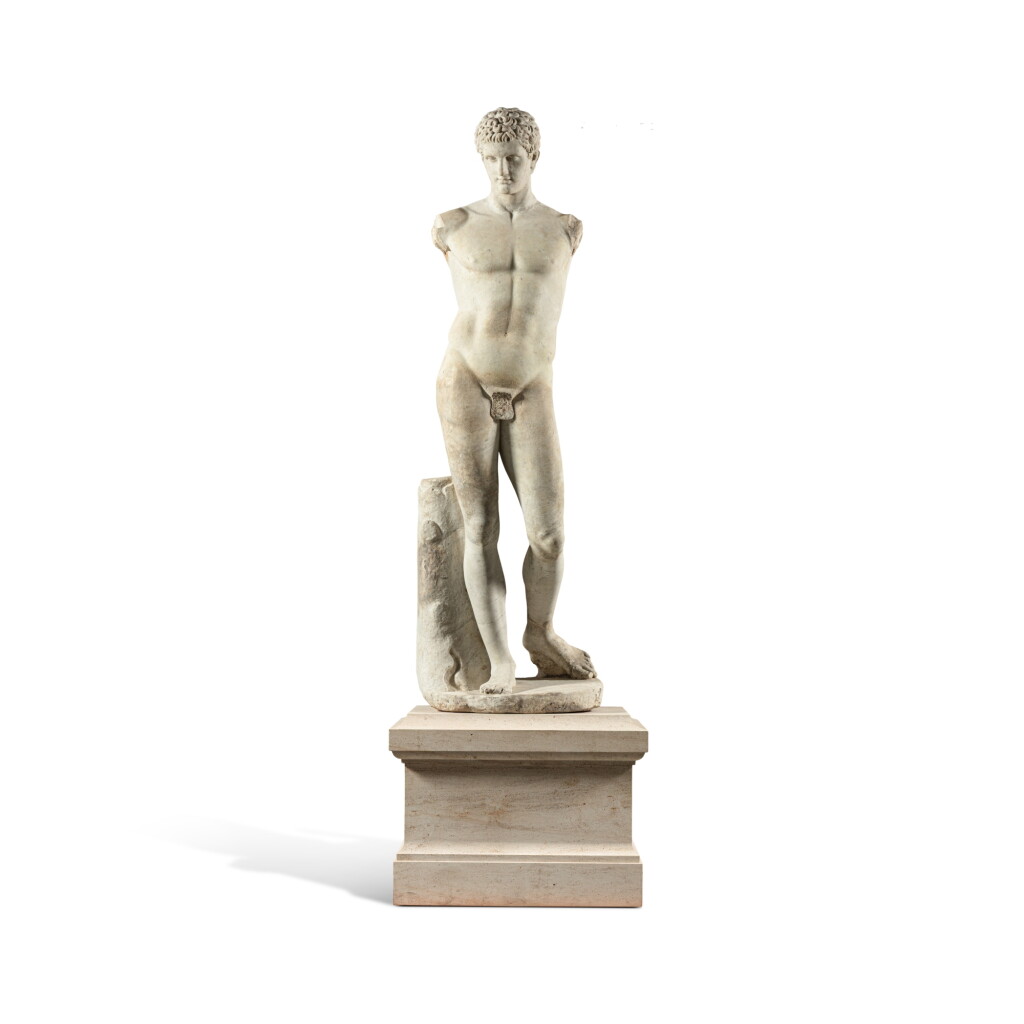
A Monumental Roman Marble Figure of a Youth, 1st/2nd Century A.D., with late 17th/early 18th Century Restorations
standing with the weight on his right leg, the base, support, legs, and head restored, the arms formerly restored.
on a modern limestone base
Height 81½ in., 207 cm.
base: 65 by 86.5 by 70.5 cm., 25⅝ by 34 by 27¾ in.
(2)
Thomas Herbert, 8th Earl of Pembroke, 1656-1733, Wilton House, Wiltshire
Henry, 9th Earl of Pembroke, 1693-1749
Henry, 10th Earl of Pembroke, 1734-1794
George Augustus, 11th Earl of Pembroke, 1759-1827
Robert Henry, 12th Earl of Pembroke, 1791-1862
George Robert Charles, 13th Earl of Pembroke, 1850-1895
Sidney, 14th Earl of Pembroke, 1853-1913
Reginald, 15th Earl of Pembroke, 1880-1960
Sidney Charles, 16th Earl of Pembroke, 1906-1969 (Christie's, Wilton House, A Selected Portion of the Collection of Ancient Marbles formed by Thomas 8th Earl of Pembroke, July 3rd, 1961, no. 48)
Ralph and Esther Merton, The Old Rectory, Burghfield, Berkshire
Sotheby's, New York, 4 June 2009, lot 116, illus. (with restored arms)
Jean-David Cahn, Basel
acquired by the present owner from the above in 2012
"A Copy of ye Book of Antiquities at Wilton," manuscript, circa 1730(British Library, MS 1018)
Cary Creed, The Marble Antiquities, The Right Hon. The Earl of Pembroke's, at Wilton, &c., 1731, pl. 27
Richard Cowdry, A Description of the Pictures, Statues, Busto's, Basso-relievo's, and other Curiosities at the Earl of Pembroke's House at Wilton, London, 1751, p. 18
Thomas Martyn, The English Connoisseur: Containing an Account of Whatever is Curious in Painting, Sculpture, &c, in the Palaces and Seats of the Nobility and Principal Gentry of England both in Town and Country, Dublin, 1766, vol. I, p. 130
James Kennedy, A description of the Antiquities and Curiosities in Wilton House, Salisbury, 1769, p. 8
George Richardson, Aedes Pembrochianae: or a critical account of the statues, bustos, relievos, paintings, medals, and other curiosities and antiquities at Wilton House, London, 1774, p. 17 of 1798 edition
Johann Jacob Volkmann, Neueste Reisen durch England, 1788, p. 679
S.H. Spiker, Travels through England, Wales & Scotland in the Year 1816, London, 1820, p. 148
John Preston Neale and Thomas Moule, Views of the Seats of Noblemen and Gentlemen in England, Wales, Scotland, and Ireland, London, 1823, p. 12
Charles, Comte de Clarac, Musée de sculpture antique et moderne, vol. V, Paris, 1839-1841, pl. 953, no. 2446A
Charles T. Newton, "Notes on the Sculptures at Wilton House," in Memoirs Illustrative of the History and Antiquities of Wiltshire and the City of Salisbury, London, 1851, p. 251, no. 13
James Smith and Walter F. Tiffin, Wilton and its Associations, Salisbury and London, 1851, p. 177, no. 13
Gustav Friedrich Waagen, Treasures of Art in Great Britain, vol. III, London, 1854, p. 145
Adolf Michaelis, Ancient Marbles in Great Britain, 1882, p. 676, no. 13
Nevile Rodwell Wilkinson, Wilton House Guide: A Handbook for Visitors, London, 1908, p. 9, no. 13
Johann Jakob Bernoulli, Römische Ikonographie, part 2: Die Bildnisse der Römischen Kaiser und ihrer Angehörigen. II. Von Galba bis Commodus, Stuttgart, Berlin, and Leipzig, 1891, p. 187
Salomon Reinach, Répertoire de la statuaire grecque et romaine, vol. I, 3rd ed., Paris, 1916, p. 587, fig. 3
Anthony Huxley, "Always in Flower: Garden of the Old Rectory, Burghfield, Berkshire," Country Life, March 16th, 1978, p. 667, illus.
https://www.alaintruong.com/archives/2009/06/05/13978018.html (last checked 12 Aug. 2026)
Arachne, no. 1200823 (arachne.dainst.org/entity/1200823)
Peter Stewart, A Catalogue of the Sculpture Collection at Wilton House, Oxford, 2020, p. 402, no. 12
From the early 1720s until the mid 19th Century, when it was moved to the Cloisters with most of the other antiquities, the present statue was set in a niche in the Great Hall, one of the grandest spaces at Wilton House; in a corresponding niche was a statue of Mercury. After its sale at auction in 1961, the present statue was displayed for many decades in the middle of a pond at The Old Rectory in Burghfield, Berkshire.
The somewhat crudely engraved inscription "Antinous" on the base was probably commissioned by the 8th Earl himself, who was an enthusiastic antiquarian and to whom "it was a matter of pride that no head that entered his collection could be allowed to remain anonymous" (J. Scott, The Pleasures of Antiquity: British Collectors of Greece and Rome, 2003, p. 43). Ever since the 16th Century, Antinous had been "a title frequently given to figures of male youths" (F. Haskell and N. Penny, Taste and the Antique, 1981, p. 141).
You May Also Like