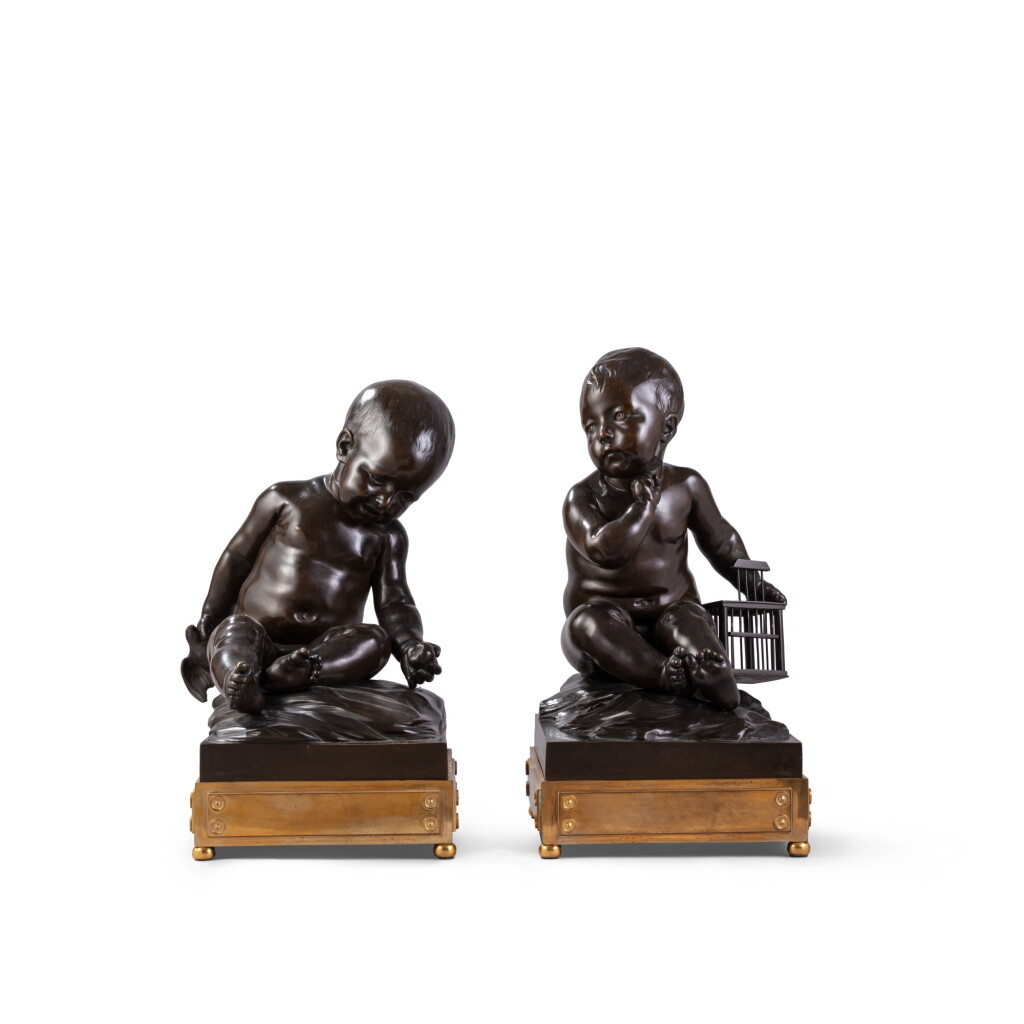
French, first quarter of the 19th century, after Jean-Baptiste Pigalle (1714-1785)
Enfant à la cage, Fillette à la pomme et à l'oiseau
Auction Closed
November 6, 06:14 PM GMT
Estimate
20,000 - 30,000 EUR
Lot Details
Description
French, first quarter of the 19th century
After Jean-Baptiste Pigalle (1714-1785)
Probably cast by Philippe Thomire (1741-1843)
Enfant à la cage (Child with a cage)
Fillette à la pomme et à l'oiseau (Girl with an apple and a bird)
bronze, brown-green patina; on gilt bronze bases
- Girl: bearing the signature and date: PIGALLE F. / 1784, and inscribed in black ink to the underside: BoR 32 (for Botschaft R Besitz)
45 by 28.5 by 34.5cm., 17¾ by 11¼ by 13⅝in.
53.5cm., 22½in. overall
- Boy: bearing the signature and date: PIGALLE F. / 1749, and inscribed in black ink to the underside: BoR 31 (for Botschaft R Besitz)
49 by 28.5 by 34.5cm., 19¼ by 11¼ by 13⅝in.
57 cm., 22½in. overall
(2)
Alphonse de Rothschild (1827–1905);
Baron Edouard de Rothschild (1868–1949), Château de Ferrières;
Seized by the Nazis in October 1940, transferred to the Jeu de Paume and subsequently sent to Germany (Munich);
Repatriated to France in July 1946;
Transferred to the Louvre Museum in 1972, in. nos. RFR 63 and RFR 64;
On deposit with the Mobilier National for the Hôtel Matignon from 1984 to 1997;
Restituted to Guy de Rothschild (1909–2007) on 11 May 2000;
With Didier Aaron & Cie., Paris, 2010.
Paris, Musée du Louvre, Présentation des œuvres récupérées après la Seconde Guerre mondiale et confiées à la garde des musées nationaux, 9 April - 5 May 1997.
J.-R. Gaborit, Jean-Baptiste Pigalle 1714-1785, Sculptures du musée du Louvre, Paris, 1985, p. 89 (ill.);
Présentation des œuvres récupérées après la Seconde Guerre mondiale et confiées à la garde des musées nationaux, exh. cat. Louvre Museum, Paris, 9 April - 5 May 1997, p. 378.
When it was exhibited at the 1750 Salon, the marble of L’Enfant à la cage, a presumed portrait of Armand Joseph de Marmontel (1748–1781), Marquis de Brunoy and the only son of Madame de Pompadour’s godfather, Jean Pâris de Marmontel, met with considerable acclaim (Louvre Museum, inv. RF 654). In a letter to Grimm, Diderot wrote in 1776: “You know this child… It is, I swear, the finest thing he has ever made, and that has come from the chisel of our French sculptors.” (see J.-R. Gaborit, op. cit., p. 48). Evidently attached to his marble, Pigalle bought L’Enfant à la cage back at the sale of the Marquis de Brunoy on 2 December 1776 (lot 63); he would retain it until his death, as attested by the sculptor’s posthumous inventory. A biscuit version was produced by the Sèvres Manufactory, probably around 1770, thereby contributing to the dissemination of the model, as did numerous later marble copies made to meet the demand of collectors.
As a pendant to the aforementioned marble, Pigalle conceived the model of the Fillette à l’oiseau et à la pomme in 1784, of which several autograph versions are known, including one in the Musée du Louvre (inv. no. RF 1511). Thirty-five years separate L’Enfant à la cage, who mourns the loss of his bird, from the Fillette, who offers him an apple in exchange for the precious bird she firmly holds in her other hand. Beyond the suggestive symbolism associated with the apple and the lost bird, Pigalle instead offers a naturalistic and tender vision of early childhood.
In addition to the marble of the Enfant à la cage, which he bought back in 1776, Pigalle also owned a bronze example displayed in his salon (see op. cit., p. 48). Together with another bronze, which appeared in the posthumous sale of the architect Soufflot on 20 November 1780 (lot 122), these two examples, documented during the sculptor’s lifetime, attest to casts of the model made at this time. According to J.-R. Gaborit, Thomire cast these models as pairs around 1823, including the two present examples previously in the collection of Alphonse and Édouard de Rothschild, at the Château de Ferrières (op. cit., pp. 50 and 89). Looted by the Nazis in October 1940 and transferred from the Jeu de Paume to Munich, the two bronzes were repatriated to France at the end of the war and subsequently held by the Louvre Museum (inv. RFR 63 and RFR 64), before being placed on deposit at the Hôtel Matignon and ultimately restituted to Guy de Rothschild in 2000.
You May Also Like