French, Limoges, circa 1215-1235
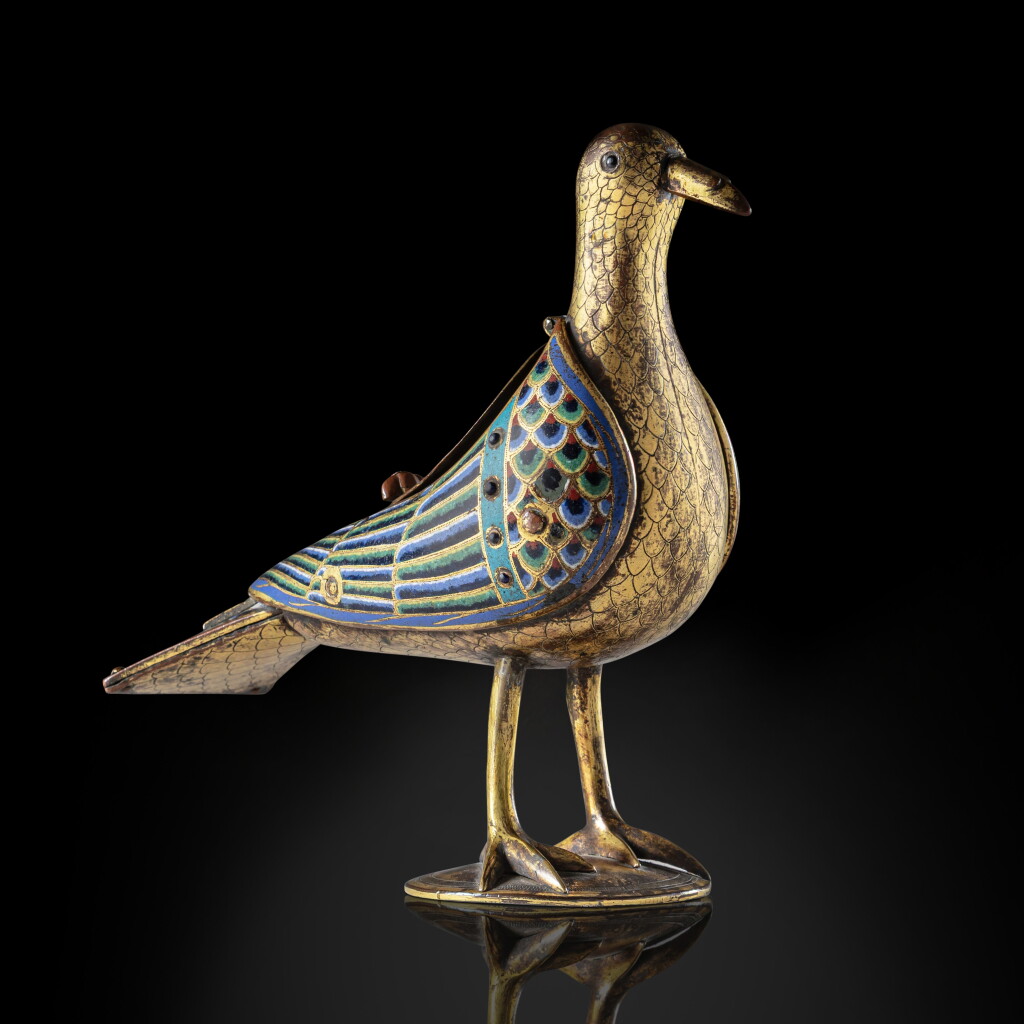
Eucharistic Dove
Estimate
200,000 - 300,000 EUR
Lot Details
Description
French, Limoges, circa 1215-1235
Eucharistic Dove
hammered, , engraved, chased, gilt and champlevéenamelled copper in dark blue, medium blue, turquoise, green, yellow, red and white, with midnight-blue glass beads; housed in an antique Japanese box and its inner box
a fragmentary label affixed to the box, bearing a handwritten inscription in kanji: « ペルシャ古代製 鍍金七宝鳩香炉 » (Antique Persian gilt cloisonné incense burner in the form of a dove)
21 by 20.5 by 8.5cm., 8¼ by 8⅛ by 3⅜in.
(the feet and circular base have been replaced; the beak may also be a replacement)
Collection of Robert Hoe III (1839–1909), New York;
His sale, Illustrated Catalogue de Luxe of the Very Valuable Art Property Collected by the Late Robert Hoe, American Art Association, New York, 15–28 February 1911, lot 2569;
Acquired in the above by Yamanaka & Co., New York;
Probably sold by the latter to a prominent Japanese family, described as a Persian gilt cloisonné-enamel incense burner;
Then by descent until recently, preserved in a kura (traditional Japanese storage), Japan.
The earliest references to bird-shaped pyxides of this kind, evoking the dove of the Holy Spirit, are found in the writings of Tertullian, dating from the early 3rd century (see B. Drake Boehm, introduction to Chapter III C, in Corpus des émaux méridionaux [CD-ROM]). Originally made of gold or silver, these objects have rarely survived the successive campaigns of precious-metal melting. Very few examples remain, such as those from Saint-Yrieix in Limousin and the Silos Treasure. According to early texts, the Abbey of Grandmont, renowned for its celebrated champlevé enamel antependium, dismantled and sold as national property in 1791, owned one of these early gold doves, stolen in 1183 by Henry the Young King, son of Henry II Plantagenet (ibid.).
At the beginning of the 13th century, Limousin workshops drew inspiration from the typology of these precious prototypes to develop a new generation of Eucharistic doves, made of gilt copper to imitate gold and embellished with shimmering enamels, whose techniques they had mastered to a high degree. These distinctive pyxides were among the movable furnishings of the liturgy. Suspended above the altar by small chains, they could be raised and lowered using a pulley. This ingenious system served to extend the metaphor of the Holy Spirit at Pentecost but also, more practically, to keep the consecrated Host out of reach of rodents. In their original arrangement, the doves were surmounted by a canopy fitted with a crown, of which a few rare examples have survived (see Musée de Cluny, inv. Cl. 14027).
The present dove is one of the few known examples in this corpus, which probably constitutes the most original - for its naturalism - and desirable group of Limoges enamels.
Anatomy of a Eucharistic Dove
The construction of the present example is entirely consistent with that of securely attributed examples in the corpus of 13th century Limousin champlevé enamels. The bird’s body consists of two embossed, engraved and gilt copper sheets, joined vertically and secured by soldering and rivets. A teardrop-shaped dorsal lid, hinged at one end, opens to reveal the compartment intended to hold the Host; it is secured when closed by a rivet with a domed head. Feathers are engraved across the dove’s body, becoming smaller around the beak and progressively larger towards the tail. A slight projection on the upper part of the beak indicates the cere, while the eyes are made of blue-black glass beads. The wings are applied and attached to the body by rivets. They lie flat against the body, with their tips crossing over the upper part of the tail. Their enamel decoration depicts down feathers towards the front, followed by flight feathers arranged in three bands. A simulated ornamental border, enamelled in turquoise and punctuated with blue-black glass beads, separates the two registers of the wings. The upper side of the tail is also enamelled, with a pattern of tail feathers, while the underside consists of an embossed gilt copper sheet engraved with the same feather motif as the rest of the body. The reserved areas surrounding the feathers on the wings and tail are embellished with a fine punched pattern.
On most known examples, as on the present dove, the legs and base—the most vulnerable components of the ensemble—are later replacements. They result from the repeated handling of these elaborately crafted pyxides during Eucharistic celebrations. However, a few examples have retained their original bases. Some take the form of a dish comparable to a gemellion (see Nationalmuseet, Copenhagen, inv. 443), while others are surrounded by crenellated walls with small towers (see Rijksmuseum, Amsterdam, inv. Bk 17205). Other bases, consisting of an enamelled disc with four projecting arms for suspension, appear in most cases to be later additions, probably dating from the late 19th century, as with the dove in the Metropolitan Museum of Art (inv. 17.190.344). This variant is found in particular among the Spitzer examples, suggesting that he may have been responsible for introducing it (see The Frances Lehman Art Center1, Vassar College, Poughkeepsie, inv. 2017.4; and the former David-Weill and Paul Salmon collections, whereabout unknown).
On some examples, the wings are also movable. Mounted on hinges, they can be spread as those of a living dove would be. With a few rare exceptions, such as the example in the Museum of Fine Arts, Boston (inv. 49.1075), this naturalistic variant is found chiefly among examples identified as late productions and thus appears to be an indication of modern manufacture, intended to meet the demand of collectors in the late 19th century.
Selected Comparisons
The construction and decoration of each of the approximately fifty known doves differ from one another. Some have a relatively slender silhouette, with a small head atop a long neck, while others are more compact, with a larger breast. Colour combinations also vary, as do the shapes of the beaks, eyes and legs, where the latter are original. The position of the wings is not governed by a strict convention either: on some examples, they rest on either side of the body without touching, while on others they cross just above or over the upper part of the tail.
Although the variations are virtually endless, certain similarities can be identified, allowing more coherent groups to be distinguished. The vertical arrangement of the down feathers on the wings of the present dove, for instance, sets it apart from most other examples. It is nevertheless found on the doves in Santa Maria e San Claudio, Frassinoro, in the Museum of Fine Arts, Boston (inv. no. 49.1075), and in the previously mentioned Frances Lehman Art Center and former David-Weill collection. Likewise, its slender silhouette can be compared with that of two doves previously sold in New York: one from the Ernst Boehlen collection (Sotheby’s New York, 7 February 2025, lot 606), and another now in the Wyvern collection (ibid., 8 February 2007, lot 418; see P. Williamson, pp. 140-141; inv. 0754). It also bears a resemblance to the aforementioned example from the former David-Weill collection.
With its more slender silhouette, slightly simplified decoration and particular proportions, the present dove appears to belong to the second generation of this peculiar type of pyxides, which also includes the examples in the Metropolitan Museum of Art (see above) and the Musée du Louvre (inv. OA 8104). Although the dating of the approximately fifty examples that make up this corpus of Limousin champlevé enamels has not been definitively established, the ornamental features of the earliest examples appear to be more elaborate. The dove in Amiens, generally regarded as the earliest, dating to around 1200 (Musée de Picardie, inv. MP 992-4-16), provides a case in point. Its wings feature two richly decorated ornamental bands, rather than the single band found here, embellished with cabochons: one separates the down feathers from the first row of flight feathers, while the other marks the boundary of the second row. The earliest examples also appear to have a more compact silhouette, as seen once again in the Amiens dove, as well as in those in Baltimore (Walters Art Museum, inv. 44.77) and in the former Robert von Hirsch collection (his sale, Sotheby’s London, 22 June 1978, lot 239), the latter originating from the collegiate church of Notre-Dame in Erfurt (Thuringia).
Apparently unrelated to any chronological pattern, the various examples also differ in the number of colours applied within each enamel cell. These variations nevertheless make it possible to identify those examples that demonstrate the highest level of technical mastery in enamelling. On the present dove, for instance, three colours alternate across the flight feathers, while as many as four are used on the slightly broader down feathers, placing it among the most technically sophisticated examples.
Based on our current knowledge, the present Dove was first documented in February 1911, when it appeared as lot 2569 in the landmark sale of the library and art collection of Robert Hoe III (1839–1909). An eminent American industrialist, bibliophile, and collector, Hoe headed R. Hoe & Co., one of the country’s leading printing-press manufacturers. A prominent philanthropist and influential figure in New York’s cultural life, he helped establish the Grolier Club in 1884, serving as its first president, and was among the founders of the Metropolitan Museum of Art. Following his death, his extensive collections were dispersed in auction sales held in 1911 and 1912. Works formerly in his possession are now held by major American institutions, including the Metropolitan Museum of Art, the Walters Art Museum, the Brooklyn Museum, and the Philadelphia Museum of Art.
At the 1911 sale, the Dove was acquired by Yamanaka & Co., the influential art-dealing firm founded by Yamanaka Sadajirō (1866–1936). Having opened his first New York gallery in 1894, Yamanaka went on to establish branches in Boston, London, Paris, Beijing, and Chicago. The firm played a pivotal role in introducing Japanese, Chinese, and Korean art to Western collectors and museums, handling an extensive range of works, from Buddhist sculptures and Chinese porcelains to lacquerware, bronzes, paintings, and screens. Its distinguished American clientele included Charles Lang Freer and members of the Rockefeller family. The firm’s fortunes declined during the Second World War, when the US government seized its American assets in 1942; the remaining stock was subsequently dispersed in a series of auction sales, notably in 1944.
Preserved for at least three generations within a prominent Japanese family, the present Dove was long misidentified as a Persian incense burner, despite its origins in the comparatively little-known tradition of medieval Western art. Yamanaka, who acquired several Japanese and Chinese bronzes at the Hoe sale, may have been responsible for this misattribution, which endured for more than a century. Its recent rediscovery thus represents a significant addition to the small corpus of Limoges champlevé enamels of this type, prized by collectors for both their rarity and their exceptional craftsmanship.
The results of the analysis of the copper alloy used for the dove’s body and of the enamel composition, conducted by portable X-ray fluorescence spectrometry (pXRF), are consistent with those obtained from other 12th and 13th century Limousin examples and reveal no markers of later production. An analytical report supplied by the CARAA laboratory, dated 7 October 2026, is available upon request.
RELATED LITERATURE
É. Antoine, D. Gaborit-Chopin (ed.), Corpus des émaux méridionaux, tome II, L’apogée de l’œuvre de Limoges, Émaux limousins, 1190-1215, Paris, 2011, (CD-ROM), III C, No. 1 to 18;
É. Bertrand, Émaux limousins du Moyen Âge, Brimo de Laroussilhe, Paris, 1995, p. 54, no. 82;
M. M. Gauthier, « Colombe limousine prise aux rêts d’un “antiquaire” bénédictin à Saint-Germain-des-Prés, vers 1726 », dans Intuition und Kunstwissenschaft: Festschrift für Hanns Swarzenski zum 70. Geburtstag, Berlin, 1973, p. 188, note 19;
E. Dabrowska et G. François, « La diffusion de l’Œuvre de Limoges à l’Est de l’Europe médiévale », dans Quaestiones Medii Aevi Novae, vol. 14, 2009, pp. 287-306, p. 296;
E. Rupin, L’œuvre de Limoges, Paris, 1890, pp. 223-234;
L .de Sanjosé Llongueras, El colom eucharístic : une obra singular del taller de Llemotges, Castelló de la Palana, 2011;
P. Williamson, The Wyvern collection. Medieval and Renaissance Enamels and Other Works of Art, London, 2021, pp. 140-141.
1 Acquired at Sotheby's New York, 26 January 2017, lot 138.
You May Also Like