Property from an Important Private Collection
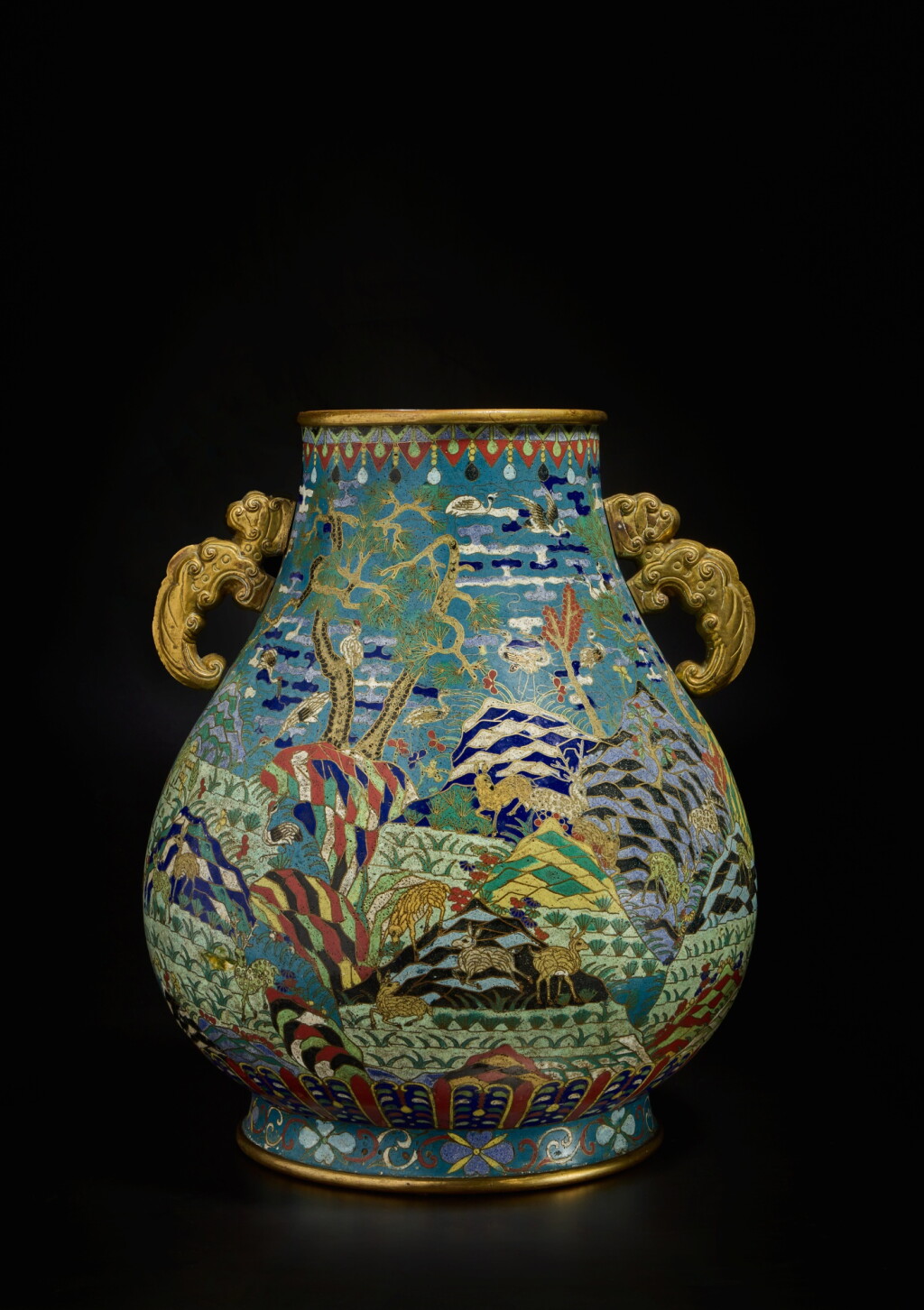
A large cloisonne enamel 'Hundred Deer' vase, Qing dynasty, Qianlong period
Auction Closed
September 17, 05:00 PM GMT
Estimate
60,000 - 100,000 USD
Lot Details
Description
Height 19¼ in., 49 cm
Christie's London, 12th July 2005, lot 175.
Ravenel, Hong Kong, 2nd June 2015, lot 8023.
Intricately rendered with vibrant enamels bringing the complex design to life, the present vase represents a rare cloisonné reinterpretation of an imperial favorite – the ‘Hundred Deer Vase’.
Vases of related designs, depicting a wild forest and mountain scene filled with stags and deer, were first produced for the imperial court during the Wanli period. Compare a jar preserved in the National Palace Museum, Taipei (accession no. gu ci 012030), illustrated in Illustrated Catalogue of Ming Dynasty Porcelain in the National Palace Museum, vol. 3, Tokyo, 1978, pl. 101. The surface filled with deer of every breed frolicking amidst pines, this design is imbued with auspicious symbolism. Homophonous with the characters for good fortune and salary (lu), deer (lu) are considered semi-mythical and, portrayed beside ever-green pines, further symbolise longevity.
However, while the ‘Hundred Deer’ motif may have earlier imperial origins, it is during the Qianlong era (1735-1795) that the present design was truly born. At once the emperors of China and leaders of the Manchu people, the emperors of the early Qing dynasty sought ways to reconcile their two identities, strengthen their legitimacy and celebrate their heritage. Based on the nomadic practices of Manchuria but ossified in official calendars, imperial hunts became a crucial part of this reconciliation. Reinstituting the regular training hunts first introduced by his grandfather, the Kangxi Emperor (r. 1662-1722), the Qianlong Emperor was an avid hunter himself and spent the summer months reconnecting with his roots in the imperial hunting preserve at Mulan near Chengde in Rehe (Jehol), northeast of Beijing, whose wooded hills were renowned for their abundance of deer.
Court painters were regularly ordered to Mulan to record these imperial hunts and it is precisely these scenes that seem to be depicted on ‘hundred deer’ vases like the present – composed much like a handscroll, unfurling as the vase rotates in one’s hands. Several paintings of this hunting genre are known, for example, attributed to the Italian Jesuit court painter Giuseppe Castiglione (Lang Shining, 1688-1766), such as Deer Hunting Patrol, The Qianlong Emperor Chasing Deer, and The Qianlong Emperor on a Hunting Trip and yet more to Ignatius Sichelbart (Ai Qimeng, 1708-1780), including A Hundred Reindeer, now preserved in the National Palace Museum, Taipei (accession no. gu hua 001735). Their intricately composed, lively depictions of animals in idealised landscapes clearly also influenced the court painters responsible for the decoration of the screen doors still preserved in the Qianlong Emperor’s private offices in the Yangxindian (‘Hall of Mental Cultivation’); see Li Shi, ‘On the Tieluo Painting of “Deers” in Yangxindian Hall of the Qianlong’s Period’, Palace Museum Journal, 2020, no. 10, pp 332–341. Visible every time the Emperor left the hall, these enormous compositions speak to the Emperor’s fondness for deer imagery, for hunting and for his expansive empire.
These hunts and vibrant handscrolls soon also inspired one of the most iconic porcelain designs in Chinese ceramic history. Skillfully rendered in a muted famille rose palette, these large ‘Hundred Deer’ vases of archaistic hu form with dragon handles were produced from very early in the Qianlong period and remain coveted among collectors for their exceptional enameling and pastoral auspicious design. Compare one such vase of Qianlong mark and period still preserved in the Palace Museum, Beijing, published in The Complete Collection of Treasures of the Palace Museum. Porcelains with Cloisonne Enamel Decoration and Famille Rose Decoration, Hong Kong, 1999, pl. 85; and another with handles covered in blue enamel, also in the Palace Museum, Beijing, illustrated in Kangxi, Yongzheng, Qianlong. Qing Porcelain from the Palace Museum Collection, Hong Kong, 1989, p. 338, pl. 19.
These extraordinary porcelain vases were undoubtedly in turn the direct inspiration for the present vase, which painstakingly recreates the ‘Hundred Deer’ motif in cloisonné enamel. Notably, while porcelain interpretations of this design seem to all follow the same general composition, cloisonné examples are attested featuring a wider range of related deer designs with some, including the present, also featuring flying cranes – another auspicious symbol representing immortality. This heterogeneity in design suggests that these vases may have been individually produced in small batches or perhaps even tailor-made in pairs to individual commissions for imperial gifts. Compare, for example, a Neiwufu (Imperial Palace Household Department) record from 1770 that lists the gifts of Liang Guo, Governor of Hubei, to the Qianlong court, including “a pair of enamel crane and deer vases”.
While porcelain examples of this type are themselves very rare, extant cloisonné interpretations are perhaps even more rarely attested. Compare a closely related pair of vases of this design without handles, sold at Christie’s Hong Kong, 27th May 2008, lot 1876; a handled example without cranes nor decorative bands to the neck and foot, reputedly taken from the Summer Palace and sold at Christie’s London, 6th November 2007, lot 97; and another example more closely modeled after the porcelain prototype, sold at Christie’s New York, 19th September 2006, lot 111.
Also compare a related group of ‘Hundred Deer’ vases rendered in painted enamels with bat-shaped handles, also generally attributed to the Qianlong period, including a yellow-ground example in the Palace Museum, Beijing, see Li Shi, op. cit., fig. 12; and another sold at Christie’s London, 14th May 2013, lot 150.
You May Also Like