PROPERTY FROM A FRENCH FAMILY COLLECTION
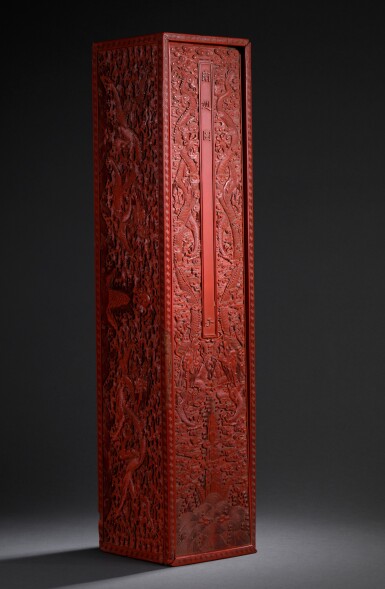
A monumental and important carved cinnabar lacquer 'Southern Inspection Tour' scroll box, Qing dynasty, Qianlong period, circa 1769
Auction Closed
June 11, 03:42 PM GMT
Estimate
100,000 - 200,000 EUR
Lot Details
Description
the cover carved with the characters nan xun tu (Southern Inspection Tour) and zi
Length 75.8 cm x 29⅞ in.
Collection of Madame C. (b. 1889), and thence by descent.
Intricately carved with majestic imperial dragons swirling amidst the clouds, the present box represents one of the most important examples of Qianlong imperial lacquerware to come to market in more than a decade. While the quality of its carved decoration, enormous size and imperial subject matter would rightly classify the present box as an imperial treasure, it is the former contents of the box that mark it as particularly noteworthy. Inscribed to the sliding lid in a finely bordered cartouche are the characters Nanxuntu zi — ‘Southern Inspection Tour Painting, no. 1.’
Setting out from Beijing in 1751 accompanied by the Empress Dowager Niohuru in her sixtieth year, the Qianlong Emperor (r. 1736–1795) began an extensive tour of his dominion known today simply as the ‘Southern Inspection Tour’ or Nanxun. Following a tradition first set by his grandfather, the Kangxi Emperor (r. 1662-1722), who made six tours across southern China over his sixty year reign, the Qianlong Emperor undertook the same grand journey to unite the nation, observe local customs, inspect official business and people’s wellbeing, review military and civil affairs, and offer sacrifices to mountains, rivers and historical figures along his path. Over the course of one hundred and twelve days, the Emperor and his retinue would pass the Huai River, the Yellow River, and the Yangzi; offer sacrifices at the Ming tombs of Xiaoling; follow the Grand Canal into the bustling capital of Suzhou and inspect the troops of Nanjing before heading north once more to the Imperial seat.
On his return, just as his grandfather had done in 1689, the Emperor turned to his court artists to immortalise the trip in a series of monumental paintings to be known as the Nanxuntu. With work beginning in earnest in 1764, this grand undertaking was spearheaded by court artist Xu Yang (fl. ca. 1750–1776) and was completed in time for the Emperor’s sixtieth birthday in 1770 when it was presented to the monarch. Divided into twelve scrolls, each roughly ten metres long, the project recorded the emperor’s journey in extraordinary detail with expensive pigments applied to the finest imperial silks.
As the archives of the imperial workshops record, the production of these monumental scrolls was accompanied by the similarly diligent production of twelve carved cinnabar lacquer boxes. As the records note:
On the 29th day of the 9th month of the 34th Qianlong year, the box workshop (Xiazuo) supervisors Side and Wude reported that the eunuch Hu Shijie had conveyed an imperial decree: the twelve handscrolls of the Southern Inspection Tour currently being mounted in the Ruyi Hall were to be fitted with twelve zitan wood boxes in the style previously used for the handscroll caskets of the Ode to Deer Hunting (Xiaolufu). Samples were first to be submitted for inspection. By imperial order.
On the 11th day of the 10th month, supervisors Side and Wude presented painted cloud-and-dragon designs for the Southern Inspection Tour handscroll boxes through the eunuch Hu Shijie. The emperor decreed: ‘Have labels written at the Maoqindian and dispatch them at once to Suzhou for the making of twelve red carved-lacquer boxes. The characters on the labels are to be executed in raised relief.’ By imperial order.
On the 13th day of the 10th month, supervisors Side and Wude reported that the eunuch Hu Shijie had delivered one sheet containing the text for Southern Inspection Tour and another sheet listing the Twelve Double-Hour designations. The imperial decree stated: ‘Send these to Suzhou. Carve the three characters “Nanxun Tu” on the labels of the twelve red carved-lacquer boxes, and below the labels carve the sequence of the Twelve Double-Hours in deeply raised relief.’ By imperial order.
In the 36th year, on the 19th day of the 4th month, supervisors including Side delivered the twelve red carved-lacquer handscroll boxes received from Suzhou to the eunuch Hu Shijie for presentation to the throne.”
As described in the palace records, the character zi accompanying the title slip – the first of the twelve Earthly Stems – marks the present box not only as a rare and important piece until now thought to have been lost to history but as the first in the entire sequence of the Nanxuntu, depicting the royal departure from Beijing.
Together with the seventh, eighth and eleventh scrolls of the Nanxuntu, the first scroll of the series, once housed in the present box, is now presumed lost. However, thanks to a duplicate paper copy of all twelve scrolls produced by Xu Yang in 1776, preserved in the National Museum of China, Beijing, we are still able to accurately presume the first scroll’s erstwhile contents: the Qianlong Emperor and Empress Dowager Niohuru depart from the Qianqing Gate in Beijing on the thirteenth day of the first lunar month; they pass through the Zhengyang Gate; turn right and travel west along Xiheyan Street; pass the Xuanwu Gate and exit Beijing through the Guangning Gate; they pass Gongji city in Wanping county; reach Lugou Bridge, then pass Changxindian and Tazhu, and proceed to the Huangxinzhuang Imperial Palace in Liangxiang county where the scroll ends. Accompanied by poetry from the leading calligraphers of the day and imperial seals, the scroll would have been a marvel of imperial workmanship; a testament to the Emperor and his journey south.
Aside from the aforementioned missing sections, the remaining eight scrolls of the Nanxuntu remain preserved across the world, occasionally in their original lacquer boxes. The second scroll, depicting Dezhou, is preserved in its box (marked chou, ‘no. 2’) in the Mactaggart Art Collection, University of Alberta, Edmonton (accession no. 2004.19.15), illustrated in John Vollmer and Jacqueline Simcox, Emblems of Empire. Selections from the Mactaggart Art Collection, Edmonton, 2009, pp 198-199; the third in the Musée des Beaux Arts Jules Chéret, Nice (accession no. N.Mba 2498) depicts the crossing the Yellow River; the fourth, in the Metropolitan Museum of Art, New York (accession no. 1984.16a–c), depicts the confluence of the Huai and Yellow Rivers and was included in Chou Ju-hsi and Claudia Brown, The Elegant Brush: Chinese Painting Under the Qianlong Emperor 1735-95, Phoenix Art Museum, Phoenix, 1985, cat. no. 9, its lacquer box illustrated in Wen C. Fong and James C. Y. Watt, ed., Possessing the Past: Treasures from the National Palace Museum, Taipei, New York, 1996, p. 533, fig. 177; the fifth scroll, depicting the crossing of the Yellow River, is preserved in the collection of Keitaro Tanaka, Tokyo; and the sixth, also in the Metropolitan Museum of Art, New York (accession no. 1988.350a–d) and depicting the entering of Suzhou along the Grand Canal, was included in Chumei Ho and Bennet Bronson, Splendors of China's Forbidden City: The Glorious Reign of Emperor Qianlong. London, 2004, cat. no. 110. The ninth scroll in the series is preserved in the Palace Museum, Beijing, depicting Shaoxing and the Temple of Yu, and was included in The Life of Emperor Qianlong, Macao Museum of Art, Macau, 2002, cat. no. 110; the tenth in the Musée Guimet, Paris (accession no. EO3577) depicts the journey to Nanjing and military inspections; and the twelfth and final scrolls, in the Palace Museum, Beijing, marks the return to Beijing, and was included in China - The Three Emperors 1662-1795, Royal Academy of Arts, London, 2005, cat. no. 14.
To date, only two other boxes from this series appear to have ever come to market, once containing the missing seventh and eighth scrolls, illustrated together in The Minor Arts of China III, Spink & Son, London, 1987, cat. no. 11, and sold at Christie’s Hong Kong, 30th May 2012, lot 4012 for more than ten million Hong Kong dollars.
Boxes of a closely related dragon and wave decoration are exceedingly rare, particularly at this scale. Compare a group of smaller scroll cases of similar subject matter with a slight variation in cover design, in which the top cover lifts from a cupped base, including an example inscribed with the title Mulan Tu sold at Christie’s Paris, 23rd September 2001, lot 133, thought to accompany the fourth painting in the Mulan series painted by Giuseppe Castiglione, now preserved alongside the painting in the Musée Guimet, Paris (accession no. MA6955); and another housing Zhang Tingyu’s Comment of Sanlao Wugeng in the Palace Museum Beijing, included in The Imperial Packing Art of the Qing Dynasty, Palace Museum, Beijing, 2000, cat. no. 44. Also compare the black lacquer box once containing the second scroll of Kangxi’s Southern Inspection Tour paintings, sold in our Hong Kong rooms, 9th October 2012, lot 3015.
You May Also Like