Property from a Distinguished Spanish Private Collection (lots 5, 7, 8, 11, 12, 13, 14, 17, 20, 122 and 129) | Provenant d'une prestigieuse collection particulière espagnole (lots 5, 7, 8, 11, 12, 13, 14, 17, 20, 122 et 129)
Sebastien Vrancx
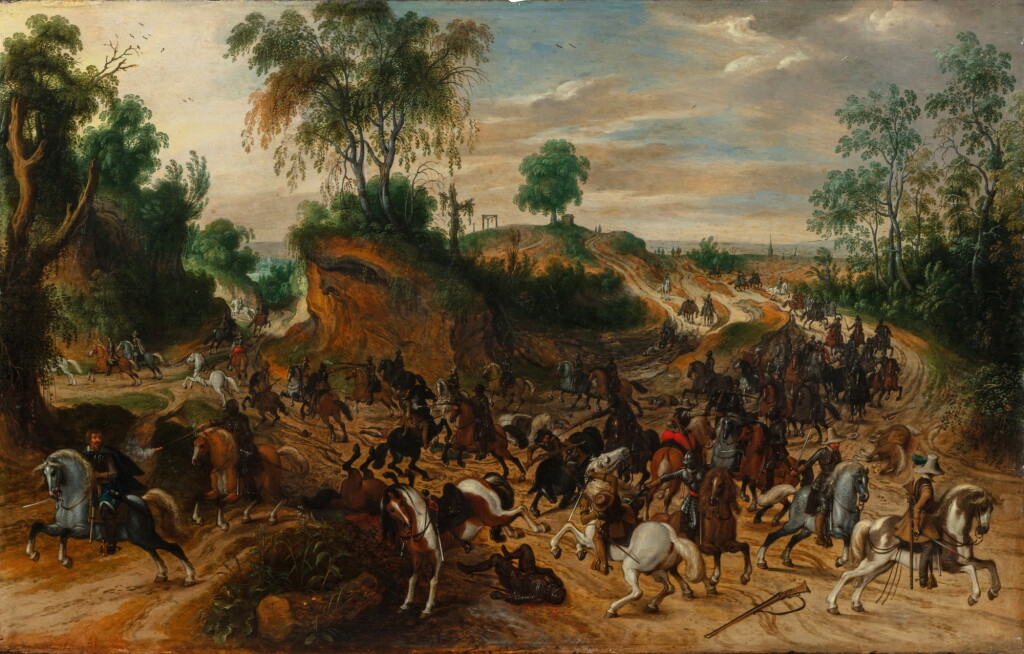
Cavalry scene | Scène de cavalerie
Auction Closed
June 19, 03:36 PM GMT
Estimate
40,000 - 60,000 EUR
Lot Details
Description
Property from a Distinguished Spanish Private Collection
Sebastian Vrancx
Antwerp 1573 - 1647
Cavalry scene
Oil on panel
Signed with monogram and dated on the tree trunk lower left SV / 1617
47,8 x 77,9 cm ; 18⅞ by 30⅝ in.
____________________________________________
Provenant d'une prestigieuse collection particulière espagnole
Sébastien Vrancx
Anvers 1573 - 1647
Scène de cavalerie
Huile sur panneau
Monogrammé et daté sur un tronc en bas à gauche SV / 1617
47,8 x 77,9 cm ; 18⅞ by 30⅝ in.
Anonymous sale, Tajan, Paris, 22 June 2006, lot 15.
____________________________________________
Vente anonyme, Tajan, Paris, 22 juin 2006, lot 15.
Sebastien Vrancx is one of the most important Netherlandish painters of battle scenes: he was among the first to move away from the monumental format of the previous century and produce paintings in an accessible size. In preference to heroic representations, Vrancx chose compositions that focussed on men’s actions and the reality of battlefields and war.
Born in 1573 in Antwerp, Vrancx had witnessed at a very young age the cruel scenes of pillage and fighting that took place from 1568 onwards during the Eighty Years’ War, when the Spanish monarchy fought against the united provinces. Probably marked by these terrible memories, he sought to render in his paintings the cruelty that he must have seen.
The present work, dated 1617, was made in the midst of a conflict which only ended almost thirty years later. It shows the chaos of two cavalries meeting head to head as the road bends around a hillock. The terrified horses are taking off in different directions, if they have not already been felled, while the soldiers, their armour shining, brandish swords and guns, toppling their adversaries. Above, a gallows is a reminder of the fate that awaits those captured. In the background, a church’s belltower stands out against the clouds, as in many of the artist’s works, especially The Battle of Nieuwpoort, now in the Museum of Fine Arts in Seville.
Typical elements of Vrancx’s art include the many variously coloured figures; the landscape’s brown and green tones; the dense, fluid brushstroke; and the dynamic arrangement of the composition. With an eye for detail, he outlines his figures with a thin black line, perfectly conveying their movement without upsetting the balance or legibility of the subject.
Vrancx here demonstrates the extent of his talent in a realistic scene of organized chaos that perfectly describes the horrors of war.
____________________________________________
Sébastien Vrancx figure parmi les peintres majeurs de batailles aux Pays Bas : il est en effet l’un des premiers à traiter ce sujet non plus dans un format monumental, comme c’était le cas au siècle précédent, mais dans des tableaux aux formats plus accessibles. A une représentation héroïque, Vrancx préfère une composition mettant en valeur l’action de l’homme, la réalité des champs de bataille et de la guerre.
Né en 1573 à Anvers, Vrancx a assisté dès son plus jeune âge aux cruelles scènes de pillage et de combats durant la Guerre de Quatre-Vingt Ans, opposant la monarchie espagnole aux provinces unies dès 1568. Probablement marqué par ces terribles souvenirs, il s’attache à rendre dans ses œuvres cette cruauté dont il a dû être le témoin.
Notre œuvre, datée de 1617, fut réalisée au cœur de son conflit qui ne prendra fin qu’une trentaine d’années plus tard. Elle représente le chaos d’un choc de cavaliers se rencontrant au détour d’une butte : les chevaux affolés se dirigent chacun dans des directions opposées, quand ils ne sont pas déjà couchés à terre ; les soldats, revêtus de brillantes armures, brandissent épées et fusils, renversant leurs adversaires. Au-dessus, une potence rappelle le sort réservé aux prisonniers qui seront capturés… En arrière-plan, un clocher d’église se dessine sur les nuages, comme dans beaucoup d’œuvres de l’artiste, et notamment dans La Bataille de Nieuport, aujourd’hui au Musée des Beaux-Arts de Séville.
La multitude de figures aux coloris variés, les tons bruns et verts du paysage, la touche épaisse et fluide, mais aussi la dynamique de la composition, sont caractéristiques de Vrancx. Avide de détails, il délimite ses figures d’un fin cerne noir, traduisant parfaitement leurs mouvements, sans toutefois troubler l’équilibre ni la lisibilité du sujet.
Vrancx déploie ici tout son talent, livrant une véritable scène de chaos organisé traduisant parfaitement les affres de la guerre.
You May Also Like