Studio of Jean-Marc Nattier
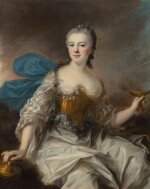
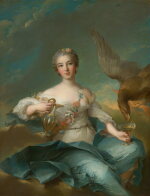
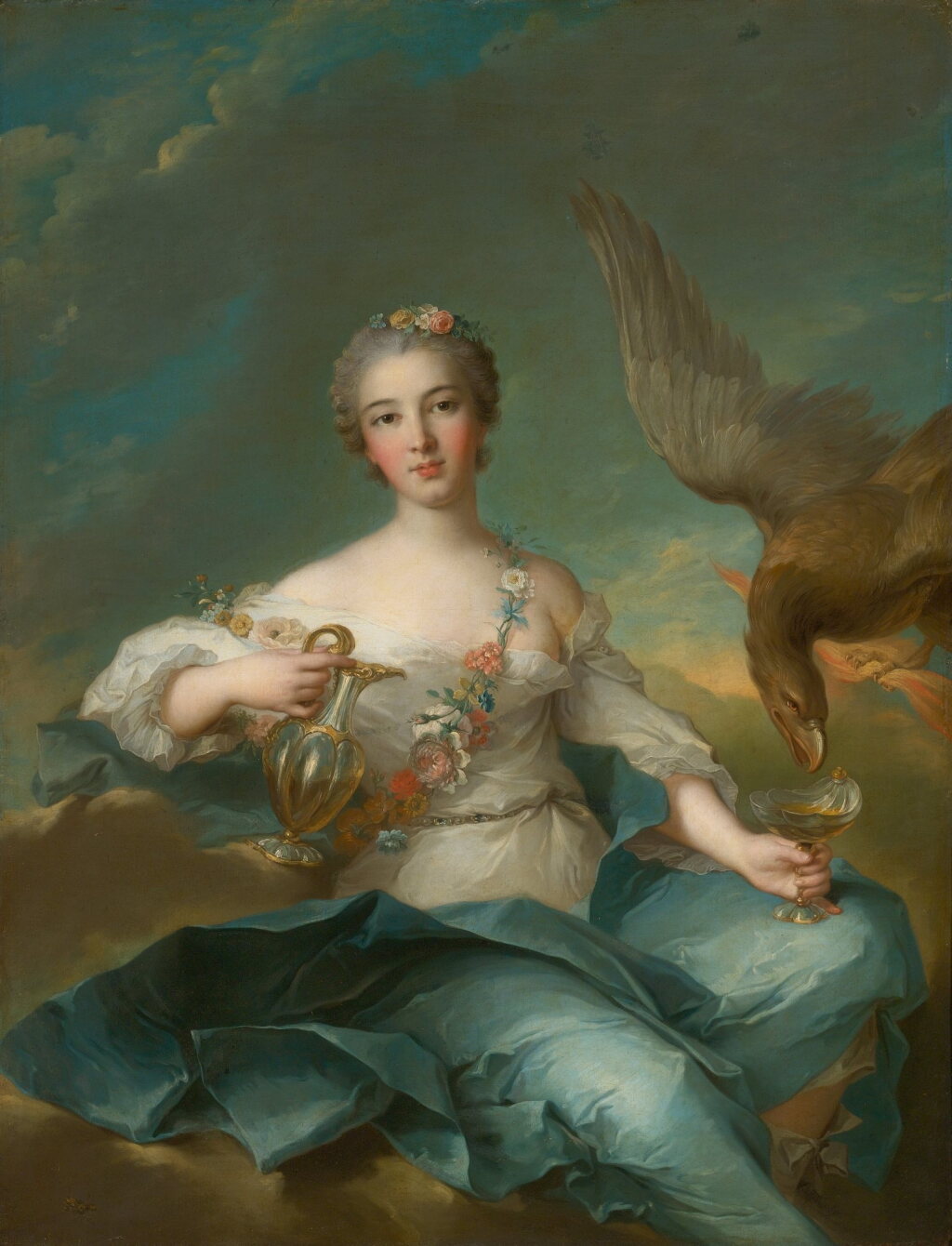
Portrait of Louise-Henriette de Bourbon-Conti, Duchesse de Chartres as Hébé
Estimate
60,000 - 80,000 EUR
Lot Details
Description
Studio of Jean-Marc Nattier
Paris 1685 - 1766
Portrait of Louise-Henriette de Bourbon-Conti, Duchesse de Chartres as Hébé
Oil on canvas
138 x 106,4 cm ; 54⅜ by 41⅞ in.
Earl Stendahl, Los Angeles, as of 1937;
Anonymous sale, Sotheby's, New York, 28 January 2010, lot 327 (with an erroneous provenance);
Where acquired.
Los Angeles, Art Association, Loan Exhibition of International Art, 15 October - 15 December 1937, no. 80, reproduced p. 18.
Possibly X. Salmon, Jean-Marc Nattier, cat. exh., Versailles, 1999-2000, p. 249.
Louise Henriette de Bourbon, née Mademoiselle de Conti, was the daughter of Louis Armand II de Bourbon, Prince of Conti (1695–1727), and Louise Élisabeth de Bourbon-Condé. She married her cousin Louis Philippe, Duke of Chartres (1725–1785), and the couple inherited the titles of Duke and Duchess of Orléans in 1752, following the death of his father.
The original composition by Nattier is dated 1744. Louise Henriette de Bourbon-Conti had married the Duke of Chartres the previous year and was then only eighteen years old. Celebrated by her contemporaries for her beauty, she is depicted by Nattier in the guise of Hebe, goddess of youth. The Duchess holds a crystal ewer in her right hand and, in the other, a cup from which Zeus, in the form of an eagle, drinks the divine nectar conferring immortality, served by the goddess on Mount Olympus.
Representations of young noblewomen in the guise of Hebe are numerous in Nattier’s oeuvre, and more generally throughout the eighteenth century (see, for example, the Portrait of a Woman as Hebe by Marie-Anne Loir, lot 35). This sometimes led to confusion over the identities of the various sitters, as is the case with the Portrait of Louise-Henriette de Bourbon-Conti, Duchess of Chartres as Hebe.
Thus, the portrait now in the Musée Condé in Chantilly (inv. 376) was long considered to be the original painting exhibited at the Salon of 1745. However, as early as 1905, Pierre de Nolhac drew attention to a probable confusion of identities, owing to the recurring nature of this iconography in the artist’s work. In light of recent research, the young woman depicted in the Chantilly painting, who bears little resemblance to the portrait of the Duchess of Chartres engraved in 1744 by Jean Patricot, may in fact be identified as the Duchess of Chaulnes, whose portrait as Hebe was also exhibited by Nattier at the same Salon of 1745.
It is therefore the painting now in the Nationalmuseum in Stockholm (inv. NM 1186), signed and dated 1744, that is today recognized as the original portrait of the Duchess of Chartres.
Although our version is considered an early copy, its fine quality suggests that the artist’s workshop may have been involved in its execution. Other replicas are known, of varying quality, some of which have belonged to prestigious collections, such as the version owned by Louis-Philippe in 1826, which remained in the family of the Duke of Vendôme until the 1930s.
You May Also Like