From the private collection of Philip & Sylvia Spertus
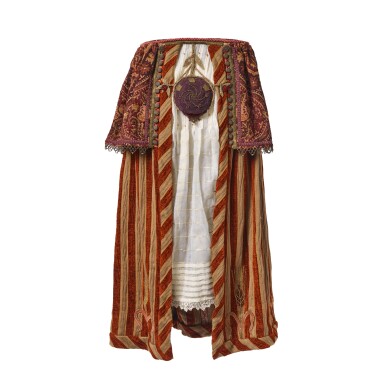
First Prize, 2000 Philip and Sylvia Spertus Judaica Prize. Torah Mantle, Temma Gentles and Dorothy Ross, Toronto, circa 2000.
Lot Closed
June 27, 02:45 PM GMT
Estimate
2,000 - 3,000 USD
Lot Details
Description
Variety of fabrics, trims, beads, and Mylar.
Height 39 1/2 in.
99.5 cm
Chicago, 2000: Judging the Book by its Cover: Torah Coverings. The Philip & Sylvia Spertus Judaica Prize Competition. Spertus Museum, no. 1.
Gomberg, Betsy, and Susan Schaalman Youdovin, eds. Judging the Book by its Cover: Torah Coverings. The Philip & Sylvia Spertus Judaica Prize Competition. Chicago: Spertus Museum, 2000, pp. 16-19.
Commentary from the 2000 catalogue:
This Torah mantle is reminiscent of the Baroque wedding finery of 17th century Italy. The sumptuous style connoted to us celebration and freedom of movement. The Torah is cloaked for modesty, yet a glimpse of the scroll is offered from behind the white dress.
We use the symbolism of an Italian ketubbah by placing seven barley stalks around the hem. These reference the spring harvest festival of Shavuot, as well as the seven weeks of the Omer, the time between Passover and the festival.
The double-layered beaded locket combined the priestly breastplate and an amulet like that frequently worn by brides for protection. The pomegranate shape suggests fertility as well as commitment to the 613 mitzvot, since it is said that a pomegranate contains 613 seeds. The three crowns are a traditional Torah covering motif. They refer to crowns of Torah, priesthood, and royalty, although it is said that the crown of a good name surpasses them all. Four ruby-colored seeds represent the matriarchs (Sarah, Rebecca, Rachel, and Leah), and refer to the passage in Proverbs 31 which compares a woman of valor to rubies. The 18 amber beads which encircle the locket ...symbolize life... Borrowing folk traditions, the crimson ribbons are meant to repel the evil eye and the leather applique to confuse jealous spirits.
You May Also Like