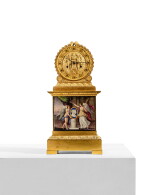
A Gilt-Bronze Mounted Chinese Porcelain Three-Piece Clock Garniture, Including a Clock and a Pair of Two-light Candelabra, Probably Viennese, Second Quarter 18th Century
Auction Closed
February 3, 09:38 PM GMT
Estimate
25,000 - 35,000 USD
Lot Details
Description
the gilt-bronze dial signed Prevost London, within a drum-shaped case, supported on the head of seated Buddha with glove puppets on a circular base , the whole mounted with white porcelain flowers, together with a pair of twin branch candelabra in the form of a seated Buddha on similarly cast base
(3)
height clock 9 1/2 in.
height candelabra 7 1/2 in.
24 cm.; 19 cm.
Nicolas Prevost, English, active circa 1710-1730
Alberto Bruni-Tedeschi Collection, Sotheby's London, 21 March 2007, lot 47
Elegance and Wonder: Masterpieces of European Art from the Jordan and Thomas A. Saunders III Collection, Virginia Museum of Fine Arts, Richmond, Virginia, May 2022-October 2023
Chinese and Japanese porcelain and earthenware figures were regularly exported to the West in the late 1600s and early 1700s and also copied by the newly founded European porcelain factories. Such figures, referred to as magots or pagodes, became extremely popular interior embellishments among fashionable collectors, so much so that in 1765 Diderot would write in the Encyclopédie that the era of Louis XV had become the ‘reign of the magots’ (Daniëlle Kisluk-Grosheide, 'The Reign of Magots and Pagods', Metropolitan Museum Journal, v. 37 (2002), p.184). The 18th-century Parisian marchand-mercier Lazare-Duvaux records the sale of many Magot figures usually decorated as a squat Chinese male figure in white porcelain, celadon, turquoise, or green and grey.
Three Chinese porcelain magots mounted as candelabra with gilt-bronze hats conceived in a similar vein are illustrated in Th. Lunsingh Scheurleer , Chinesisches und Japanisches Porzellan in Europaischen Fassungen, Braunschweig 1980, p. 361 plate 368.
You May Also Like