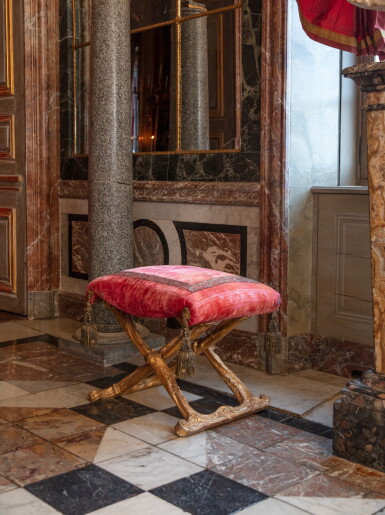
A giltwood stool, after a model by Marc Vibert or Michel Poncet, Italy, Parma, circa 1750, delivered to Madame Elisabeth, duchess of Parma for the Colorno Palace | Ployant en bois doré d’époque Louis XV, Italie, Parme d'après un modèle de Marc Vibert ou Michel Poncet, vers 1750, livré à Madame Elisabeth, duchesse de Parme au Palais de Colorno
Auction Closed
May 16, 02:17 PM GMT
Estimate
60,000 - 100,000 EUR
Lot Details
Description
A giltwood stool, after a model by Marc Vibert or Michel Poncet, Italy, Parma, circa 1750, delivered to Madame Elisabeth, duchess of Parma for the Colorno Palace
decorated with flowers, with red silk velvet decorated with a braid of silver and gold threads and metal thread trimmings (gold and silver) upholstery, iron marked with a crowned "ML" underneath one foot and ink mark "C1313" and "41078" under the seat, label "French and Co"
Height. 21⅝in, width. 27½in
---------------------------------------------------------------------------
Ployant en bois doré d’époque Louis XV, Italie, Parme d'après un modèle de Marc Vibert ou Michel Poncet, vers 1750, livré à Madame Elisabeth, duchesse de Parme au Palais de Colorno
décoré de fleurs, la garniture de velours de soie rouge ornée d’un galon de fils d’argent et or et de passementerie en fils métalliques (or et argent), marque au fer « ML » couronnée sous un pied et marque à l’encre « C1313 » sous l’assise, marque "41078", étiquette « French and Co »
Haut. 55 cm, larg. 70 cm
Delivered for the palace of Louise-Elisabeth of France (1727-1759), Duchess of Parma in Colorno; Marie-Louise of Austria (1791-1847), Empress of France, then Duchess of Parma from 1815 French&Co Gallery, New York
---------------------------------------------------------------------------
Livré pour le palais de Louise-Elisabeth de France (1727-1759), duchesse de Parme à Colorno; Marie-Louise d'Autriche (1791-1847), Impératrice de France, puis duchesse de Parme à partir de 1815 Galerie French&Co, New York
Le ployant est illustré dans A. Gonzalez-Palacios, Gli Arredi francesi, Milan, 1995, p.56, n°55.
Louise-Elisabeth of France (1727-1759) was the eldest daughter of Louis XV and his wife Queen Marie Leczinska. With her twin, Madame Henriette, she grew up in Versailles in the Princes' wing with her sister Adélaïde and the heir Louis. The only royal daughter to marry, she married in 1739 her distant cousin, the infant Philip of Spain, younger son of Philip V. Finding the Spanish royal etiquette even more difficult than that of Versailles and not being on very good terms with her mother-in-law Elisabeth Farnese, Louise-Elisabeth obtained for her husband the duchy of Parma, Piacenza and Guastella, following the war of duchies, where the couple settled in 1748. Daughter of France, she dreamed of greater territories and allied herself with the Empress Maria Theresa of Austria, who promised her the Netherlands in case of victory in the Seven Years War. But she soon lost her illusions and often returned to Versailles where she died in 1759.
The Palace of Colorno, a small Italian Versailles
When the ducal couple moved to Parma, they lived in the ducal palace, property of the Farnese family. The Marquis d'Argenson reported that the palace was empty, so Madame Elisabeth had thirty-four carts loaded with furniture brought in. Wishing to recreate the atmosphere of Versailles that she missed, she called upon the artists Boudard and Petitot to create the designs for her new furniture. Marc Vibert, Nicolas Yon, but also the upholsterers Petrus and Marnet are responsible for decorating the palace. She also ordered furniture from the greatest cabinetmakers such as Michel Cresson, Jean-Baptiste Tilliard and Nicolas-Quinibert Foliot. A sofa attributed to Foliot is kept in the Quirinal Palace in Rome (inv. 1662), an armchair also attributed to Foliot is kept in the Hermitage Museum in St Petersburg (CR.4864-2) and another in the Metropolitan Museum in New York (CR4865, inv.07.225.57).
To complete her furniture, the duchess did not hesitate to order from local carpenters furniture made after French models, a common practice at the time. Thus, our stool is described as a Parmesan copy in the work of the historian Alvar Gonzalez-Palacios (op.cit.p. 56).
Our stool does not bear the usual iron mark with the usual CR for the pieces inventoried around 1855 in the Ducal Palace, but it bears the inked number C.1313 and another inked number 41078, characteristic of this provenance. Moreover it is marked with the iron of the crowned ML, mark of the Empress Marie-Louise, second wife of the emperor Napoleon Ist, titled duchess of Parma in 1815. The stool was probably sold after the Italian reunification in 1868 and part of the furniture is now kept in the Quirinal Palace in Rome.
For a pair of chairs with this same iron mark, see sale Christie's Paris, April 18th, 2019, lot 121.
---------------------------------------------------------------------------
Louise-Elisabeth de France (1727-1759) est la fille ainée de Louis XV et de son épouse la reine Marie Leczinska. Avec sa jumelle Madame Henriette, elle grandit à Versailles dans l'aile des Princes avec sa soeur Adélaïde et l'héritier Louis. Seule fille royale à se marier, elle épouse en 1739 son cousin éloigné l'infant Philippe d'Espagne, fils cadet de Philippe V. Trouvant l'étiquette royale espagnole encore plus lourde que celle de Versailles et n'étant pas en très bons termes avec sa belle-mère Elisabeth Farnèse, Louise-Elisabeth obtient pour son époux le duché de Parme, de Plaisance et de Guastella, suite à la guerre de duchés, où le couple s'installe en 1748. Fille de France, elle rêve de plus grands territoires et s'allie avec l'impératrice Marie-Thérèse d'Autriche qui lui promet les Pays-Bas en cas de victoire pendant la guerre de Sept ans. Mais rapidement, elle perd ses illusions et retourne souvent à Versailles où elle meurt en 1759.
Le palais de Colorno, un petit Versailles italien
Lorsque le couple ducal s'installe à Parme, il réside dans le palais ducal, propriété des Farnèse. Le marquis d'Argenson relate que le palais étant vide, Madame Elisabeth fait rapporter trente-quatre chariots chargés de mobilier. Souhaitant recréer l'atmosphère de Versailles qui lui manque, elle fait appel aux artistes Boudard et Petitot pour réaliser les dessins de son nouvel ameublement. Marc Vibert, Nicolas Yon, mais aussi les tapissiers Petrus et Marnet sont chargés de décorer le palais. Elle commande également un mobilier auprès des plus grands ébénistes tels que Michel Cresson, Jean-Baptiste Tilliard et Nicolas-Quinibert Foliot. Un canapé attribué à Foliot est conservé au palais du Quirinal à Rome (inv. 1662), un fauteuil également attribué à Foliot est conservé au musée de l'Ermitage à St Petersbourg (CR.4864-2) et un autre au Metropolitan Museum de New York (CR4865, inv.07.225.57).
Pour compléter son mobilier, la duchesse n'hésite pas à commander aux menuisiers locaux des meubles réalisés d'après les modèles français, pratique courante à l'époque. Ainsi, notre ployant est décrit comme une copie parmesane dans l'ouvrage de l'historien Alvar Gonzalez-Palacios (op.cit.p. 56).
Notre ployant ne porte pas la marque au fer avec le CR habituel pour les pièces inventoriées vers 1855 au palais ducal mais il porte le numéro C.1313 à l'encre et une autre numéro à l'encre 41078, caractéristiques de cette provenance. De plus, il est marqué au fer du ML couronné, marque de l'impératrice Marie-Louise, seconde épouse de l'empereur Napoléon, titrée duchesse de Parme en 1815. Il est ensuite probablement vendu après la réunification italienne en 1868. Une partie du mobilier est maintenant conservée au palais du Quirinal à Rome.
Pour une paire de chaises avec cette même marque au fer, voir vente Christie's Paris, 18 avril 2019, lot 121.
You May Also Like