Antoine-Pierre Jacot
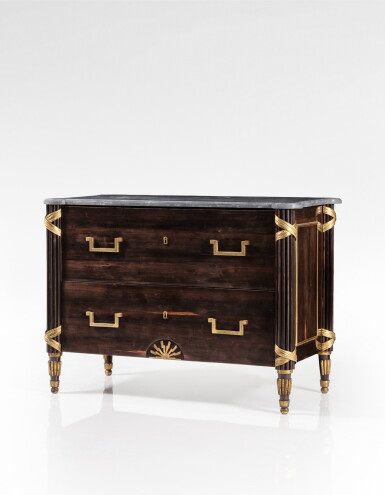
A Louis XVI gilt-bronze mounted ebony and ebony venereed commode, circa 1775-1785
Estimate
30,000 - 50,000 EUR
Lot Details
Description
Antoine-Pierre Jacot
A Louis XVI gilt-bronze mounted ebony and ebony venereed commode, circa 1775-1785
Opening with two drawers, the mounts adorned with fasces with gilt ribbons, with a later Turquin blue marble top, stamped A.P.JACOT
Haut. 84,5 cm, larg. 118,5, prof. 62 cm ; Height 33 ¼ in, 46 ½ in, depth 24
Hélène Rochas collection, Paris;
Thence by descent.
Antoine-Pierre Jacot, cabinetmaker, admitted as a master craftsman in 1766.
Our commode perfectly exemplifies the new, restrained, and masculine style that came into vogue in the 1760s, particularly through its use of lictors' fasces to decorate furniture. Originally, this decorative motif symbolized the power to coerce and punish. A characteristic image in Roman art, it was adopted by ornamental designers during the final years of Louis XV's reign. As early as 1762, for instance, the architect Claude-Nicolas Ledoux created a martial decorative scheme for the Café Militaire on Rue Saint-Honoré, featuring trophies of arms, shields, and lictors' fasces (now in the Musée Carnavalet, Paris; inv. BO121). Similarly, a few years later, the Comte d'Artois—brother of King Louis XVI and the future King Charles X—had his bedroom at the Pavillon de Bagatelle decorated in the style of a military tent, incorporating these same lictors' fasces (see C. Arnaud et al., La folie Artois, Paris, 1988, pp. 132–133).
Notable examples of furniture featuring this martial decor include a green-painted commode adorned with fasces, held at the Musée Carnavalet (inv. MB202), as well as a bureau plat by Joseph Stöckel, now at the National Assembly. The style achieved its ultimate expression in a magnificent commode crafted by Guillaume Benneman and Joseph Stöckel; delivered by the dealer Houré to Louis XVI for the Council Chamber at Compiègne, the piece is now housed at the Château de Fontainebleau (inv. F1049C). Finally, an ebony-veneered flat-top desk displays this same rigorous style, featuring ebony veneer and fluted elements. It was formerly in the collection of Charles de Beistegui and was sold during the Château de Groussay, Sotheby's Paris on 3 June , 1999, lot 791.
Our commode is remarkable for its modernity—a quality also seen in an ebony drop-front secretary featuring the same "fasces"motif. That piece, stamped by Bernard Molitor, was sold at Christie's on 7 November 2012, lot 293) ( sold for €103,000). The similarity in decoration suggests that both pieces originated from the same commission for a distinguished collector, likely orchestrated by a marchand-mercier who subcontracted the work to several cabinetmakers to ensure faster delivery of the complete suite of furniture.
You May Also Like