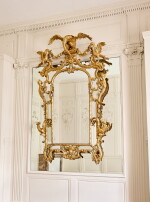
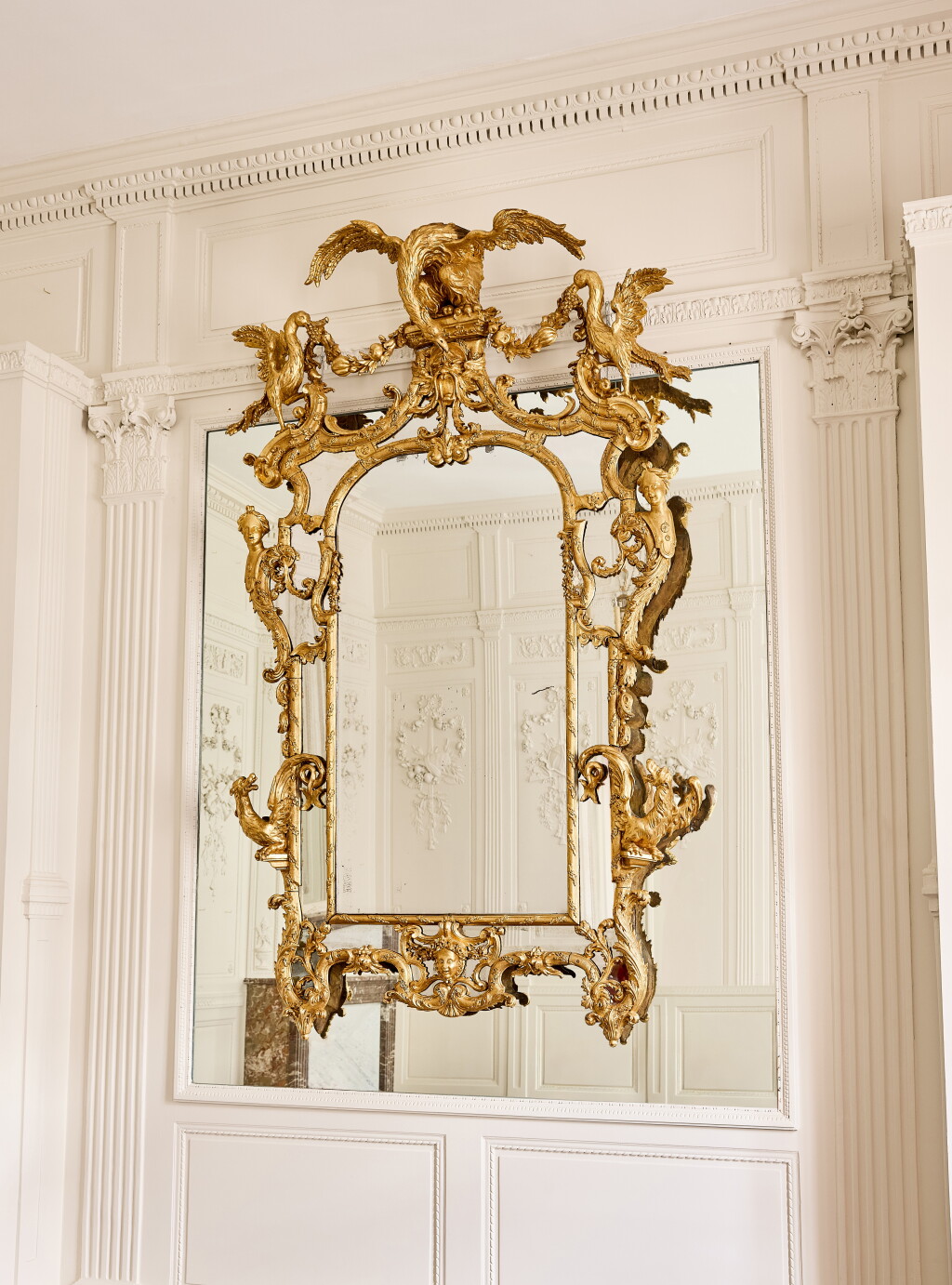
A North Italian giltwood mirror, circa 1720, after Jean-Bernard-Honoré Turreau
Lot Closed
September 17, 11:15 AM GMT
Estimate
22,000 - 32,000 EUR
We may charge or debit your saved payment method subject to the terms set out in our Conditions of Business for Buyers.
Read more.Lot Details
Description
the central plate surrounded by marginal places and enclosed by a carved frame incorporating dragons, espagnolettes and birds, the crest with a carved mask being pecked by an eagle, re-gilt
240cm high, 149cm wide; 94 ½ in., 58 ⅝ in.
Grand Salon of the Palazzo Fani Pecci Blunt, Rome;
Sotheby's London, 27 September 2012, lot 246.
C. Vicenti and F. Benzi, Palaces of Rome, London, 1997, p.126.
This exceptional mirror teems with life, bringing a level of richness and fantasy to its carving that is seldom seen in Northern Italian mirrors of this type and scale.
The form of this mirror, using smaller marginal plates with their joins concealed by decorative carved borders, was characteristic of mirrors at this scale in the early to mid-eighteenth century, allowing a level of imposing grandeur at a time when single mirror plates could not be manufactured beyond a certain size. The interlocking borders presented a creative opportunity to incorporate fluid, foliate decoration into the mirror beyond the external frame, and so was well-suited to Régence and Rococo designers operating in a naturalistic, expressive mode. One well-known carver and designer in this mode is Bernard-Honoré Turreau (1672–1731), who was active in Provence and was also known under the Italianate form of his surname, 'Toro'. Turreau is of particular note with respect to the present mirror because his published book of designs includes an illustration for a crest that also shows an eagle above a mascaron face.1 The lively sense of narrative in the illustration, with the wincing mascaron face apparently being pecked by the proud eagle, can also be observed in the present mirror; both also have this central motif flanked by magnificent birds in rising attitude with elevated and addorsed wings.
Very few mirrors at this scale with ornament this rich are documented, with most of the comparable examples featuring more conventional decoration with fewer imaginative animals, espagnolettes and mascarons. More typical mirrors in this mode can be seen, for instance, in Roberto Antonetto's study of Piedmontese furniture2 or the catalogue of the major exhibition of Piedmontese baroque art organised by the City of Turin in 1963.3 Among the large-scale mirrors that do incorporate a diversity of figures and animals into their frames are two examples in Genoan palazzi, one by Mongiardino Filippo Maria in the Palazzo Spinola (GNPS 0287 02)4 and another Bartolomeo Steccone in the Galleria di Palazzo Rosso.5 On the market, comparable mirrors include four sold at Sotheby's in 1997, 1999, 2006 and 2009,6 as well as an example with Antonacci Efrati.
This mirror once adorned the walls of the main parlour the Palazzo Fani Pecci Blunt, where it was photographed in-situ by Roberto Schezen.7 This early-sixteenth-century Roman palace looks directly onto the colossal monument to Victor Emmanuel II from its western side, and directly faces the Piazza del Campidoglio designed by Michelangelo in the 1730s. It was first built for the Albertoni family, passing through various hands over the centuries including the noble Fani family, until it was purchased by the Pecci Blunt family in 1929. Its modest exterior conceals a lush historic interior with impressive vaulted ceilings and mannerist frescoes from the sixteenth century.
1 Desseins Arabesques à Plusieurs Usages Inventés par J.B. Toro, Paris, 1716, n.p.. Digitised by the Metropolitan Museum of Art, with the design in question as object number 38.69.3(24).
2 R. Antonetto, Il Mobile piemontese nel settecento, Turin, vol II, 2010, pp.183-187, figs.13-17.
3 V. Viale (ed.), Mostra del barocco piemontese, Turin, 1963, pl.255-258.
4 also illustrated in F. Simonetti (ed.), L'Eredità donata: Franco e Paolo Spinola e la Galleria Nazionale di Palazzo Spinola, 2009, Turin, p.108.
5 Alvar Gonzales-Palacios, Mobile in Liguria, Genoa, 1996, p.142, ill. pp.163-164, figs. 194-195.
6 3 December 1997, lot 91; 15 December 1999, lot 51; 6 December 2006, lot 55; 17 November 2009, lot 124. All Sotheby's London.
7 C. Vicenti and F. Benzi, Palaces of Rome, London, 1997, p.126.
You May Also Like