Francis Bacon
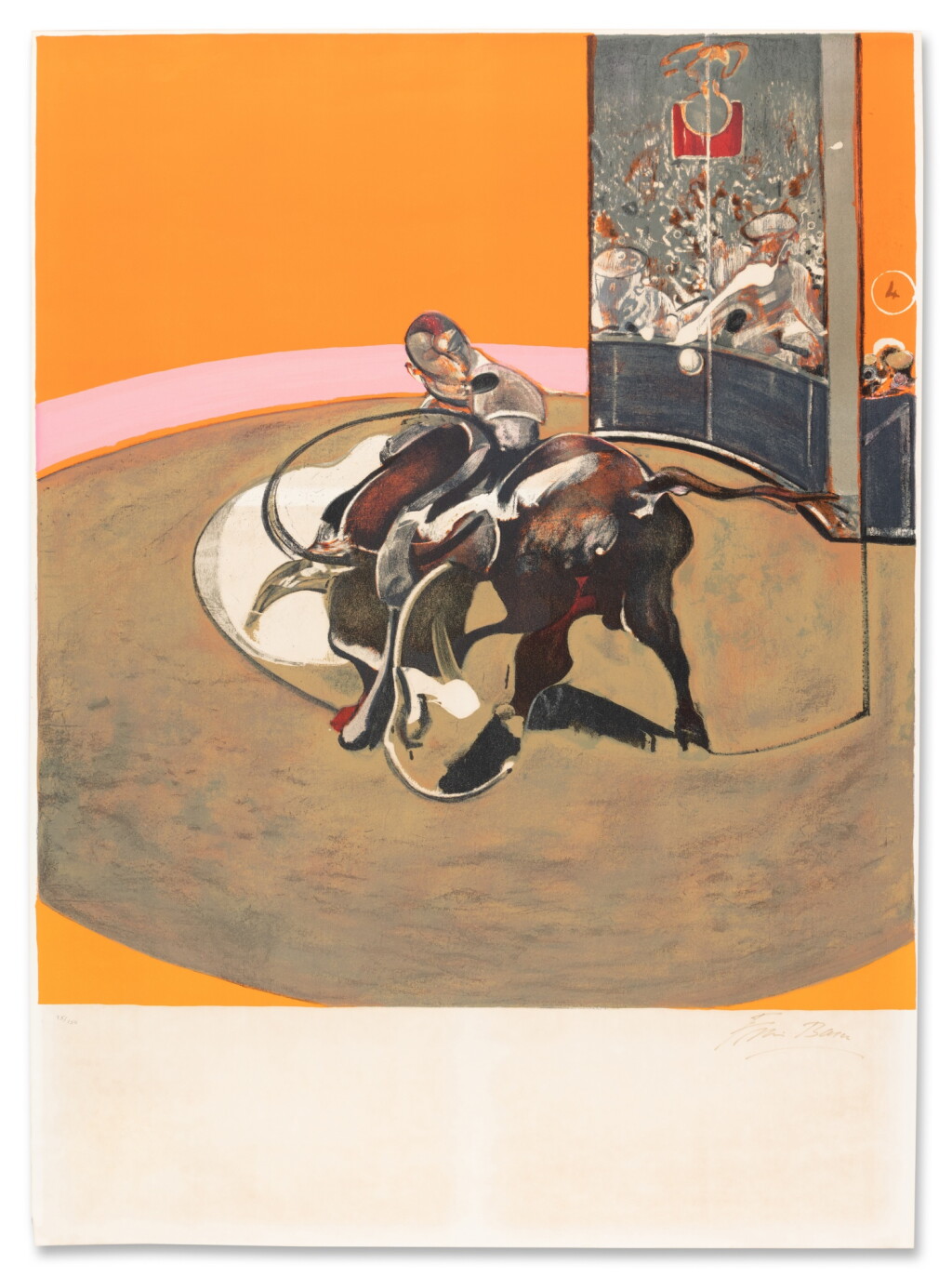
Etude pour une corrida (d'après Study for a bullfight no. 1)
Lot Closed
March 30, 11:23 AM GMT
Estimate
24,000 - 34,000 EUR
Lot Details
Description
Francis Bacon
1909-1992
Etude pour une corrida (d'après Study for a bullfight no. 1)
signed and numbered 95/150
lithograph in color
159 x 116,5 cm ; 62 5/8 x 45 7/8 in. (sheet)
133 x 115 ; 52 3/8 x 45 1/4 in. (image + signature)
Executed in 1971, this work is number 95 from an edition of 150.
_________________________________________________________
Francis Bacon
1909-1992
Etude pour une corrida (d'après Study for a bullfight no. 1)
signé et numéroté 95/150
lithographie en couleurs
159 x 116,5 cm ; 62 5/8 x 45 7/8 in. (feuille)
133 x 115 ; 52 3/8 x 45 1/4 in. (image + signature)
Exécutée en 1971, cette oeuvre est le numéro 95 d'une édition en 150 exemplaires.
Private Collection, France
Private Collection, France (acquired from the above)
Thence by descent to the present owner
__________________________________________________
Collection Particulière, France
Collection Particulière, France (acquis auprès du précédent)
Puis par descendance jusqu'au propriétaire actuel
Bruno Sabatier, Francis Bacon: The Graphic Work, Paris, 2012, no. 10
____________________________________________________________
Bruno Sabatier, Francis Bacon: The Graphic Work, Paris, 2012, no. 10
Born in 1909, Francis Bacon is an English artist known for his flayed and contorted figures that translate the suffering and harshness of human existence. Inspired by his personal experience, the painter also draws inspiration from the traumas that marked his time. Situated halfway between the sacred and the profane, Bacon's works emphasize certain aspects that are inherent to the human condition.
Study for a Bullfight is a signed lithograph that revolves around one of Bacon’s highly praised themes. Fascinated by the choreographed violence that characterizes this fight between man and bull, Bacon represents this spectacle in six of his works produced between 1967 and 1987. In this composition, the animal and human figures become one, highlighting the bestiality that characterizes both species. This scene conveys the ambivalence between wildness and rationality. This theme is further emphasized by the integration of elements referring to the horrors perpetuated during the Second World War. In the background, the artist represents a haunting crowd with a red sign that evokes the Nazi emblem. In this way, Bacon refers once again to the irrational and brutal behavior of man.
Moreover, the work created in the decade 1970 constitutes a high point in the artist's career. It brings together several elements that are typical of Bacon's pictorial language. Among them, is the orange background used by the artist in many of his compositions, such as Three Studies for Figures at the Base of a Crucifixion. The intensity of this color present in the background, emphasizes the violence of the represented scenes. Whether it is the subject matter, or the formal approach adopted by the artist, these elements attest to Bacon's tortured imagination.
________________________________________________________
Né en 1909, Francis Bacon est un artiste anglais réputé pour ses figures écorchées et contorsionnées qui traduisent la souffrance et la dureté de l’existence humaine. Tout en puisant dans son expérience personnelle, le peintre s’inspire également des traumatismes qui ont marqué son époque. Situées à mi-chemin entre le sacré et le profane, les œuvres de Bacon mettent en abyme certains aspects inhérents à la condition humaine.
Etude pour une corrida est une lithographie signée qui reprend l’un des sujets de prédilection de l’artiste. Fasciné par la violence chorégraphiée qui régit ce combat entre homme et taureau, Bacon se penche sur ce spectacle tauromachique dans six de ces œuvres réalisées entre 1967 et 1987. Au sein de cette composition, la figure animale et celle de l’homme ne font plus qu’un, mettant en exergue la bestialité qui caractérise ces deux espèces. Cette scène est vectrice de l’indéniable ambivalence entre le sauvage et le rationnel. Ce thème se concrétise par l’intégration d’éléments renvoyant aux horreurs perpétuées au cours de la seconde guerre mondiale. A l’arrière-plan l’artiste représente une foule inquiétante munie d’un panneau rouge évoquant l’emblème nazi. C’est ainsi que Bacon fait, une fois de plus référence au comportement irrationnel et brutal de l’homme.
De plus, l’œuvre réalisée dans la décennie 1970 constitue un point culminant dans la carrière de l’artiste. Cette dernière rassemble plusieurs éléments qui sont typiques du langage pictural de Bacon. Parmi ceux-ci, on retrouve le fond orange utilisé par l’artiste dans un grand nombre de ses compositions tel que Three Studies for Figures at the base of a Crucifixion. L’intensité de ce coloris qui surplombe l’arrière-plan traduit notamment la violence des scènes morbides que l’artiste à l’habitude de représenter. Qu’il s’agisse du sujet évoqué ou encore de l’approche formelle adoptée par l’artiste, ces éléments attestent parfaitement de l’imagination torturée de Bacon.
You May Also Like