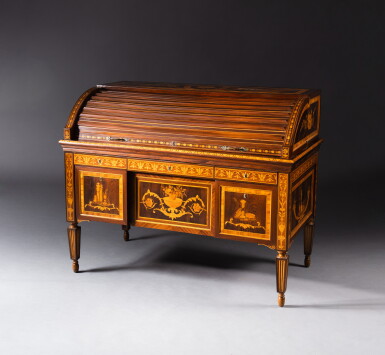
A rosewood, tulipwood, amaranth and mahogany marquetry sliding desk, Italy, by Giuseppe Maggiolini, circa 1804 | Bureau à cylindre en marqueterie de palissandre, acajou, amarante et bois de rose, par Giuseppe Maggiolini, vers 1804
Auction Closed
June 28, 03:24 PM GMT
Estimate
70,000 - 100,000 EUR
Lot Details
Description
A rosewood, tulipwood, amaranth and mahogany marquetry sliding desk, Italy, by Giuseppe Maggiolini, circa 1804
decorated with musical trophies, the cylinder opening with six drawers, the sides with hinges, the lower part with a gallery opening with three drawers, then two lower drawers and a central sliding panel
Height. 47 ½ in, length. 58 ¾ in, depth. 33 in
-------------------------------------------------------
Bureau à cylindre en marqueterie de palissandre, acajou, amarante et bois de rose, par Giuseppe Maggiolini, vers 1804
à décor de trophées musicaux, le cylindre ouvrant à six tiroirs, les côtés sur charnière, la partie inférieure avec galerie à trois tiroirs, en bas deux tiroirs et au centre un plateau coulissant
Haut. 121 cm, larg. 149 cm, prof. 84 cm
Giuseppe Beretti e Alvar González-Palacios, Giuseppe Maggiolini. Catalogo ragionato dei disegni, In limine, Milano 2014
Our desk can be compared with two drawings for Count Andreani's cylinder desk (B 256, B 257), kept at the Fondo dei disegni di bottega. However, the final version differs somewhat from the preparatory drawings. In fact, the latter show a piece of furniture with tulipwood frames and reserves decorated with walnut inlays, whereas our desk has a rich decoration inspired by drawings by Giuseppe Levati and Andrea Appiani made for Maggiolini and kept in the same collection as the previous drawings. The inlaid decorations are typical of Italian art in the second half of the 18th century. The drawers, for example, feature capricci marquetry depictions of ancient ruins, based on plates from the volume Le antichità di Ercolano Esposte (The Antiquities of Herculaneum Exposed). Giuseppe Levati used drawings he had made for a commission from Archduke Ferdinand of Habsburg-Lorraine (1754-1806) in the mid-1780s (B 122 bis and B 125), which Maggiolini reused in several of his works. There is another drawing related to our piece of furniture, a drawing of a column and an amphora (B 123), which can be found on the sides of the desk. Finally, on one side, there is a description of an altar decorated with an ax, an amphora, an eagle and a brazier, taken from a drawing by Andrea Appiani from the same collection (B 15). On the sides of the desk, Maggiolini added very elongated cornucopias to the marquetry decoration, emphasizing and renewing it. Drawing B 404 is the only one that has survived and was created specifically for this design. It depicts a shield with Medusa's head on one side. This desk is a work of rare ornamental richness, in which each decorative element has been designed, studied and reworked to fit perfectly into the overall composition.
The decoration stands out against a background of dark rosewood, characteristic of Maggiolini's work of the early 19th century, when he preferred more marked contrasts to marquetry in delicate tones, in keeping with the taste for Empire furniture.
Thanks to Giuseppe Beretti for his help and research on this desk.
---------------------------------------
Notre bureau est à rapprocher de deux dessins pour le bureau à cylindre du comte Andreani (B 256, B 257), conservés au Fondo dei disegni di bottega. Mais la réalisation finale diffère quelque peu des dessins préparatoires. En effet, ces derniers montrent un meuble avec des encadrements en bois de rose et des réserves ornées d'incrustations de noyer tandis que notre bureau présente un riche décor inspiré de dessins de Giuseppe Levati et Andrea Appiani réalisés pour Maggiolini et conservés dans le même fonds que les dessins précédents. Les décors marquetés sont caractéristiques de l'art italien de la deuxième moitié du XVIIIe siècle.
On observe, par exemple, sur les tiroirs, des représentations en marqueterie de capricci de ruines antiques, d'après des planches du volume Le antichità di Ercolano Esposte (Les antiquités d'Herculanum exposées). Giuseppe Levati se resservant ici de dessins réalisés pour une commande de l'archiduc Ferdinand de Habsbourg-Lorraine, (1754-1806), vers le milieu des années 1780 (B 122 bis et B 125) et que Maggiolini réutilisera pour plusieurs de ses réalisations. Un autre dessin est aussi à rapprocher de notre meuble, il s'agit d'un dessin d'une colonne et d'une amphore (B 123), que l'on retrouve sur les côtés du bureau. On retrouve enfin, sur un côté, la représentation d'un autel décoré d'une hache, d'une amphore, d'un aigle et d'un brasero, repris d'un dessin d'Andrea Appiani, issu de la même collection (B 15). Maggiolini, sur les côtés du bureau, ajoute à ce décor de marqueterie, des cornes d'abaondace très allongées qui permettent de souligner le décor tout en le renouvelant. Le dessin B 404 est, quant à lui, le seul conservé de nos jours et réalisé spécifiquement pour cette création. Il représente un bouclier avec la tête de Méduse que l'on retrouve sur un des côtés. ce bureau est une oeuvre d'une richesse ornementale rare où chaque élément de décor a été dessiné, étudié, retravaillé, pour s'insérer parfaitement dans cette composition d'ensemble.
Le décor se détache sur un fond de palissandre foncé , caractéristique de ses réalisations du début du XIXe siècle, lorsque Maggiolini préfère aux marqueteries de tons délicats, des contrastes plus marqués, en accord avec le goût pour les meubles Empire.
Merci à Monsieur Giuseppe Beretti pour son aide et ses recherches sur ce bureau.
You May Also Like