From the Library of Jay Michael Haft
Poe, Edgar Allan | The culmination of Poe's efforts
Lot Closed
December 9, 08:11 PM GMT
Estimate
8,000 - 12,000 USD
Lot Details
Description
From the Library of Jay Michael Haft
Poe, Edgar Allan
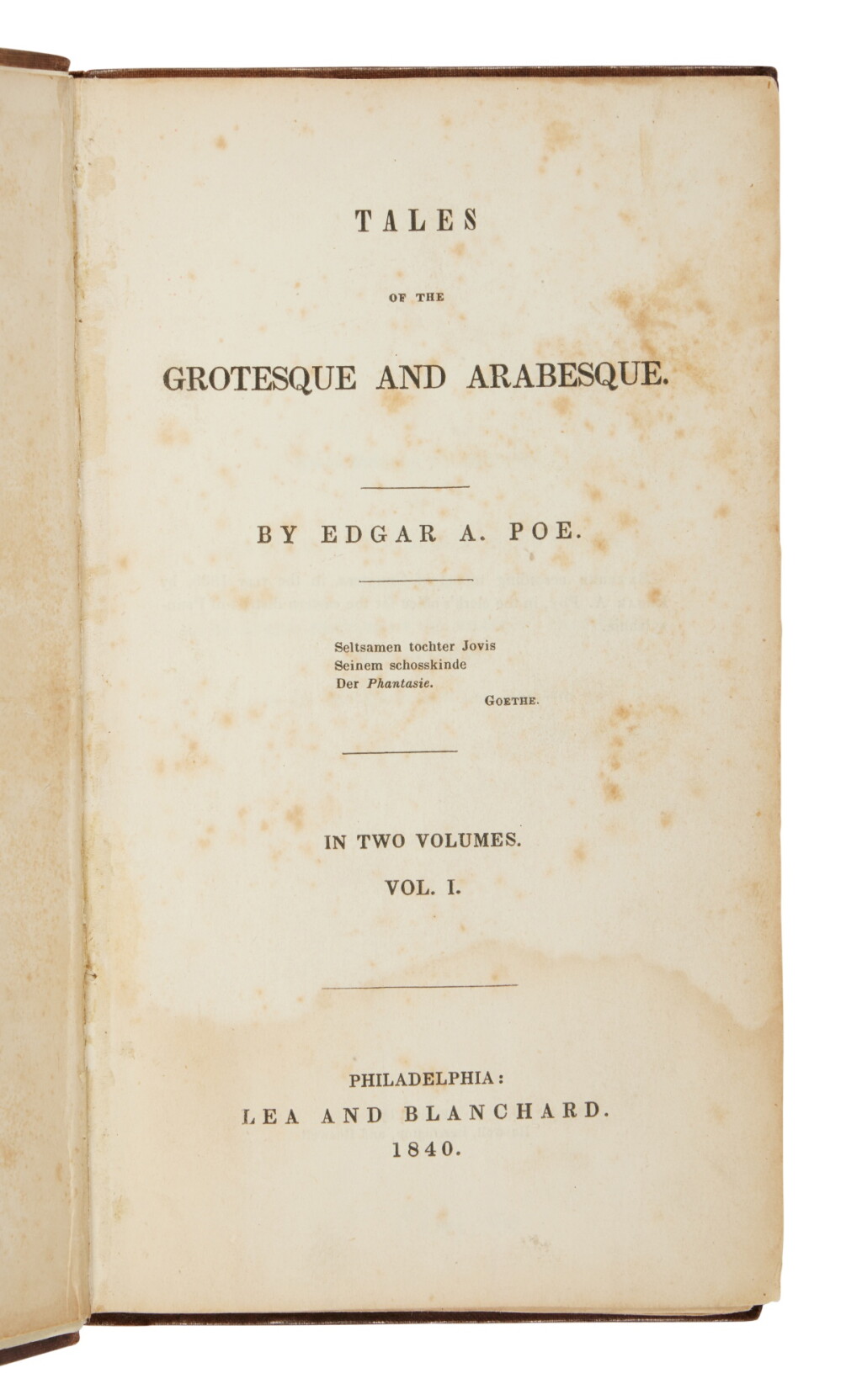
Tales of the Grotesque and Arabesque. Philadelphia: Lea and Blanchard 1840
2 volumes, 12mo (194 x 106 mm). 4pp. of publisher's notices to front of Vol. II, which has page 213 correctly numbered; light foxing, faint dampstain to bottom half of first and last pages in Vol. I, stain in gutter affecting first page of ads and last page of text in Vol. II, new endpapers, a few stray spots as usual. Publisher's purple muslin cloth, printed ruled paper labels on spines restored; one volume nicely rebacked using original cloth and with some slight restoration to spine ends.
First edition, from a printing of perhaps only 750 copies and containing two of Poe's most enduring stories: "Ms. Found in a Bottle" and "The Fall of the House of Usher."
"These volumes mark the culmination of Poe's effort, beginning as early as 1834 to get his prose tales into volume form. It is a milestone in his career as a prose writer, but was a failure commercially" (Heartman & Canny). Indeed, it seems that in the end Poe's only payment for the present work was a few gratis copies from the publisher to distribute among friends.
Poe is now regarded as one of the great masters of horror and detective fiction. His fascination with empirical science, however, is—in relative term—referenced very little. In reality, Poe was fascinated with empirical methods, and the mystery and wonder it gave rise to. In fact, he deemed the advanced in photography that he witnessed during his lifetime “most important, and perhaps the most extraordinary triumph of modern science.” For Poe, science and technology was a way of accessing what had previously been hidden, and casting a light on “truth itself in the supremeness of its perfection.”
As the merits of scientific advance were explored and debated across the United States in the early 19th century, Poe was admitted to West Point, functionally a scientific school, modeled on France's École Polytechnique. A training ground for future engineers, Poe was a promising student, raking 17th in math out of 87 cadets before dropping out. In 1839, Poe helped produce The Conchologist's First Book, which sold more copies during his life than any other title bearing his name. By 1840, while was working at a men’s magazine, Poe penned a regular column titled “A Chapter on Science and Art"—a sort of precursor to Popular Mechanics. While his interest in the field was keen, he also routinely published separate articles exposing pseudoscience and charlatans.
As movements were made to standardize and regulate scientific exploration and experimentation in the United States, Poe was largely supportive of these efforts. But, perhaps unsurprisingly, Poe also maintained an interest in the research happening at the margins, once claiming that phrenology had “assumed the majesty of a science; and, as a science, ranks among the most important.” As evidenced in several of his short stories, Poe was also persuaded by the theories of mesmerists (see lot 1003), believing this practice could help illuminate "relations between matter and spirit, observation and imagination” (Tresch). It would be a mistake to view Poe's interest in these long-disproven methods as some sort of split in his reasoning or approach. Rather, this willingness to remain open to the scientific methods happening on the fringes can be regarded as "Poe's endorsement of a synthesis of science and Romanticism, in which perfect, sublime laws of nature—and perfect, sublime laws of verse—are set in motion (in the manner of the divine watchmaker) by an all-supreme creative force" (Engber).
REFERENCE:
BAL 16133; Hartmann and Canny 49-54; NYPL/Gordan 479; Robertson 46-49; Yale/Gimbel 3; Engber, "Edgar Allan Poe’s Other Obsession," The Atlantic, 11 June 2021: https://www.theatlantic.com/magazine/archive/2021/07/john-tresch-edgar-allan-poe-science/619014/; Tresch, The Reason for the Darkness of the Night: Edgar Allan Poe and the Forging of American Science. New York: Farrar, Straus and Giroux, 2001


![Archimedes | De iis quae vehuntur in aqua libri duo, a Frederico Commandino... [Bound with:] Federico Commandino. Liber de centro gravitatis solidorvm, Bologna, 1565](https://sothebys-md.brightspotcdn.com/dims4/default/38d76db/2147483647/strip/true/crop/2000x2000+0+0/resize/150x150!/quality/90/?url=http%3A%2F%2Fsothebys-brightspot.s3.amazonaws.com%2Fmedia-desk%2Fwebnative%2Fimages%2Fe3%2Fa8%2Fdf66fdd24c5ebc499d2a9dc83cd4%2Fn12451-bkh3x-t2-01.jpg)

![Pliny, the Elder | Historia naturalis [Italian], Venice, 12 September 1489](https://sothebys-md.brightspotcdn.com/dims4/default/9db2168/2147483647/strip/true/crop/2000x2000+0+0/resize/150x150!/quality/90/?url=http%3A%2F%2Fsothebys-brightspot.s3.amazonaws.com%2Fmedia-desk%2Fwebnative%2Fimages%2F7e%2F0c%2Fa8f2c8eb4fe384efbf7f5fb1128c%2Fn12451-b8s5d-t2-02.jpg)