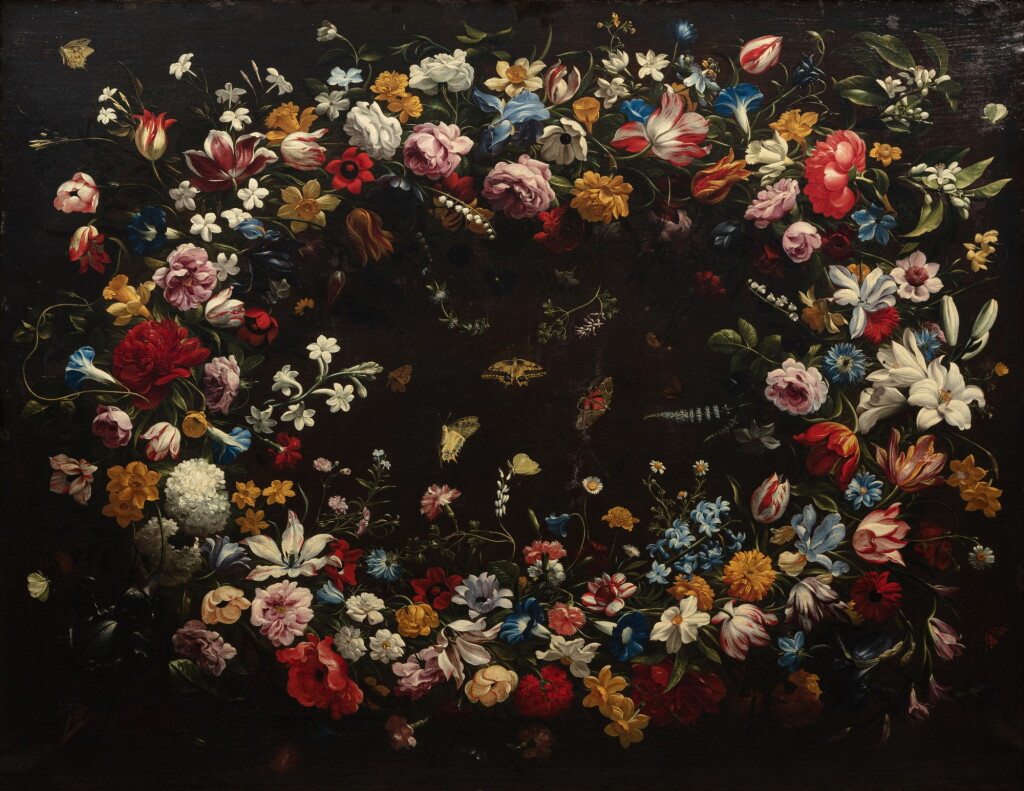
Giovanni Stanchi, Garland of flowers | Guirlande de fleurs
Lot Closed
November 10, 02:54 PM GMT
Estimate
20,000 - 30,000 EUR
Lot Details
Description
Giovanni Stanchi
Rome 1608 - 1675
Garland of flowers
Oil on canvas
106 x 137,5 cm ; 41¾ by 54⅛ in.
___________________________________________
Giovanni Stanchi
Rome 1608 - 1675
Guirlande de fleurs
Huile sur toile
106 x 137,5 cm ; 41¾ by 54⅛ in.
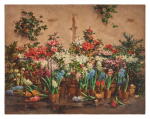
This garland of flowers bears the name Seghers on its frame, but although it is indeed comparable to the Flemish artist, it cannot be attributed to him. In the view of Ludovica Trezzani, this painting is actually closer to the work of Giovanni Stanchi, the oldest of three brothers, the others being Niccolo and Angelo.
It is usually difficult to distinguish between the work of these brothers, but the floral wreaths are more easily dated. Because of their more obvious Flemish influence, they can be assigned to the first half of the century and therefore attributed to Giovanni, as is the case for the Garland of Flowers and Butterflies in the Pinacoteca, Bologna (inv. 51, fig. 1), which has particular affinities with the present painting.
It seems undeniable that the artist of the present composition had seen in particular the Garlands of Flowers Surrounding a Medallion Depicting the Triumph of Love by Daniel Seghers and Domenico Zampieri. Now in the Musée du Louvre in Paris (inv. 797), this painting was produced between 1625 and 1627, while Seghers was working in Rome: it seems that the Stanchi brothers knew him.
The extremely delicate flowers in the present composition have been rendered in meticulous detail, so that every species can be identified: this obvious attention to naturalism is inherited from the Flemish manner, which had recently arrived in Rome. Lilies of the valley, blue irises and hyacinth can be spotted among the other flowers.
In the centre of the composition, the mythological or religious scenes of Roman works by Flemish artists have been replaced by butterflies. A religious symbolism persists, however: the chrysalis changing into an elegant flying insect must be interpreted as a metaphor for the resurrection of Christ and souls saved from evil.
___________________________________________
Portant sur son châssis la mention de Seghers, cette couronne de fleurs se rapproche en effet de l’artiste flamand sans toutefois pouvoir lui être attribuée. Selon Madame Ludovica Trezzani, notre tableau est en réalité à rapprocher de l’œuvre de Giovanni Stanchi, l’aîné de la fratrie comptant également Niccolo et Angelo.
S’il est habituellement difficile de différencier le travail de chacun des frères, les guirlandes florales sont quant à elles plus facilement datables. L’ascendance flamande, davantage présente, permet de les placer dans la première moitié du siècle et donc de les attribuer à Giovanni, à l’image de La Guirlande de fleurs et papillons conservée à la Pinacothèque de Bologne (inv. 51, fig. 1), se rapprochant tout particulièrement de notre tableau.
Il semble indéniable que l’auteur de la présente composition ait vu notamment les Guirlandes de fleurs entourant un médaillon représentant le triomphe de l'Amour de Daniel Seghers et Domenico Zampieri. Aujourd’hui conservé au Musée du Louvre à Paris (inv. 797), le tableau a été réalisé entre 1625 et 1627, années durant lesquelles Seghers travaille à Rome : les frères Stanchi en ont à l’évidence eu connaissance.
D’une finesse extrême, les fleurs représentées dans notre composition ont été détaillées avec soin, permettant d’en identifier toutes les espèces, dans un souci de naturalisme évident, hérité de la manière flamande récemment apportée à Rome. L’on reconnaît ainsi notamment des fleurs de muguet, de lys bleu ou encore de hyacinthe.
Au centre de la composition, les scènes mythologiques et religieuses visibles dans les œuvres romaines des peintres flamands, ont laissé place à des papillons. Ceux-ci perpétuent néanmoins la symbolique religieuse : la chrysalide se transformant en un élégant volatile est à lire comme une métaphore de la résurrection du Christ et des âmes sauvées du péché.
Fig. 1 Giovanni Stanchi, Guirlande de fleurs et papillons © Ministero della Cultura – Archivio Fotografico Direzione regionale Musei dell’Emilia-Romagna.
You May Also Like