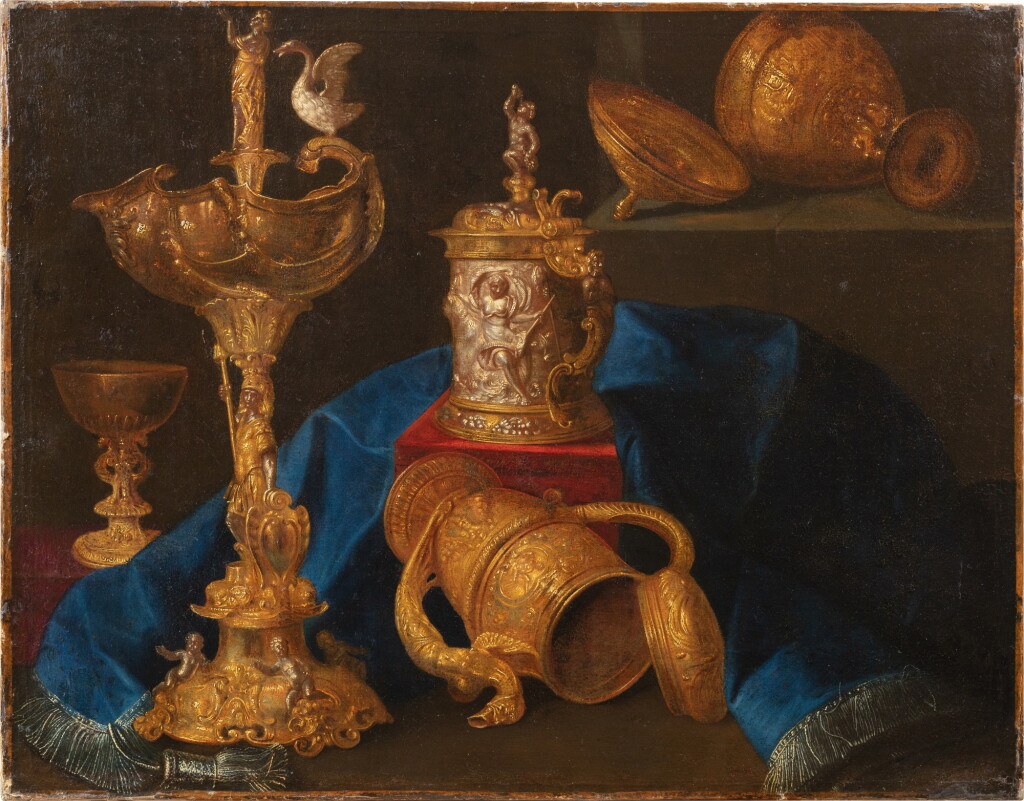
Attributed to Pieter Gerritsz. van Roestraten, Still life with silverware | Attribué à Pieter Gerritsz. van Roestraten, Nature morte aux éléments d'orfèvrerie
Lot Closed
November 10, 02:53 PM GMT
Estimate
6,000 - 10,000 EUR
Lot Details
Description
Attributed to Pieter Gerritsz. van Roestraten
Haarlem 1630 - 1700 London
Still life with silverware
Oil on canvas
80 x 102,5 cm ; 31½ by 40⅜ in
___________________________________________
Attribué à Pieter Gerritsz. van Roestraten
Haarlem 1630 - 1700 Londres
Nature morte aux éléments d'orfèvrerie
Huile sur toile
80 x 102,5 cm ; 31½ by 40⅜ in
Collection A.B. Olson, Stockholm (as per a label on the reverse).
___________________________________________
Collection A.B. Olson, Stockholm (selon une étiquette au dos).
Dutch still life painting reached its Golden Age in the wake of Willem Claesz. Heda (1594-1680) and Willem Kalf (1619-1693). Paintings featuring goldsmiths’ work were particularly popular: for artists, they were a way of demonstrating their refined technique, their mastery of perspective and their skill at depicting light and its reflections.
The present painting is a fine example: while the pieces of goldsmiths’ work display the refinement for which Dutch painters of the seventeenth century were renowned, the trimmings of the blue cloth and the ornamentation are instead conveyed with subtle impasto. The mise-en-scène of these objects, very tightly framed and arranged at different heights, gives this still life its lively quality.
The precision of the brushstroke is such that it is possible to identify the pieces illustrated. On the left there is an impressive silver gilt South German cup, probably from Nuremberg, from the years 1620-1630; on its right, a tankard covered in silver and silver gilt, dating to 1650-1660, stands on a small red pedestal; at the foot of the tankard, a ewer seems to have been knocked over; at the top right of the composition, another covered cup has fallen over; finally in the background there is an agate cup mounted in silver gilt.
On the basis of a comparison between the present painting and one by Meiffren Conte (1630-1705) in the Musée des Beaux-Arts in Valenciennes (inv. P.46.1.105), an attribution to Meiffren Conte (1630-1705) has also been suggested to us.
___________________________________________
Dans le sillage de Willem Claesz. Heda (1594-1680) ou de Willem Kalf (1619-1693), la peinture hollandaise atteint son Age d’Or. Celles incluant des éléments d’orfèvrerie connaissent alors un grand succès : elles sont, pour les peintres, un moyen de déployer la finesse de leur technique, leur maîtrise de la perspective, ainsi que leur habileté à représenter la lumière et à jouer avec ses reflets.
Le présent tableau en est un bel exemple : tandis que les pièces d’orfèvrerie sont traitées avec la finesse qui fait la renommée des peintres hollandais du XVIIe siècle, les passementeries du drap bleu et les ornements font au contraire l’objet de subtils empâtements. La mise en scène de ces objets, dans un cadrage très rapproché, et disposés à des hauteurs différentes permet de donner vie à cette nature morte.
La précision du pinceau est telle qu’elle nous permet d’identifier les pièces représentées : à gauche se dresse une impressionnante coupe d’Allemagne du sud, probablement de Nuremberg, en vermeil, des années 1620-1630 ; à sa droite, sur un petit piédestal rouge, se tient une chope couverte en argent et vermeil, datant de 1650-1660. Aux pieds de celle-ci, une aiguière semble avoir été renversée ; en haut à droite de la composition, une autre coupe couverte est tombée ; enfin, en arrière-plan à gauche de la composition se dresse une coupe en agate montée en vermeil.
Rapprochant notre œuvre de celle de Meiffren Conte (1630-1705) conservée au Musée des Beaux-Arts de Valenciennes (inv. P.46.1.105), une attribution à cet artiste nous a également été suggérée.
You May Also Like