The Property from an important Private European Collector | Provenant d'une importante collection particulière européenne
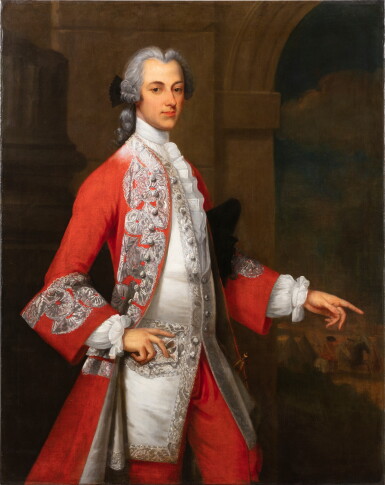
Attributed to William Aikman, Portrait of a gentleman, traditionally identified as Viscount Falkland | Attribué à William Aikman, Portrait d'un gentilhomme dit du Vicomte Falkland
Lot Closed
November 10, 03:40 PM GMT
Estimate
12,000 - 18,000 EUR
Lot Details
Description
Attributed to William Aikman
Cairnie 1682 - 1731 London
Portrait of a gentleman, traditionally identified as Viscount Falkland
Oil on canvas, unframed
127,3 x 101,6 cm ; 50⅛ by 40 in.
___________________________________________
Attribué à William Aikman
Cairnie 1682 - 1731 Londres
Portrait d'un gentilhomme dit du Vicomte Falkland
Huile sur toile, sans cadre
127,3 x 101,6 cm ; 50⅛ by 40 in.
Mount Congreve: The London Sale, London, Christie's, 23 May 2012, lot 3.
___________________________________________
Mount Congreve: The London Sale, Londres, Christie's, 23 mai 2012, lot 3.
Scottish by birth, William Aikman was at university when he met the painter Allan Ramsay (1713-1784), a painting by whom is also being offered in the current sale (lot 102). In 1707, Aikman left for Rome, to study the works of antiquity. In order to be able to devote himself to painting, he decided to sell the properties he had just inherited and travelled to Constantinople (now Istanbul). He returned to Edinburgh in 1712, where his portraits met with success. In 1723, John Campbell, Duke of Argyll and Greenwich (1680-1743) provided Aikman with the financial support that enabled him to settle in London with his family.
Here he met Sir Godfrey Kneller (1646-1723), with whose works his own are sometimes confused, and received commissions for portraits from London aristocrats. Members of the nobility who commissioned him included the Earl of Burlington, who asked him to paint a portrait of the royal family.
The present portrait, with its serene simplicity, is close to the works that made William Aikman’s name. The costume is rendered accurately, in simple colours and without superfluous effects. The base of ruined columns, on the left of the composition, as well as the rounded arch behind the figure, could be a memory of his time in Italy. In the background, cavalrymen in front of an encampment suggest that the subject had a military connection, although he cannot be precisely identified.
___________________________________________
D’origine écossaise, William Aikman rencontre à l’université le peintre Allan Ramsay (1713-1784), dont nous présentons également une toile dans cette vente (lot 102). Dès 1707 il part à Rome, pour y découvrir les œuvres de l’Antiquité. Pour pouvoir se consacrer à la peinture, Aikman choisit de vendre les propriétés dont il vient d’hériter, et se rend à Constantinople, l’actuelle Istanbul. Il rentre à Edinbourg en 1712, où il trouve le succès grâce à ses portraits. John Campbell, Duc d’Argyll et de Greenwich (1680-1743) fournit alors le soutien financier nécessaire à Aikman pour qu’il s’installe à Londres en 1723, avec sa famille.
Il y rencontre notamment Sir Godfrey Kneller (1646-1723), avec qui ses œuvres sont parfois confondues, et reçoit des commandes de portraits de la part de l’aristocratie londonienne. Parmi ses nobles commanditaires, le Comte de Burlington le sollicite pour exécuter un portrait de la famille royale.
Le présent portrait, de par sa simplicité et sa sérénité, se rapproche des œuvres de William Aikman qui firent sa renommée. Les costumes sont représentés avec justesse, dans des coloris simples et sans effets superflus. La base de colonnes en ruines, à gauche de la composition, ainsi que l’arche arrondie derrière le personnage pourraient être un souvenir de son séjour italien. Au fond, des cavaliers devant un campement désignent le portraituré comme un militaire, sans qu’il soit possible de préciser davantage son identité.
You May Also Like