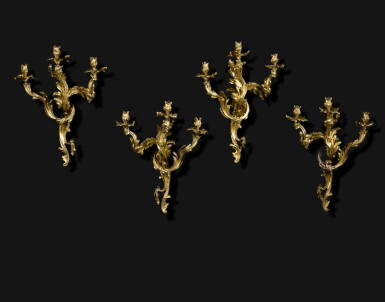
A Set of Four Louis XV Style Gilt Bronze Three-Branch Wall Lights After the Model by Jean-Claude Duplessis, Circa 1850
Auction Closed
September 14, 09:44 PM GMT
Estimate
20,000 - 30,000 USD
Lot Details
Description
A Set of Four Louis XV Style Gilt Bronze Three-Branch Wall Lights After the Model by Jean-Claude Duplessis, Circa 1850
with mercury gilding; pierced for electricity
height 31 1/2 in.; width 23 in.
80 cm; 58.4 cm
The original model for these wall lights dates to the mid-18th century, and a pair of identical design, bearing the crowned C tax mark used between 1745 and 1749, is in the Wrightsman Collection at the Metropolitan Museum of Art, New York (1971.206.30-31), displayed in the period room decorated with boiseries from the Hôtel de Varengeville, Paris.
Their impressive scale and irreproachable elegance have ensured the model's perennial popularity, such that even in 1804, when the Napoleonic court was assiduously refurnishing the former royal palaces in the most up-to-date Empire style, a set of four bras de lumière of this model, presumably drawn from the government's reserves of furniture confiscated during the Revolution, was sent to the apartments used by the Pope at Fontainebleau. They remained in the château for much of the 19th century and are now divided between the Louvre and Versailles (J.-P. Samoyault, Fontainebleau, Pendules et bronzes d'ameublement entrés sous le Premier Empire, Paris 1989, p.123, cat.88). By the second quarter of the 19th century new casts were already being taken after the original models and fire-gilded with mercury, following the same practices of the Ancien Régime and often executed in workshops run by direct descendants of the 18th century bronziers.
The design has been attributed to Jean-Claude Duplessis (1699-1774), who like his contemporary Juste-Aurèle Meissonnier was born in Turin and trained as a goldsmith before relocating to Paris to work as an sculptor and designer. He was artistic director of the Vincennes and later Sèvres porcelain factories from 1748, and in 1758 was appointed orfèvre du roi, a position he held until his death. The exuberant but controlled sinuosity of these wall lights' composition is typical of the forms he designed for production in ceramics and silver during the 1750s, which rank among the finest accomplishments of the high rococo style in the decorative arts.
You May Also Like