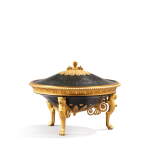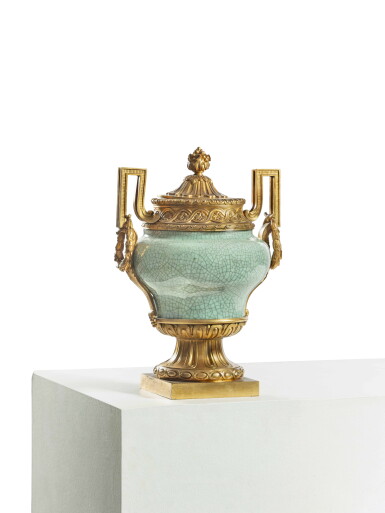
A Louis XV style gilt-bronze mounted celadon porcelain vase, the porcelain Qing dynasty, 19th century, the mount second half of the 19th century by Henri Picard
Estimate
5,000 - 8,000 EUR
We may charge or debit your saved payment method subject to the terms set out in our Conditions of Business for Buyers.
Read more.Lot Details
Description
on a square base, on a gadrooned and fluted foot, with angular handles decorated with laurel garlands, the cover with a fruit finial, signed under H. PICARD
Height 16 1/2 in. ; Haut. 42 cm
RELATED LITERATURE:
M.-F. Dupuy-Baylet, De Bronze et de Cristal, Dijon, 2020, p. 361
Henri Picard (fl. 1814-1864), gilder and bronzier, worked in Paris at rue Jarente from 1831 to 1839, then at rue de la Perle from 1840. He developed an important activity as a decorative and furniture bronzier, distinguishing himself through the production of candelabra, wall lights, fireplace garnitures and decorative objects. His work, remarkable for its finesse and quality, quickly set him apart and made him one of the most sought-after craftsmen of his day.
While Picard and his workshop worked for a prestigious bourgeois clientele, they also contributed to the furnishing of the imperial residences under the Second Empire. Picard received commissions in particular for Napoleon III's apartments at the Palais du Louvre, the Tuileries, and the Élysée Palace, for which gilt-bronze elements were executed. This is attested by a pair of bronze and griotte marble candelabra, made for the study of the Prince Imperial at the Élysée (inv. GML 6571 and GML 6571/002), today preserved at the Mobilier national.
Picard drew his inspiration from the decorative repertoire of the 18th century, whose forms he reinterpreted with the historicist taste characteristic of the Second Empire. Our lot belongs to this approach, being derived from a celadon vase model dating from the second half of the 18th century, preserved at the Musée du Petit Palais (inv. ODUT1196).
You May Also Like