
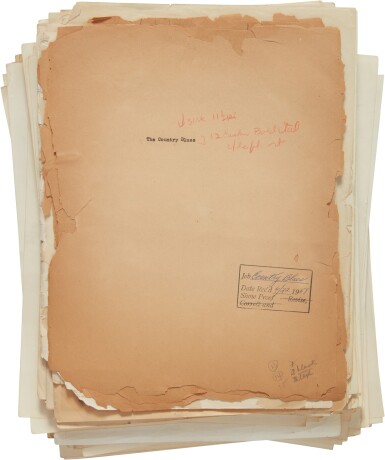
Charters, Samuel | Typescript printing proof for The Country Blues with manuscript annotations
Lot Closed
July 16, 08:10 PM GMT
Estimate
5,000 - 7,000 USD
Lot Details
Description
Charters, Samuel
Typescript printing proof for The Country Blues (New York: Rinehart & Company, 1959) with manuscript annotations
Approximately 320 pp. typescript (216 x 279 mm), with extensive handwritten edits in red and purple crayon, graphite, and blue ink, stamped and accomplished in pen: "Job: Country Blues | Date Rec'd 6/22 1959 | Show Proof | Print Dummy", frontmatter printed on fragile brown paper, also including printed proofs of frontmatter; general handling wear, extensive chipping to frontmatter, hole where previously joined along upper margin, thumbsoiling, light toning, occasional tape repairs, ink markings, a couple pages stapled together.
A typescript printing proof for Samuel Charters first book, The Country Blues, the first scholarly book-length treatment of American blues music
Along with fellow musicologists Alan Lomax and Harry Smith, Samuel Charters was one of the galvanizing forces behind the folk music revival of the 1950s and 1960s. Upon its publication The Country Blues was initially received by a small but influential and enthusiastic group that included college students and budding folk musicians like Bob Dylan. This work marked the formal beginning of academic blues scholarship, and Charters went on to publish numerous works in the subsequent years as the audience for blues expanded exponentially, including The Poetry of the Blues (1963), The Bluesmen (1967), Jazz New Orleans (1963), and, with Leonard Kunstadt, Jazz: A History of the New York Scene (1962).
The Country Blues was issued alongside an album on Folkways Records, which included recordings from Blind Lemon Jefferson, Blind Willie McTell, the Memphis Jug Band, Robert Johnson, and others. Blues records from the 1920s and 1930s were particularly hard to find, owing to limited production and distribution, and heavy wear from repeated play on low-quality machines with worn needles. Charters was part of a nascent generation of scholars who were fighting against a great impending cultural loss. Compilations put out by Folkways, like Country Blues, or the Anthology of American Folk Music, reintroduced the greater American public to one of the America's most authentic and enduring musical forms—the blues.