Property from the Jerrehian Family’s Personal Collection
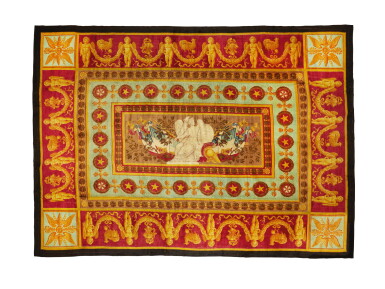
A Savonnerie-Style Moquette depicting a Personification of Victory, Possibly Tournai, Circa 1832-40
Lot Closed
April 19, 05:58 PM GMT
Estimate
5,000 - 7,000 USD
Lot Details
Description
Property from the Jerrehian Family’s Personal Collection
A Savonnerie-Style Moquette depicting a Personification of Victory, Possibly Tournai, Circa 1832-40
the classical female figure holding a shield inscribed ARMEE DU NORD 1832 and flanked by military trophies and French tricolour flags, within pale green and crimson borders decorated with Imperial symbols and the Gallic cockerel in gold; machine loomed strips, pieced together
approximately 197 ½ in. by 261 ½ in.
501.7 cm; 664.2 cm
The Armée du Nord was a division of the French Army first formed by the French Revolutionary government in 1792 to fight against the coalition of European powers opposed to the abolition of the French monarchy. It also played a prominent role during Napoleon's Hundred Days in 1815 when the deposed Empire attempted to return to power, culminating in the Battle of Waterloo. This fascinating carpet is replete with Imperial iconography and French national symbols like the Gallican cockerel and the tricolour flag, which came back into use when the Bourbon monarchy was overthrown in favour of the Duc d'Orléans Louis-Philippe in 1830. It may have been commissioned in connection with the Armée du Nord's activities in Belgium in 1831 and 1832 following the Belgian Revolution of 1830, in which the southern provinces of the Low Countries declared their independence from the Netherlands and created the modern Kingdom of Belgium.
In August 1831 King William I of the Netherlands ordered the invasion of Belgium in an attempt to regain control of the provinces, but was rebuffed by the intervention of the French Army of the North led by Maréchal Étienne Gérard in what was known as the '10 Days' Campaign'. The Dutch army withdrew from Belgium, only retaining the citadel of Antwerp, which they lost a year later when the French Army besieged and captured the city in November 1832.
In honour of the role played by the Armée du Nord in securing Belgian independence, King Louis-Philippe and his family undertook an official visit to Lille in January 1833, where he inspected the troops and was met by the new King of the Belgians Leopold I, who had married Louis-Philippe's daughter Princesse Louise the previous year. It is possible this carpet may have served to commemorate the event.