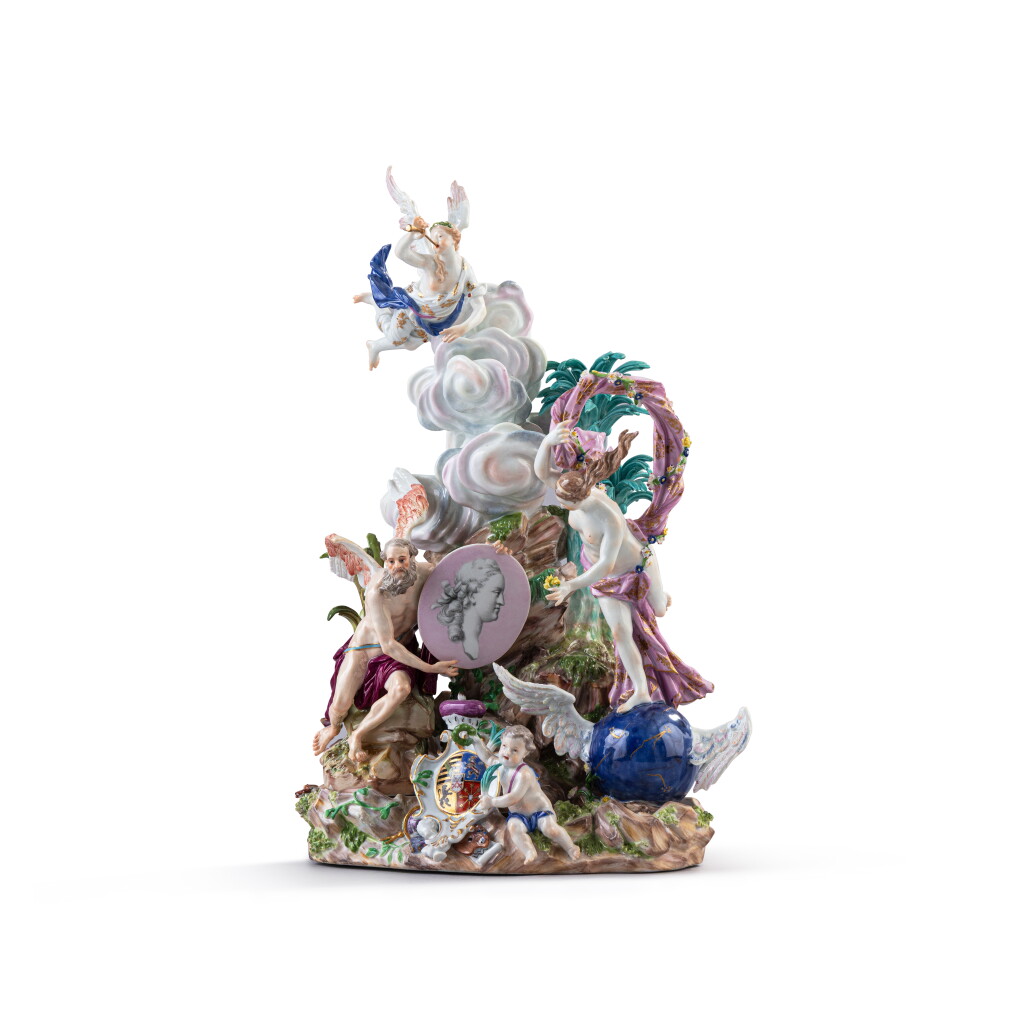
A Meissen porcelain large figural centerpiece group, 'The Glorification of The Electorate of Saxony', circa 1766
Lot Closed
September 17, 01:11 PM GMT
Estimate
4,000 - 6,000 EUR
We may charge or debit your saved payment method subject to the terms set out in our Conditions of Business for Buyers.
Read more.Lot Details
Description
formed of four sections, modelled by J.J. Kändler, with figural allegories of Time, Fortune and Fame, Chronos holding a pink-ground oval medallion painted en grisaille with a portrait, probably of Maria Antonia of Bavaria (1724-1780), Dowager Electress of Saxony, Fortune to one side, standing on a winged globe, holding a flower in her left hand, winged Fame above, blowing a trumpet and supported on a column of clouds, the centre of the rocky base applied with the crowned Electoral Saxon coat of arms with electoral cap, a putto to one side, and attributes of the fine arts and astronomy below, crossed swords and dot mark in underglaze-blue
Height 35.3 cm; 14 ⅞ in
Dorotheum, Vienna, 26 April 2018, lot 900;
Acquired at the above sale.
This complex figure group, known as the ‘Glorification of the Electorate of Saxony’, was modelled by Johann Joachim Kändler between December 1765 and February 1766. The principal female figure is thought to represent Maria Antonia of Bavaria (1724-1780), Dowager Electress of Saxony, who was then serving as co-regent of the Electorate alongside Prince Xavier of Saxony.
Franz Xavier of Saxony (1730-1806) was the second surviving son of Augustus III of Poland and Elector of Saxony and Maria Josepha of Austria. Following the death of his elder brother, Frederick Christian, Elector of Saxony, on 17 December 1763, after a reign of just seventy-four days, Franz Xavier assumed the regency of the Electorate alongside his sister-in-law, Maria Antonia of Bavaria, Dowager Electress of Saxony. Acting on behalf of Frederick Christian's minor son, the future Elector Frederick Augustus III, Franz Xavier and Maria Antonia jointly governed Saxony until the young elector attained his majority in 1768.
A further example of this model, painted with a male portrait facing dexter, likely representing Franz Xavier of Saxony, is illustrated in K. Berling, Festschrift zur 200 jährigen Jubelfeier der ältesten europäischen Porzellanmanufaktur Meissen, 1910, p. 67, fig. 134. Berling records that Prince Xavier, having expressed a desire to witness the modelling process firsthand, visited the Meissen manufactory accompanied by several members of the Saxon princely family. On that occasion Kändler demonstrated the initial stages of creating a porcelain model, an exercise that reportedly met with universal approval. The Dowager Electress subsequently ordered that an inscription be added to the tablet held by the allegorical figure of Time, commemorating the event: "daß am 3. Dezbr. 1765, Sr. Kögl. Hoheit des Herrn Administrators Höchsten Nahlmens Tag, Xaverius in Meissen auff der Porcellain Manufactur celebriret worden", [That on 3 December 1765, the most exalted name day of His Royal Highness the Administrator, Xavier, was celebrated at the Meissen Porcelain Manufactory].
A further example of this model with the medallion and armorial reserves simply painted with flowers, was sold at Sotheby's, London, 14 November 1995, lot 121.
The coat of arms displays a variation of the Electorate of Saxony's coat of arms as it was used from the early 17th century onwards. The coat of arms: Main shield, quartered: Field 1: Duchy of Saxony; divided nine times by black and gold, above a green bend sinister wreath. Field 2: Landgraviate of Thuringia; in blue, a lion rampant crowned and armed gold, divided seven times by silver and red. Field 3: Duchy of Jülich; in gold, a lion rampant black, armed silver. Field 4: Duchy of Cleves: in red, with a silver escutcheon, a gold wheel of glebe. Inescutcheon: in a field divided black and silver, two swords in saltire red, the electoral swords symbol of the office of Archmarshal (Archimareschallus), which was granted to the Elector of Saxony in 1356 by the Golden Bull. Above the shield, the electoral cap of the Holy Roman Empire.
You May Also Like