P
ierre Soulages, a leading figure of post‑war European abstraction, developed his signature outrenoir paintings by using dense black surfaces, scraped passages and thick impasto to explore primal, urgent states of human experience “beyond black.” Exhibited globally since the 1940s and celebrated with major honors including the Praemium Imperiale and the Legion d’Honneur, his works now reside in institutions such as MoMA, the Guggenheim, the Tate and the Art Institute of Chicago.
Pierre Soulages Biography
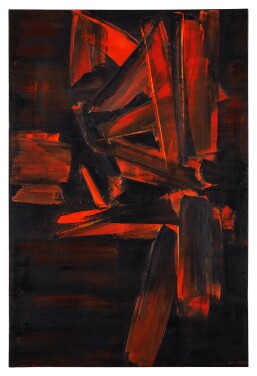
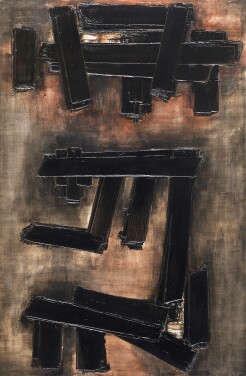
Nonagenarian Pierre Soulages is known for his outrenoir paintings, meaning “beyond black”, as much of his artistic practice has focused on deep black as color and anticolor. While his influences include prehistoric and Romanesque images, he has explained that he wishes to access layers of the human condition through color that is primal, urgent, and stripped of connotations. He is considered one of the leading figures of post-war European abstraction.
Born in 1919 in Aveyron, Soulages began his career after World War II. He turned to the automatism, thick impasto, and focus on artistic processes of the Abstract Expressionists, but developed his own unique style and approach to production. By relying on black as a conveyer of meaning through thick layers or scraped passages, Soulages evokes the birth of life out of darkness, the nature of the human soul, and the materiality of the physical paint on the canvas. He often hangs his works in the center of rooms or exhibition spaces, explaining that he prefers paintings as “walls rather than windows.” The textural quality of his paintings links him to the traditions of French Modern artists as well as the work of his contemporaries in Europe and the United States.
Soulages has exhibited since the 1940s, in solo shows, retrospectives, and major museum exhibitions around the world. He was the first contemporary artist to exhibit at the Hermitage Museum in Saint Petersburg in 2001. In 2014, former French president François Hollande referred to Soulages as the “world’s greatest living artist.” In 2015 he received the Legion d’Honneur, and in 1992 the Praemium Imperiale Prize for Painting from the Japan Art Association in Tokyo. His works consistently sell for record prices; Peinture, 14 Avril 1962 sold for $6.9 million, and Peinture, 21 Novembre 1959 sold for $6.7 million at Sotheby’s. His works are included in the Museum of Modern Art, the Guggenheim, the Phillips Collection, the Art Institute of Chicago, the Tate Gallery, and many other major international collections.