When Fine Art Meets Haute Horlogerie: The Legacy of Enamel Watches Across Three Generations

When Fine Art Meets Haute Horlogerie: The Legacy of Enamel Watches Across Three Generations

Three master enamellers, three iconic artists – explore how masterpieces by Vermeer, Renoir and Chagall are brought to life in miniature through one of horology’s most exacting crafts.

T he art of miniature enamel painting, rooted in ancient traditions yet refined in Europe during the Renaissance, is among the most exacting of decorative arts – where colour, light and permanence are fused through fire. Emerging from early techniques such as cloisonné and champlevé, the practice evolved in Limoges into a painterly discipline defined by microscopic brushwork and successive firings, allowing artists to achieve extraordinary tonal depth and detail. It is within this demanding and highly specialised tradition that a remarkable lineage of mastery in the exquisite art of enamelling in horology unfolds across three generations in Geneva each artist refining the language of fire, colour and patience, while ensuring the survival of the craft into the present day.

Below, we explore three extraordinary and unique miniature enamel watches offered in Important Watches (24 April) at Sotheby’s Hong Kong. Where fine art converges with haute horlogerie, each creation emerges as a singular masterpiece – uniting painterly virtuosity with mechanical precision – and resonating equally with the art connoisseur, who recognises its iconography, and the discerning watch collector, who values its rarity, craftsmanship and enduring beauty.

A Tale of Three Generations

At its foundation stands Charles (Carlo) Poluzzi (1899–1978), whose early 20th-century practice bridged tradition and modern horology. Born in Seveso, Italy, and trained in Geneva from a young age, Poluzzi honed his skills at the historic Fabrique d’émaux de Genève while studying at the École des Beaux-Arts, earning his diploma in 1918. By the time he established his own atelier in Carouge, Poluzzi had developed a renowned reputation defined by meticulous brushwork, refined tonalities and atmospheric compositions. Collaborating with leading watchmakers such as Rolex, Patek Philippe and Vacheron Constantin, Poluzzi elevated enamel beyond ornament – positioning it as a form of miniature painting of the highest order and himself earning the recognition as one of the foremost artisans of his era.

From this foundation emerged Suzanne Rohr (b. 1939), Poluzzi’s student and a defining voice of the next generation. Born in Geneva, Rohr’s artistic path began early, shaped by an encounter with enamels at the Museum of Art and History. After graduating as the sole student in her class at the School of Decorative Arts – earning the Hans Wilsdorf Foundation Prize – she opened her studio in 1960 and soon apprenticed under Poluzzi. Under his mentorship, Rohr mastered the Geneva Technique and refined an exacting method grounded in discipline and sensitivity to light. Rohr’s mature works, often requiring up to 25 layers of enamel and countless firings, are celebrated for their luminosity and emotional nuance. Her life-long collaboration with Patek Philippe provided a platform for her to reinterpret masterpieces with remarkable fidelity and poetic presence. Beyond her own creations, Rohr played a crucial role in sustaining the tradition, passing her knowledge to a new generation at a moment when the craft faced decline.

That continuity finds its most celebrated contemporary expression in Anita Porchet (b. 1961), Rohr’s protégé and one of the most revered enamel artists working today. Born in La Chaux-de-Fonds, Porchet encountered enamelling as a child through her godfather and later formalised her training at the École des Beaux-Arts and the École cantonale d’art de Lausanne, earning her certificate in 1984. Under Rohr’s mentorship, she inherited not only the technical mastery but also an ethos of patience and precision. Since opening her atelier in 1993, Porchet has cultivated a practice defined by extraordinary finesse across techniques including cloisonné, miniature painting and paillonné. Her work – commissioned by maisons such as Patek Philippe, Piaget, Hermès and Chanel – transforms mere centimetres of surface into radiant works of art.

Together, Poluzzi, Rohr and Porchet represent more than individual achievement; they form an unbroken chain of transmission in a craft that today is practiced by only a handful of artisans. Through mentorship and dedication, they have preserved and advanced one of the most exacting decorative arts. Their legacy resides not only in the rarity and beauty of their works, but in the knowledge carried forward – ensuring that the fragile, luminous art of enamel continues to endure in the world of haute horlogerie.

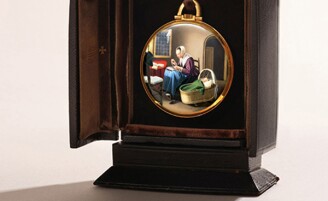
VACHERON CONSTANTIN | CHARLES POLUZZI | AFTER THE PAINTING PLAQUE OF A DUTCH WOMAN TATTING LACE BY JOHANNES VERMEER, CIRCA 1951

A masterpiece of the Dutch Golden Age, Johannes Vermeer’s (1632-1675) Plaque of a Dutch Woman Tatting Lace is recreated here in the hands of Charles Poluzzi with remarkable sensitivity. Poluzzi translates Vermeer’s quiet world and tender, domestic scene of Dutch woman focused in the delicate rhythm of lace making while a baby sleeps in a bassinet beside her.

First revealed in 2012 from the collection of an esteemed Japanese connoisseur, this exceptional miniature enamel has since belonged to one of the world’s most distinguished private collections. More than a reproduction, this is a poetic reimagining, an alchemical fusion of Old Master painting and Genevan craftsmanship, preserved in fire and glass.

PATEK PHILIPPE | SUZANNE ROHR | AFTER THE PAINTING PORTRAIT OF TWO GIRLS BY PIERRE-AUGUSTE RENOIR, CIRCA 1997

Unseen in the market for more than a decade this pocketwatch is an example from Suzanne Rohr’s mature period and beautifully portrays Pierre‑Auguste Renoir’s Portrait de deux fillettes (Portrait of Two Girls) (1890-1892) with exquisite emotional sensibility and fine detail – reproducing the sublime softness of Renoir’s brushstrokes in miniature. The painting, housed in the collection of the Musée de l'Orangerie in Paris, portrays two young girls enjoying a leisurely pastime – one of Renoir’s favourite and most defining subjects in the 1890s.

The case is embellished with intricately chased gold scrollwork that elegantly frames the enamel, like a miniature artwork set in precious metal. Accompanied by its original certificate, tag, and presentation box, the timepiece is a radiant homage to a master of her craft – embodying the rare skill, measured precision and distinctive beauty that define Rohr’s artistry.

VACHERON CONSTANTIN | ANITA PORCHET | AFTER THE FRESCO ADORNING THE CEILING OF THE PALAIS GARNIER BY MARC CHAGALL, CIRCA 2012

Commissioned by Vacheron Constantin, the present watch is a singular achievement, remarkable for capturing the magic of Marc Chagall’s dreamlike fresco painted on the ceiling of the Palais Garnier. Anita Porchet renders it in grand feu enamel, layering translucent pigments with microscopic precision. Each firing deepens the blues, ignites the golds, and tests the work against total loss, until the dial emerges as a fragile yet vivid echo of Chagall’s celestial imagination.

This watch distils one of the 20th century’s most poetic artistic visions into an object of extraordinary intimacy. Chagall’s art – weightless, radiant, and steeped in memory – unfolds in a symphony of floating figures, luminous colour, and emotional reverie in Porchet’s hands.

Watches

About the Author

More from Sotheby's

Sell with Sotheby's

Sell with Sotheby's


Wondering what your item could be worth?

Share a few details and photos to receive a complimentary online estimate.

Request an Estimate
Hand holding iphone with Sotheby's estimate tool showing

Stay informed with Sotheby’s top stories, videos, events & news.

Receive the best from Sotheby’s delivered to your inbox.

By subscribing you are agreeing to Sotheby’s Privacy Policy. You can unsubscribe from Sotheby’s emails at any time by clicking the “Manage your Subscriptions” link in any of your emails.

arrow Created with Sketch. Back To Top