Introduction
Saint John is shown in typical pilgrim’s attire half length beside his eagle on the island of Patmos. Rembrandt used the half-length figure for a number of religious half-figures created in the late 1650s and first half of the 1660s (fig. 1). In this painting Rembrandt interprets the subject with originality using his son, Titus, as a model.

While scientific, technical and historical analyses reveal a great deal about a painting, much of the interpretation, including questions of attribution, depends on stylistic assessment and contextualization of the technical findings. This requires not only careful side by side comparisons with related works, close reading of the paint handling and composition, but also a deep understanding of Rembrandt’s painting technique and materials and, and how natural aging and past interventions have impacted on their appearance.
To gain insight into these important aspects, close examination of the painting after its recent cleaning, scientific analysis of the ground, along with X-radiography and infrared reflectography (IRR) were conducted. Close comparison with related works was also made. Results of these investigations, presented here, provides new information and insights about the placing of the painting within Rembrandt’s oeuvre.
Materials and technique
The first step in evaluating the painting was to characterize the materials used for the painting.
Canvas
The original canvas (without the added strips) consists of a single piece of finely woven plain weave canvas, that now measures c. 80 x 61cm. The painting has been reduced in size along all edges, more so at the left and top edges. Examination of the x-radiograph shows no cusping at the left and upper edges; while the presence of cusping along the bottom edge and faint cusping along the right side, suggests only a small amount of original canvas has been lost. In a subsequent conservation treatment, thin strips of different canvas cut from another painting have been added to the left and lower edges: a strip of c. 1 cm at the lower edge, and c. 2 cm on the left edge. In the upper corners, small triangular-shaped pieces cut from the previously removed strips from either the left or upper edges of the painting have been used to fill in the corners, returning the painting to its original rectangular format (fig. 2).

Hofstede de Groot gives the original dimensions of the paintings as 92.7 x 72.39 cm. (36½ by 28½ inches) suggesting some 10 cm has been lost from both the height and width.1 Given the weave of the canvas has the weft running horizontally the original width of the painting most likely corresponds with a standard 1 ell strip width of about 70 cm. This accords with depth of cusping often encountered in paintings of this size, as well as observations made by Simon Howell who treated the painting in the winter 2024-25 that if the canvas insert at the top right is rotated ninety degrees so that its weave corresponds to that of the original canvas and then placed on the left side of the composition, then its 8 cm width would restore the central position of the head, producing a final minimum width of c. 69 cm.2
These changes to the format to the painting are in line with Christian Friedrich Wiegand’s (1752–1832) watercolour of the painting from 1790–1800 (fig. 3), in which the painting is shown with a low arched top, and where more of the painting is visible on left.3 Other paintings on canvas from this period where Hendrickje and Titus are considered to have posed, such as the Metropolitan Museum of Art’s Hendrickje Stoffels (c. 1660), the Rijksmuseum’s Titus in monk's costume (1660) and A Smiling Young Man (Titus) (1660) in Baltimore, which measure 78.4 x 68.9 cm, 79.5 x 67.7 cm and 81.5 x 78.5 cm respectively, have similar dimensions.


Preparation layer
The ground layer that was applied to the canvas in preparation for painting is brown in colour and comprises a single layer of a quartz-rich clay, a type of ground referred to as a ‘quartz’ ground that is unique to Rembrandt’s studio (fig. 4).4

Examination of minuscule samples of the ground by Tracey Chaplin using SEM-EDX imaging and analysis, indicates the ground is a single thick layer (up to 250 µm) composed of quartz grains (sand) and clay minerals, primarily illite; the ground also contains a significant proportion of calcium carbonate grains in the form of calcite and chalk. SEM-EDX mapping, which provides detailed elemental information, demonstrates a high proportion of aluminium, silicon and potassium (associated with clays) surrounding the angular quartz and calcium carbonate grains. Titanium-dioxide particles are also present as a minor element in the ground matrix. Backscattered electron images showing the abundant needle-like and lamellar clay particles surrounding the quartz grains, compare well with the quartz-rich clay grounds characterized by Karin Groen in the past (fig. 5).5 This type of ground, which was used by Rembrandt and his workshop for the majority of paintings produced between 1642 and 1669, has not been associated with any other 17th-century Dutch painter/ or workshop, with the exception of Samuel van Hoogstraten (1627– 1678), who worked in Rembrandt’s workshop in the 1640s.


Right: Fig. 6 St. John on Patmos, Backscattered electron image (1900x) of detail from the ground in the same cross section showing the abundant needle-like and lamellar clay particles surrounding the quartz grains. Image, Tracey Chaplin, report 17 November 2025.
The ground, which is reflective in infrared (appearing light), fills the canvas weave creating a smooth painting surface with little evidence of the canvas texture apart from small areas of wear (for example in Saint John’s left cheek). Effective use of the ground layer is made throughout the composition, especially in the clothing where large areas of the brown ground were left exposed.
The painting process
On top of the brown preparation layer a few rough sketch lines, visible in the infrared reflectogram, were used to indicate initial contours and position of the head, eyebrow, eyes, nose and chin.6 The infrared reflectogram also suggests the use of a broadly brushed tonal sketch in black and brown paint that was used to lay in the composition, leaving the lit areas – the face, shirt, lit areas of the robe and hands – in reserve (fig. 2).7
Background
The background paint containing large amounts of the pigment, smalt (a ground potassium silicate glass), which now appears a translucent warm brown – is similar in appearance to other paintings by Rembrandt that show similarly discoloured smalt-rich layers, including Rembrandt’s Susanna (1636) and Homer (1663) (The Hague, Mauritshuis).8 It is therefore possible the background of the Saint John may have been originally greener and cooler. In three paint samples from upper left and upper right corners, Chaplin identified the background paint as containing mostly smalt, along with some lead white and a little earth pigment.9 Examination of the paint surface with magnification shows this layer is worn and that only islands of the final paint layer remain.
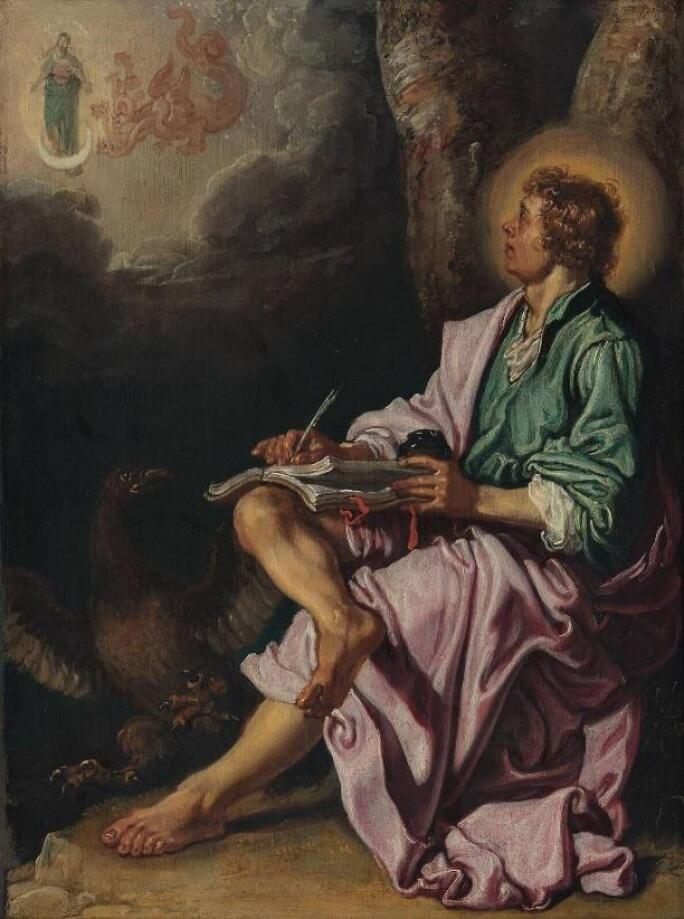
Summarily indicated forms using small diagonal brown strokes in the background above the left and right shoulders – suggest receding ridges of a landscape alluding to the landscape topography associated with Patmos that is usually depicted as hilly or rocky, such as we see in the 15th-century print of Saint John on Patmos by Martin Schongauer, from which Rembrandt’s teacher Pieter Lastman drew inspiration for his Saint John on the Isle of Patmos from 1613 (Rotterdam, Museum Boijmans van Beuningen) (fig. 7). Interestingly, in the Saint John the landscape elements are even further reduced than in the Lastman. At base of the tree only the head, eye and beak of the Saint’s emblem of an eagle sketchily indicated with dark paint are depicted, a feature that only became visible after the recent cleaning, but which can clearly be seen in the infrared reflectogram (fig. 2).
Flesh paints
In the face, the underlying sketch does not play a role in the structure of the face; instead, the flesh tones in the face are painted with broad brushstrokes on top of an ochre-coloured mid-tone. The strokes of lead-white rich flesh paint that were added along the left side of the face and nose, as well as the forehead, cheeks, eyelids, nose and chin suggest extensive working and reworking of the face. In contrast, the hands, which were roughly left in reserve, were painted directly on the ground. The flesh paint applied with a few patchy dabs of paint is dominated by lead white, with bone/ivory black, earth pigment/s and a little red lake. Just below the hands, on the table beside the book are a few small vertical scratch marks scored into the wet paint.
Clothing
The simple attire consisting of a red cloak and brown green robe is painted in a very direct sketchy abbreviated style leaving much of the underlying ground and sketch layers exposed. The white shirt visible at the neck is painted directly on the ground in lead white with a small amount of carbon black; largely abraded, essentially only the thick highlights remain. The reserve for the shirt (visible in the infrared reflectogram), which was initially wider extending more to the left, was later covered by the robe. Saint John’s undergarment is painted using vertical strokes of yellow earth and lead white with a little red lake added wet-in-wet. Some remains of a red lake layer are also visible, especially in the lower vee-shaped area of the undergarment.

The robe was first laid in with dull greenish paint containing lead white (visible in the X-radiograph), leaving large areas of the ground in the lit areas on the left to function as half-shadows. The robe was then further worked up with long slashing strokes of brownish green paint composed of yellow earth, smalt and black applied wet-in-wet. Final black contour lines were then applied on top with a broad brush, with some areas further worked into these lines wet-in-wet. In some places, the final strokes are dragged with a brush over underlying paint that was already dry.
Around his shoulder he wears a brownish red cloak. Two brown layers identified in a paint sample from his right shoulder contain earth pigments, lead white and smalt followed by a thin dark brown upper layer containing the same mixture in addition to bone/ivory black and red lake. In the lit area of the cloak on the left, diagonal- and crisscrossed strokes were added in dark brown along with dull red highlights and final black outlines. The same pigments were used to define the tassel hanging from a cord that has yellowish highlights into which red lake and white were mixed wet-in-wet (fig. 8). A change to the position of the tassel is also visible in the X-radiograph.
Comparisons
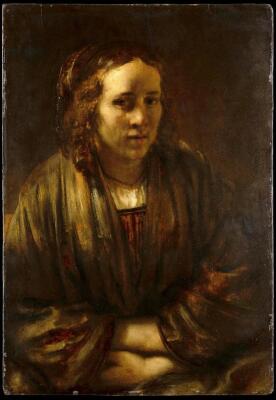
Among Rembrandt’s works, Saint John has the most in common stylistically with his Lighting Study with Hendrickje Stoffels, generally dated circa 1659, in the Städel Museum in Frankfurt (fig. 9). The compositions of the works, which show half-length figures, are similar, as is the direct sketchy abbreviated style prominent in the thinly painted clothing.11 The relative thinness of the paint application and direct painting technique employed in both paintings, are clearly demonstrated in their infrared reflectograms (figs. 2, 10).
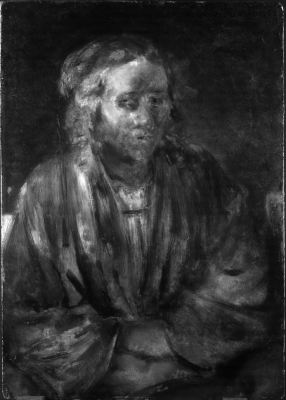
Right: Fig. 10 Lighting Study with Hendrickje Stoffels, infrared reflectogram captured with an Osiris camera in the 900-1700 nm range
Although the Städel’s Hendrickje is painted on panel with a conventional light-coloured ground, the way the underlying brown sketch layers are exploited in the clothing is markedly similar, as is the use of the long sweeping brushstrokes in tones of yellow brown and green for her simple robe. This shows Rembrandts’ penchant for rendering loosely falling fabrics, masterfully achieved in both works using fluid paint applied in vertical and near vertical strokes of the brush.
For the diagonally placed brushstrokes in Saint John’s cloak comparison can be made with Rembrandt’s Apostle Bartholomew signed and dated 1661 in the J. Paul Getty Museum (fig. 11), whose garments also display prominent diagonally slanted brushstrokes and black contour lines (figs. 8, 12).
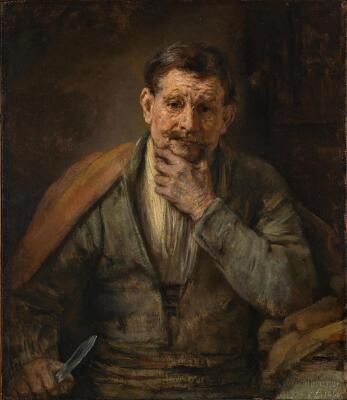

Right: Fig. 12 Saint Bartholomew, detail of the clothing
Conclusion
This short and by no means comprehensive overview provides new information on the format of the painting, on the composition of the ground and paint, and its placing within Rembrandt’s oeuvre. It is especially the handling of the paint, visible in the infrared images and X-radiographs in combination with close examination of the painting, and comparison with Rembrandt’s Lighting Study with Hendrickje Stoffels and a number of secure works by Rembrandt from the early 1660s that prove crucial for the interpretation of the painting.
The subject matter and depiction of the attributes are thoroughly in keeping with the iconographical tradition of Saint John on the island of Patmos. With his head turned and eyes downcast, and his hands resting on his book, this painting, however, conveys a sober image of the Saint that seems uniquely Rembrandt. From a material point of view, the technical investigation of this intriguing painting of Saint John on Patmos makes it highly plausible that it was conceived and painted by Rembrandt, as part of the group of half-length apostles and evangelists executed in the years between 1657 and 1661, where Titus served as model.
Acknowledgments
Simon Howell compiled the condition report in 2024-25. The infrared reflectogram was captured by Tagar Stoner Richardson in 2024. Scientific analysis of the paint samples was conducted by Tracey Chaplin in 2024-25. Grateful thanks to Ann T. Woollet (J. Paul Getty Museum) for supplying high-resolution images of the Saint Bartholomew and to Jochen Sander and Corinna Gannon (Städel Museum, Frankfurt) for facilitating examination of the Lighting Study with Hendrickje Stoffels and for generously providing high-resolution visible light- and infrared images of the painting.
Footnotes
1 C. Hofstede de Groot, A catalogue raisonné of the works of the most eminent Dutch painters of the seventeenth century, London 1916, vol. VI, p. 156, no. 246 (as Rembrandt, no. 246, ‘A devout youth’).
2 Simon Howell, Condition report, May 2025.
3 Gleisberg 2011–12 and Pabstmann 2024, reproduced fig. 49.3.
4 Tracey Chaplin, ‘St John the Evangelist - Summary of recent SEM-EDX analysis’, Report, 17 November 2025.
5 For ‘quartz grounds’ see Karin Groen, “Earth Matters: the origin of the material used for the preparation of the Night Watch and many other canvases in Rembrandt’s workshop after 1640” Art Matters: Netherlands Technical Studies in Art 3 (2005) 138-154. Karin Groen, “Grounds in Rembrandt’s Workshop and in Paintings by His Contemporaries,” in Paintings in the Laboratory: Scientific Examination for Art History and Conservation, ed. Esther van Duijn (London, 2014), 39–49.
6 The infrared reflectogram was captured by Tagar Stoner Richardson using an Osiris camera (Opus Instruments) equipped with an InGas sensor sensitive in the 900-1700 nm range. Report, 8 November 2024.
7 For Rembrandt’s sketch layers see for instance E. van de Wetering, Stichting Foundation Rembrandt Research Project, Rembrandt’s Painting Revisited. A Complete Survey, Dordrecht 2015. Reprinted in 2 vols, Dordrecht, Springer 2017, pp. 662-63.
8 For discoloured smalt in Rembrandt’s paintings, see for instance Petria Noble and Annelies van Loon, “New Insights into Rembrandt’s Susanna: Changes of Format, Smalt Discolouration, Identification of Vivianite, Fading of Yellow and Red Lakes, Lead White Paint”, ArtMatters International Journal for Technical Art History 2 (2005), pp. 76-97; David Bomford, Jo Kirby, Ashok Roy, Axel Rüger and Raymond White, Art in the Making Rembrandt, Yale University Press, 2006, pp. 46-47 and 176-77.
9 Tracey Chaplin, Technical Report, May 2025.
11 E. van de Wetering, Stichting Foundation Rembrandt Research Project, Rembrandt’s Painting Revisited. A Complete Survey, Dordrecht 2015. Reprinted in 2 vols, Dordrecht, Springer 2017, pp. 659-663.
References
C. Hofstede de Groot, A catalogue raisonné of the works of the most eminent Dutch painters of the seventeenth century, London 1916, vol. VI, p. 156, no. 246 (as Rembrandt, ‘A devout youth’)
Karin Groen, “Earth Matters: the origin of the material used for the preparation of the Night Watch and many other canvases in Rembrandt’s workshop after 1640” Art Matters: Netherlands Technical Studies in Art 3 (2005) 138-154.
David Bomford, Jo Kirby, Ashok Roy, Axel Rüger and Raymond White, Art in the Making Rembrandt, National Gallery Company London/ Yale University Press, 2006.
E. van de Wetering, Stichting Foundation Rembrandt Research Project, Rembrandt’s Painting Revisited. A Complete Survey, Dordrecht 2015. Reprinted in 2 vols, Dordrecht 2017.
