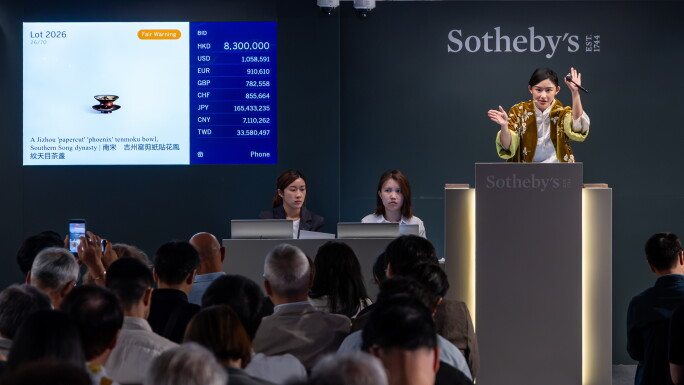
Throughout the full-day auction, Japanese art drew spirited bidding across ceramics, paintings, folding screens and other works of art, underscoring the continued strength of the market for exceptional Japanese art with distinguished provenance.
Among 117 lots of Japanese art, all of which successfully sold, with many exceeding pre-sale estimates, four carved wood figures modelled as the Four Heavenly Kings (Shitenno) from the Kamakura period achieved the top price. Bids soared, and within one minute it had surpassed HK$2 million against a pre-sale high estimate of HK$400,000. After more than 30 bids, the 13th century figures sold to a gentleman in the room for HK$6,528,000, more than 16 times its high estimate.
Attributed to the Hasegawa school and dated to the early 17th century, an evocative six-panel folding screen illustrating Chapter 51, ‘A Boat Cast Adrift’ (the Ukifune chapter), from the so-called ‘Ten Uji Chapters’ of The Tale of Genji (Genji monogatari) garnered more than 30 bids, selling for HK$3,840,000, more than 15 times its high estimate. Also attributed to the Hasegawa school, a pair of six-panel folding screens depicting waves and rocks similarly saw more than 30 bids placed, selling to a bidder in the room for HK$4,096,000, more than 13 times its high estimate.
The strong competition and remarkable result reflects the sustained market interest for Japanese folding screens, or byōbu, celebrated as one of the most distinctive and sophisticated forms of Japanese decorative art. Highly prized by collectors and museums, they were developed as both a practical furnishing and a fine work of art often depicting historical narratives, landscapes, flowers and seasonal compositions designed to unfold across multiple panels.
All 18 lots of folding screens offered in the auction fetched above pre-sale estimates, notable results include:
- Anonymous, Whose Sleeves? (Tagasode), Edo period, early 17th century, sold for HK$1,728,000 (3.4X high estimate)
- Anonymous, Moon over Musashi Moor, Edo period, early 17th century, sold for HK$2,304,000 (11.5X high estimate)
- Kamisaka Sekka (1866-1942), Irises, Taisho – Showa period, early 20th century, sold for HK$3,584,000 (nearly 36X high estimate)
- Attributed to the Kano school, Birds and flowers in spring and autumn, Momoyama – Edo period, early 17th century, sold for HK$1,408,000 (7X high estimate)
Early Japanese pottery and Edo-period ceramics were also well represented in the auction and achieved standout results. A flame-style earthenware deep vessel from the Middle Jomon period (3500-2500 BCE) attracted 38 bids and sold for HK$3,328,000, 11 times its high estimate.
Meanwhile, among the offerings of ceramics from the Edo period—Japan’s golden age of ceramics—Kenzan ware saw robust interest. Ogata Kenzan (1663-1743), brother of the famous painter Ogata Kōrin, remains one of the most celebrated ceramic artists in Japanese history. His influence extended well beyond his lifetime, giving rise to Kenzan ware, a distinctive strand of Kyoto pottery with an artistic lineage stretching from Edo through to later periods.
Notable results for Kenzan ware:
- A stoneware dish, Signed Kenzan sei sho and Hokkyo Korin and kao [cursive monogram], Kenzan ware, Kyoto, Edo period, early 18th century, after a bidding battle that saw more than 50 bids placed, sold for HK$2,432,000 (30X high estimate)
- A set of ten enamelled stoneware dishes, Signed on the base Kenzan (Ogata Kenzan, 1663-1743), Kenzan ware, Kyoto, Edo period, 18th century, sold for HK$768,000 (nearly 4X high estimate)
- A set of five enamelled stoneware mukozuke [side dishes], signed on the base Kenzan (Workshop of Ogata Kenzen, 1663-1743), Kenzan ware, Kyoto, Edo period, 18th century, sold for HK$704,000 (nearly 12X high estimate)
Nabeshima ware also featured heavily in the auction. Regarded as the pinnacle of Japanese porcelain, and produced under the direct patronage of the Nabeshima lords exclusively as gifts for the shogunal family and elite, Nabeshima ware is renowned for its impeccable craftsmanship, finely potted forms and smooth porcelain bodies. Their harmonious compositions—drawing on nature, seasonal motifs, textiles and geometric patterns—embody ideals of discipline, balance and the understated elegance of classical Japanese aesthetics.
Top lots for Nabeshima ware:
- A porcelain dish, Nabeshima ware, Hizen, Edo period, late 17th – early 18th century, depicting two jars with a crackled glaze within a flower basket, a branch of red camellias and narcissus, sold for HK$576,000
- A porcelain dish, Nabeshima ware, Hizen, Edo period, late 17th – early 18th century, decorated with chrysanthemums, fringed pinks (nadeshiko), bell flowers (kikyo), patrinia (ominaeshi) and Japanese arrowroot (kuzu), sold for HK$704,000
- A porcelain dish, Nabeshima ware, Hizen, Edo period, late 17th – early 18th century, decorated with trailing peonies and foliage, sold for HK$486,400
Encompassing a remarkable range of styles and schools, Edo-period paintings are greatly admired for its sophistication and breadth of subject—spanning classical literature, seasonal nature, landscapes, figures and everyday scenes—reflecting the diverse tastes of the court, samurai and merchant patrons of Edo Japan. Exceptional paintings continue to command attention at auction, as reflected in the competitive bidding garnered by several Edo-period paintings in this sale.
Notable results for Edo-period painting:
- Ito Jakuchu (1716–1800), Crested myna in moonlight, Edo period, late 18th century, sold for HK$1,792,000 (nearly 6X high estimate)
- Suzuki Kiitsu (1796-1858), Seven Grasses of Autumn (Aki no nanakusa), Edo period, early 19th century, sold for HK$960,000 (9.6X high estimate)
- Attributed to Iwasa Matabei (1578-1650), Fragment from the Tale of Horie (Horie monogatari), Edo period, mid-17th century, sold for HK$2,560,000 (nearly 13X high estimate), more than 40 bids placed
- Sakai Hoitsu (1761-1828), The Jewel River at Chofu (Chofu no Tamagawa), Edo period, dated Kinoto mi shoto (10th month in the Year of the Wood Snake [1785]), sold for HK$3,072,000 (7.6X high estimate)
- Ogata Korin (1658-1716), Hotei, Edo period, early 18th century, sold for HK$768,000 (nearly 13X high estimate)