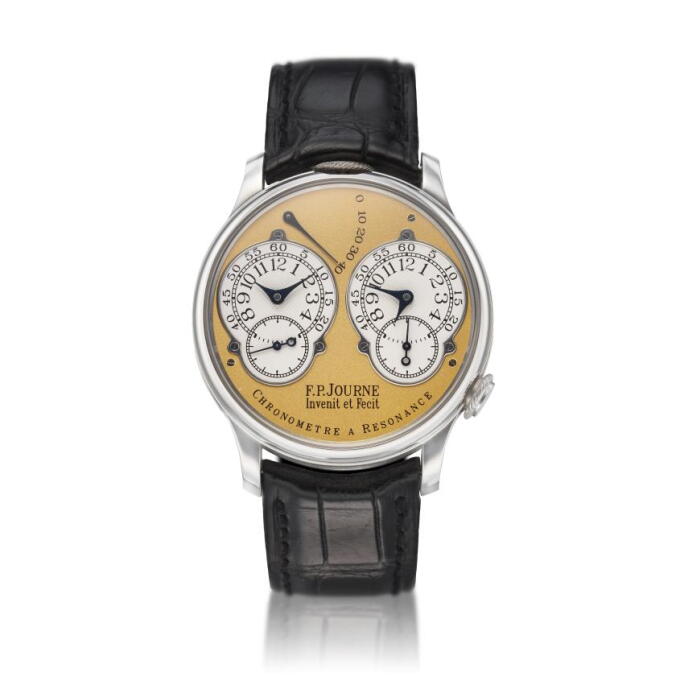
F.P. Journe: Exploring the Iconic Chronomètre à Résonance
A closer look at the F.P. Journe Chronomètre à Résonance, including its resonance mechanism, 38 mm early models and transition to pink gold calibers.

The F.P. Journe Chronomètre à Résonance occupies a distinctive position in contemporary independent watchmaking. Introduced in 2000, it was the first wristwatch to successfully apply the principle of resonance to two mechanical balances operating within the same movement. Its twin time displays suggest a conventional dual-time watch, but the mechanism beneath the dial represents one of François-Paul Journe's most ambitious technical achievements.
The concept dates to the 17th century, when Dutch mathematician Christiaan Huygens observed that pendulum clocks mounted on a shared support could synchronize their oscillations. Watchmakers Antide Janvier and Abraham-Louis Breguet later investigated the phenomenon through specialized clocks. Journe began experimenting with resonance in a pocket watch in 1983, eventually adapting the principle to the much smaller dimensions of a wristwatch. The resulting Chronomètre à Résonance became one of the defining models of his independent manufacture, established in 1999.
More than two decades of production have introduced meaningful differences between Résonance generations, from the early rhodium-plated brass movements and 38 mm cases to pink gold calibers and the redesigned Calibre 1520. Understanding these developments is essential when comparing examples on the secondary market, where early production, unusual dial configurations and mechanical revisions can influence desirability. The evolution of the Chronomètre à Résonance also offers a closer look at Journe's approach to precision watchmaking and the technical challenges behind one of his most studied complications.
| Feature | What Collectors Should Know |
|---|---|
| Introduction | Launched in 2000, the Chronomètre à Résonance was the first wristwatch to apply the principle of resonance to two independent mechanical balances. |
| Resonance Mechanism | Two closely positioned balance wheels interact through resonance, allowing their oscillations to synchronize and helping stabilize their rates. |
| Early Brass Movements | The earliest examples, produced from 2000 to 2004, feature rhodium-plated brass Calibre 1499 movements. These are among the most sought-after generations. |
| Pink Gold Movement Transition | In 2004, F.P. Journe began replacing brass movements with 18-karat pink gold calibers. The Résonance received the updated RN designation. |
| Case Sizes | Early models feature 38 mm cases, while later generations introduced 40 mm configurations in platinum and pink gold. |
| Calibre 1520 | Introduced in 2020, the redesigned movement uses a single barrel, a differential and two one-second remontoirs to distribute power to the escapements. |
| Black Label Editions | Distinguished by their black dials and restricted boutique distribution, Black Label Résonance watches are available exclusively to existing F.P. Journe clients. |
| Collector Considerations | Movement generation, dial configuration, case condition and original documentation are central to evaluating individual examples. |
The origins of the Chronomètre à Résonance can be traced to 1665, when Dutch mathematician Christiaan Huygens observed that two pendulum clocks mounted on the same support could synchronize their movements. In the 18th century, French clockmaker Antide Janvier applied this principle to precision clocks equipped with two pendulums. Abraham-Louis Breguet subsequently experimented with resonance, although translating the phenomenon into a portable timepiece presented substantial mechanical challenges. The effect depends on the interaction between two oscillating systems, making their positioning and regulation critical to achieving synchronization.
François-Paul Journe began investigating resonance in 1983, developing an experimental pocket watch before pursuing the concept in wristwatch form. His Chronomètre à Résonance debuted in 2000, one year after the introduction of the Tourbillon Souverain and the establishment of his independent manufacture. The original model featured two independently adjustable time displays powered by separate gear trains and regulated by balances designed to interact through resonance. Housed in a 38 mm case with a manually wound brass movement, it established a technical foundation that Journe would continue to refine through subsequent generations.
The Chronomètre à Résonance uses two independent balance wheels positioned close enough to influence one another through mechanical resonance. Each balance regulates its own gear train and time display, allowing the watch to indicate two different time zones. When the balances are properly adjusted, the small vibrations transmitted through the movement can bring their oscillations into synchronization. One balance effectively acts as an exciter and the other as a resonator, with the interaction helping correct minor variations in their respective rates. Unlike a conventional dual-time watch, which typically relies on a single regulating organ, the Résonance incorporates two regulators whose behavior is mechanically linked.
Achieving this effect within a wristwatch requires precise adjustment of the balances, their frequencies and their proximity. The original Calibre 1499 employed two independent power sources, while the redesigned Calibre 1520, introduced in 2020, uses a single mainspring barrel and a differential to distribute energy between the two gear trains. Each is equipped with a one-second remontoir d'égalité, designed to deliver a more consistent supply of torque to its escapement. These developments reflect Journe's continued refinement of the mechanism, addressing the stability of power delivery while preserving the principle that distinguishes the Chronomètre à Résonance.
The earliest Chronomètre à Résonance watches were fitted with the manually wound Calibre 1499, constructed from rhodium-plated brass and housed in 38 mm cases. Produced in platinum and pink gold, these first-generation models featured two independently adjustable time displays, a power reserve indicator at 12 o'clock and the Invenit et Fecit inscription at 6 o'clock. Production of brass movements ended in 2004, making these early examples significant within the development of F.P. Journe's independent manufacture.
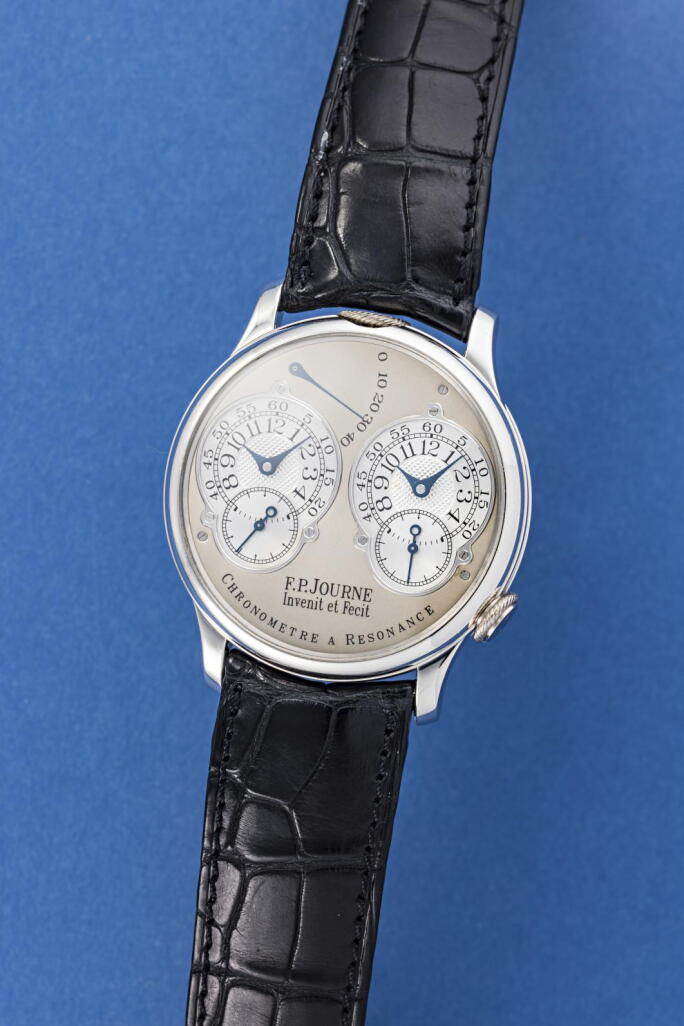
A platinum Chronomètre à Résonance from circa 2000, which sold for $454K USD in June 2022, illustrates the original configuration. Its 38 mm platinum case houses Calibre 1499, while the dial features two independent time displays. Numbered 72/01R, the watch was accompanied by its original presentation box and warranty card. Its documented history and early production details offer important context for evaluating first-generation Résonance watches.
Early Chronomètre à Résonance watches were produced with several dial configurations, including variations in precious-metal finishes. These differences are important when distinguishing individual examples from the manufacture's initial production period. The 38 mm case and brass movement remained consistent, but combinations of case metal and dial execution gave the earliest watches distinct appearances.
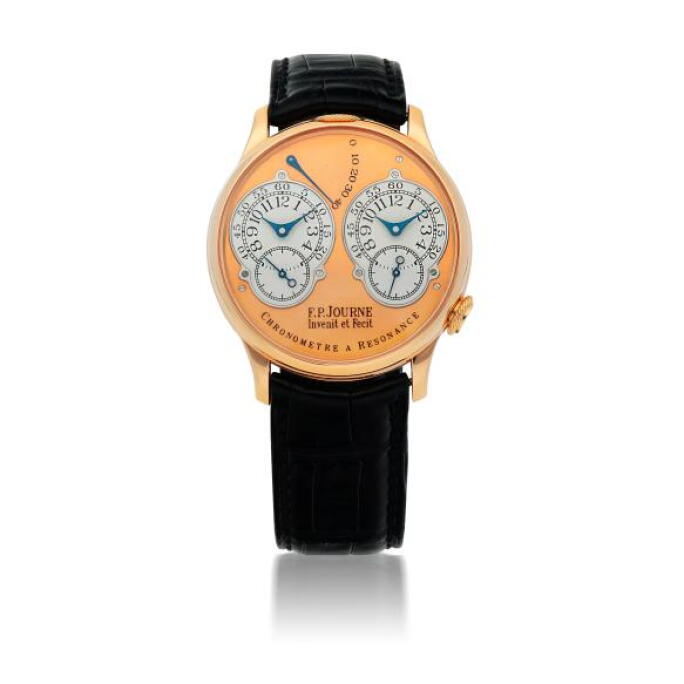
A pink gold Chronomètre à Résonance dating to circa 2002 sold for 239K CHF in November 2020. Featuring a pink dial and Calibre 1499.2, the watch combines a matching 18-karat pink gold case with the original brass-movement architecture. Another platinum example from circa 2002, fitted with a yellow gold dial and Calibre 1499, achieved $378,000 in June 2021. Both retain the original 38 mm proportions, demonstrating the dial variations found within early Résonance production.
In 2004, F.P. Journe began replacing brass movements with 18-karat pink gold calibers, a significant development in the manufacture's production history. The Chronomètre à Résonance transitioned from the original R designation to RN, short for Résonance Nouvelle. The updated movement retained the model's dual-balance architecture while introducing the pink gold construction that became a defining characteristic of later Journe watches.
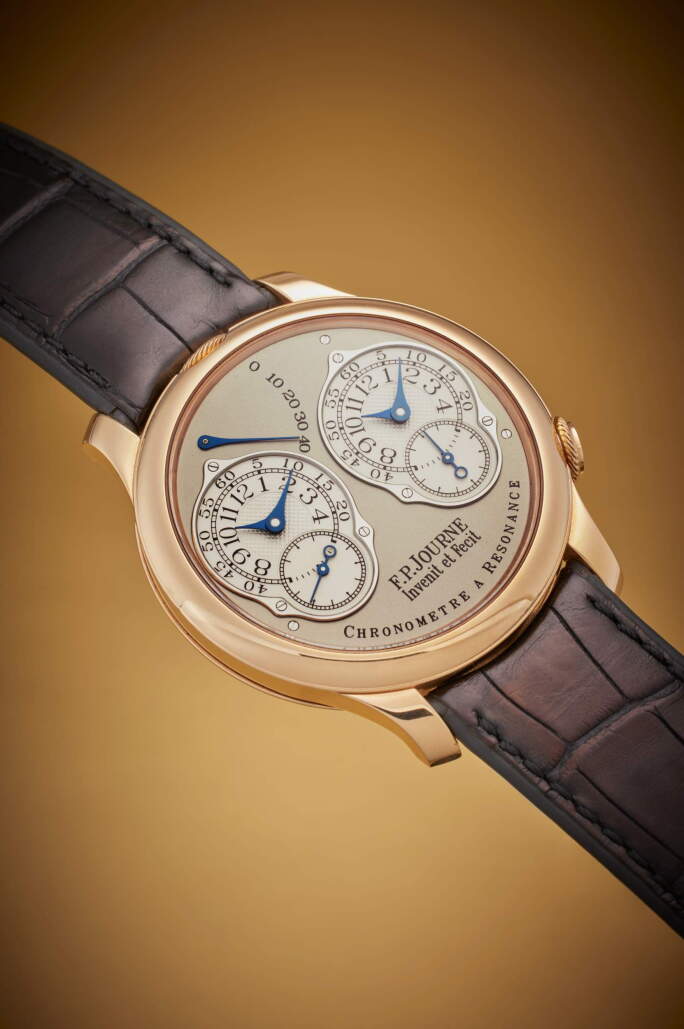
A pink gold Chronomètre à Résonance with Calibre 1499.2, which sold for $156K USD in December 2024, illustrates this transition. Housed in a 40 mm pink gold case with a silvered dial, the watch bears the RN designation and features a pink gold movement. Its larger proportions and revised caliber distinguish it from the early 38 mm brass examples.
As the collection evolved, F.P. Journe introduced 40 mm cases alongside revisions to the dial and movement. The larger format altered the proportions of the twin time displays while preserving the symmetrical arrangement associated with the original Résonance. Later examples incorporated updated versions of Calibre 1499, including Calibre 1499.3, which continued to use two independent regulating systems.
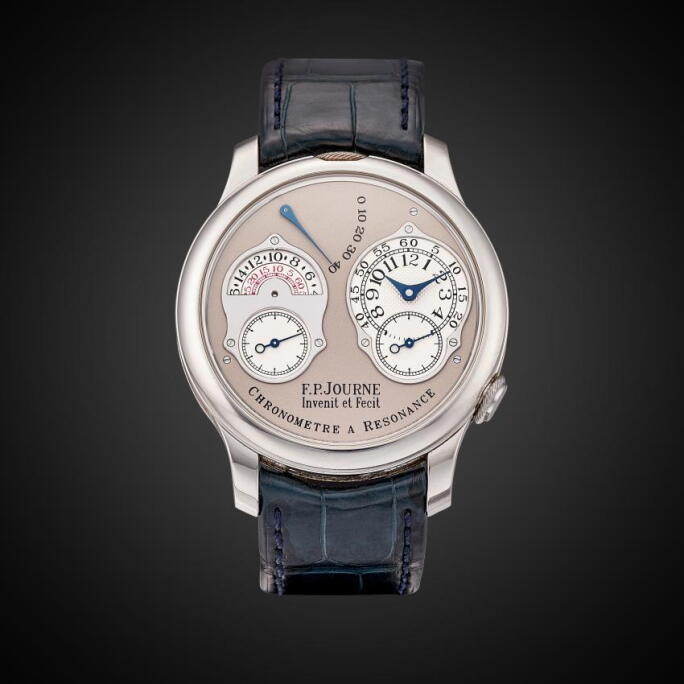
A platinum Chronomètre à Résonance from circa 2012, which sold for 2M HKD in December 2021, demonstrates this later configuration. The 40 mm platinum case houses Calibre 1499.3, fitted with 40 jewels, while the silvered dial retains the twin time displays and power reserve indication. Its proportions and movement distinguish it from the earlier 38 mm brass examples.
The Chronomètre à Résonance underwent its most substantial mechanical revision in 2020, coinciding with the model's 20th anniversary. The newly developed Calibre 1520 replaced the earlier architecture with a single mainspring barrel and a differential that distributes power between the two gear trains. Each escapement received a one-second remontoir d'égalité, intended to maintain consistent energy delivery throughout the movement's approximately 42-hour power reserve. The winding crown also moved to 2 o'clock, distinguishing the redesigned generation from its predecessors.
The 2020 redesign established a new technical foundation for the Chronomètre à Résonance, retaining its dual-balance principle while substantially revising how energy reaches each regulating system. It also marked a clear distinction between the earlier Calibre 1499 generations and the current architecture, making movement identification an essential consideration when comparing Résonance watches across production periods.
The Chronomètre à Résonance represents one of François-Paul Journe's most significant contributions to contemporary independent watchmaking. Since its introduction in 2000, the model has evolved from the original brass Calibre 1499 to the redesigned Calibre 1520, with each generation reflecting refinements to its distinctive resonance mechanism. Early 38 mm examples are closely associated with the manufacture's formative years, while later pink gold movements and revised case proportions mark important developments in the collection. Understanding these differences is essential when comparing individual watches on the secondary market.
Originality, dial configuration and documentation also influence desirability. Early warranty cards and purchase receipts can help establish provenance, while case condition and movement details deserve careful examination. The distinctions between brass and pink gold calibers are especially relevant, as are the mechanical changes introduced in 2020. More than two decades after its debut, the Chronomètre à Résonance remains a defining achievement of F.P. Journe, with its evolving construction offering collectors several distinct periods of production to consider.
Early examples produced between 2000 and 2004 feature rhodium-plated brass Calibre 1499 movements, generally housed in 38 mm cases. In 2004, F.P. Journe transitioned to pink gold movements, establishing an important distinction between the manufacture's earliest production and subsequent generations.
The original R designation identifies the early Résonance generation with brass movements. Introduced in 2004, the RN, or Résonance Nouvelle, incorporated a pink gold movement. The designation helps distinguish two significant periods in the model's production history.
Calibre 1499 uses separate mainspring barrels to power its two regulating systems. Introduced in 2020, Calibre 1520 employs a single barrel and differential, with a one-second remontoir d'égalité for each escapement to improve the consistency of power delivery.
The 38 mm models represent the original proportions of the Chronomètre à Résonance and include the earliest brass-movement examples. Their connection to the manufacture's initial production period, combined with distinctive dial variations, contributes to their desirability on the secondary market.
Movement generation, dial originality and case condition are central considerations. Collectors should also examine serial numbers, service history and accompanying documentation, including original warranty cards and purchase receipts, when available.
Whether you're a seasoned collector or new to the world of fine watches, Sotheby’s offers a trusted, seamless way to buy and sell F.P. Journe timepieces on the secondary market.
Trust our worldwide network of leading watch specialists from a globally renowned auction house established in 1744.