I
n February 1996, I visited Lucian Freud’s studio for the first time. Following the terse instructions he had sent me on a postcard, I walked from the tube station to a mid-19th century building near Holland Park, pressed a buzzer enigmatically labeled ‘Top Flat’, and walked up five flights of stairs.
There, poised at the summit holding the door open, was Freud. He showed me into a room at the back of the apartment where he worked. It was at once spacious and cluttered, filled with tubes of paint and rags, but with bare floorboards and little furniture.
In the center was a large, old and comfortable-looking leather chair. On the easel, an almost finished painting of a naked woman (as curvaceous as the prehistoric Venus of Willendorf), lolling asleep on the aforementioned seat.
Freud’s palette, dotted with blobs and squiggles of tawny pigment, lay to one side. The model was not present, perhaps she had just departed. Or possibly Freud had been breaking another of his rules in painting part of a picture—even a section in which she or he did not feature—without the living subject in the room.
It’s clear now that Sleeping by the Lion Carpet (1995-96), which was slowly growing in that studio 30 years ago, is a great work, a monumental achievement. It is about to be sold as part of Masterpieces from The Lewis Collection Evening Sale alongside 24 exceptional paintings, all of which have one thing in common: They are all, in one way or another, figurative.
For much of the later 20th century, figurative painters, and non-representational ones alike—plus many critics, curators, and art historians—were prone to believe that the art they practiced was in its final days. Ad Reinhardt (1913–67), creator of minimalist, near-monochrome black abstractions, proclaimed on several occasions “I am merely making the last painting which anyone can make.”
In other words, painting was dying, if not dead—a view which found favor starting in 1839 when Daguerre unveiled the first photographs. That went double for depictions of people, things, and landscapes because—many assumed—the task of recording what the world looked like had been taken over by the camera.
Today, it's obvious that the 20th and early 21st centuries were, in fact, extremely rich in figurative painting—it just didn't unfold in the neat “-ism” manner that art historians prefer. Yes, there have been groups—such as "Euston Road" and "Camden Town" in Britain—that have followed a shared rubric and whose works, therefore, have family resemblances. But most truly remarkable figurative painters have tended to correspond to R.B. Kitaj’s famous description of his invention, ‘the school of London’. They are "a herd of loners" linked together by mutual and critical regard rather than a shared idiom.
In the absence of an -ism, those carrying figurative painting forward were forced to engage in something else altogether in order to earn respect: originality and authenticity. Francis Bacon, asked to judge a student art competition, announced upon inspection of the works that he couldn’t give a prize, because they were all “equally dull.” When the outraged students demanded an explanation, Bacon replied, “Because they are all based on someone else's paintings.” His test of quality was not verisimilitude but a distinctive visual and emotional force.
Tracey Emin put it another way: “Painting has to have the thing. If it hasn’t got its own entity, the thing, its own being, it has no substance, no sense of being here.” Bacon’s Two Studies for Self-Portrait from The Lewis Collection, with their sense of pulsing, breathing, feral life certainly, have the “thing,” as does his extraordinary Study for Portrait (1976), in which his own features melt into those of his friend and subject of many works, Henrietta Moraes.
Pablo Picasso and Max Beckmann—scarcely members of the same group—recognized each others' ingenuity and significance. Beckmann considered the Spanish master, together with Henri Matisse, the only living painters who rose to his standards. Upon seeing Beckmann’s works, Picasso remarked, “Il est très fort”—which sounds like praise for Beckmann’s sheer force—"the thing," again—which can be felt as well as seen in Artisten (1948).
For many representational painters, Picasso was a guiding star to whom they accorded huge respect. Certainly, that was true of Bacon, whose initial ambition to become an artist was fired in part by discovering Picasso’s work as a young man.
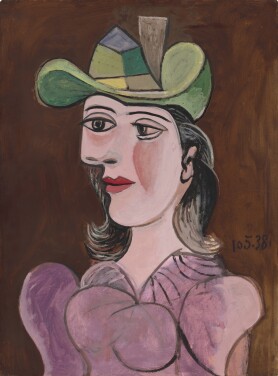
In 1942, the artist and historian Roland Penrose gave Bacon the job of transporting Picasso’s great Weeping Woman from London to Hove by train. He spent the whole journey looking at it. Such is the power of Picasso’s pictures of Dora Maar, including Buste de femme from The Lewis Collection. These products of obsessive love are imbued with Picasso’s own energy—and sometimes rage. They pre-eminently have the ‘thing.’
Although they might not have shared a nameable -ism, Bacon and Freud talked, ate and drank together for a quarter of a century (until they fell out). A comparable pair of painter friends from earlier in the century were Chaim Soutine and Amedeo Modigliani. The painter Gabriel Fournier described how in Bohemian Montmartre, “Soutine grew in Modigliani's shadow.”
Looking at a Modigliani such as Nu assis au collier (1917-18) it is not hard to believe that his inspiration came from, as he said, “the truths of art and life I have discerned scattered amongst the beauties of Rome.”
This work is not neo-classical in the manner of, say, Jean-August-Dominique Ingres. But is classicizing in that it was rooted in drawing, sensuous, relaxed and tends towards rounded, stylized forms. All Modigliani’s sitters have this certain look.
In comparison, Soutine’s works, such as Portrait du garçon en bleu, are electrifying, ecstatic and based on a way of working, going back to Rembrandt and Titian, which was all about the behavior of oil paint, applied both thickly and thinly with freedom and flare.
Although Soutine was a loner among loners and had no immediate followers, he left an important example for later artists. There are sometimes such links—Goethe called them “elective affinities”—between artists across time. For Bacon, Soutine was a predecessor of great importance (Damien Hirst has noted “without Soutine, no Bacon”). Bacon, Freud—like many in the Lewis Collection—were artists who didn’t so much grow up in a tradition, as chose their own lineage: the history of art that leads up to them.