
Remembering David Hockney
The exceptionally prolific English painter, draughtsman, printmaker and stage designer—whose work set records at auction with Sotheby's—has passed away at the age of 88. His indelible legacy as a singular artist remains.

I n 1964, the young Yorkshire-born artist David Hockney, moved to Los Angeles, California. There, he became mesmerized by the swimming pools. The shift of the water, the play of the light, the man-made colors—these factors formed something of a challenge for the artist who would go on to create countless meditations on the shimmering bodies of water.
More than 40 years later, with the news of his passing, it is impossible to remember the artist without thinking of The Splash (1966)—which was sold in 2020 for £23.1 million, setting an auction record for the series—and A Bigger Splash (1967). His legacy, which includes half a century of works, continues to inspire a new generation of artists, while his work will live forever as evidence of a man who loved what he did and painted what he loved.

Hockney was notoriously and ferociously independent. Even the venerable Royal College of Art in London was forced to change its rules when a young Hockney refused to write an essay which, at the time, was required for graduation.
After the creation of his pools, Hockney became an icon of the 1960s art scene—forming friendships with the artists Andy Warhol (with whom he shared a penchant for bleached white hair), R.B. Kitaj and the curator Henry Geldzahler. He explored themes of domesticity and homosexuality (he lived openly as a gay man following his move to LA), creating paintings of couples and collectors that would go on to join the permanent collections of major art institutions around the world. While he is widely regarded as a figure from the pop art scene of the time, Alex Branczik, Chairman of Modern & Contemporary Art in Europe and Asia, thinks this is a misnomer.
“Hockney was much more radical than any singular art genre,” says Branczik. “He was always bucking the rules, always challenging expectations, always curious.”
As he grew as an artist, so did the scale of his work. In the 1970s and 80s, he ventured into set design, crafting sets and even costumes for major operas like The Magic Flute and The Rake’s Progress.
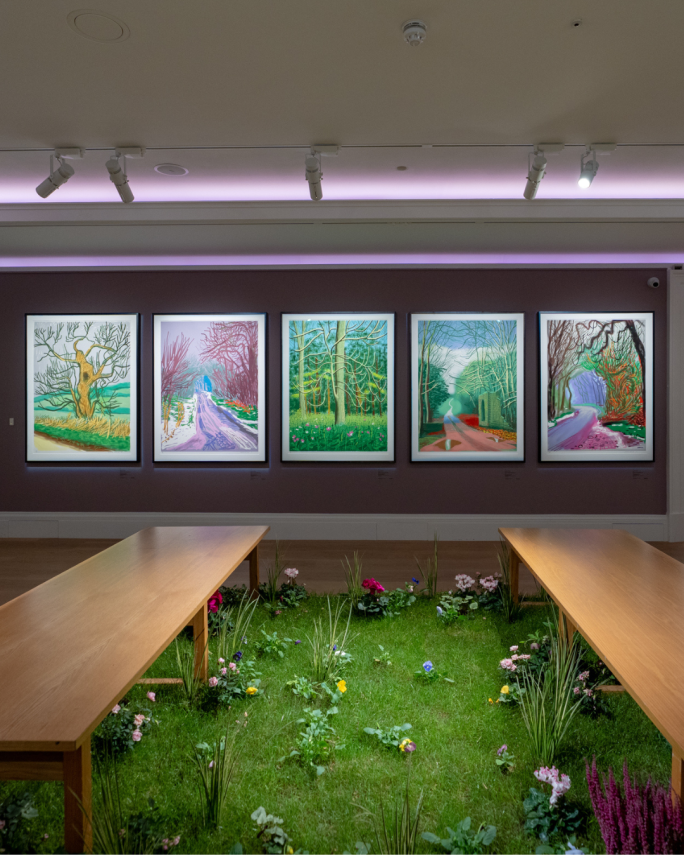
Hockney had a penchant for experimentation. He created art on fax machines in the 1980s before returning to England to create enormous landscape paintings. Unlike his peers, Hockney was not tied to one medium, moving from oil paint to acrylics, to photography and collage to modern technology to create his landscapes and portraits.
When he purchased his first iPad in 2010, he began making digital sketches, spending months mastering this new medium, practicing with still lifes and flowers. In 2025, a large collection of his iPad drawings was offered to the market by Sotheby’s in London achieving a combined £6.2 million. The Arrival of Spring in Woldgate, East Yorkshire in 2011 - 19 February, 2011 set a record for a Hockney iPad drawing at £1 million.
In his late years, Hockney continued to produce yet more work, exploring scroll-like formats and immersive art experiences that would engage and enrapture the viewer. His 2023 portrait of the pop-musician Harry Styles—painted in Hockney’s Normandy studio—reached still greater audiences, offering the world a hint that the 86-year-old painter was still very much engaged in the zeitgeist.
With his passing, we lose a fearless artist who seemed preternaturally inclined to make, make, make. He leaves behind a body of work that spans decades, genres and media. “He reinvented himself over and over again,” says Branczik, “and because of that I will always think of him as a national hero.”


