N
ext week, Sotheby's London will present a remarkable series of Old Master and 19th-century works, bringing together paintings, sculpture and rare objects that span centuries of artistic mastery and innovation. From rediscoveries to works held in the same collections for generations, the sales beginning on 27 June feature extraordinary pieces, many returning to the market for the first time in decades. Sotheby’s specialists have selected their standout lots from across the sales—now's the time to save your favorites.
Rembrandt Harmensz. van Rijn, Let The Little Children Come Unto Me, 1627
This important history painting, begun by Rembrandt in Leiden around 1627, includes a self-portrait of the young artist along with likely portraits of his mother and other family members. Left unfinished and completed by another hand some years later, the painting has recently had this overpaint removed, revealing a work entirely by Rembrandt. It is also the only surviving Rembrandt canvas that remains unlined. Unrecognized until it was exhibited at Lempertz in Cologne in 2014, it is now endorsed by leading Rembrandt scholars.
Paulus Pietersz. Potter, Landscape with livestock and a milkmaid, 1646
Signed and dated 1646, this is a superb example of Paulus Potter's pastoral landscapes, painted during the brief decade of his career before his early death at twenty-eight. He captures the late afternoon hour the Dutch call Melkuur, when cattle are brought in to be milked, using the milkmaid's red coat as anchor of the composition. The painting entered the collection of the Duke of Somerset in 1828 and has remained in the present family's ownership since 1890.
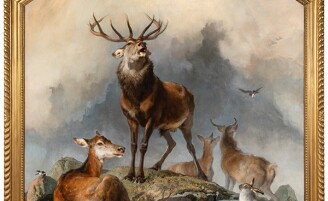
Sir Edwin Landseer, R.A., Scene in Braemar – Highland Deer, 1857
This monumental canvas by Sir Edwin Landseer, the celebrated animal painter of the Victorian age, is a sequel to his iconic Monarch of the Glen of circa 1851. It depicts a mature stag roaring atop a rocky height in the eastern Highlands, a subject Landseer returned to throughout his career. Commissioned for Preston Hall, Kent, the painting was highly regarded by critics when first exhibited at the Royal Academy in 1857, and later entered the renowned collection of the Earl of Iveagh at Kenwood House.
Giovanni Battista Foggini, Christ and the Samaritan Woman; Apollo and Daphne, 1725
This beautifully carved pair of marble reliefs by the Medici court sculptor Giovanni Battista Foggini, depicts Christ and the Samaritan Woman and Apollo and Daphne. These refined works are documented autograph sculptures by one of Florence’s leading late Baroque artists, and can be identified with reliefs recorded in Foggini’s posthumous studio inventory.
Auguste-Jean-Marie Carbonneaux, The Hamilton Laocoön, 1817
The season’s sculptural highlight is The Hamilton Laocoön, an exceptional life-size neoclassical bronze of this iconic model. Cast in 1817 by the prominent bronze founder Auguste-Jean-Marie Carbonneaux from molds taken directly from the ancient marble original, it is a tour-de-force of bronze casting and one of only four existing life-size bronze versions from this period. The Hamilton Laocoön will be sold in a dedicated auction on 1 July at 7pm, prior to the Old Masters Evening Sale.
Attributed to Hans Klingenberg or Georg Schreiber, Amber pendant with a portrait of Queen Elizabeth I (1533-1603), 1600
This remarkable rediscovered portrait of Queen Elizabeth I is carved in white amber and enclosed within a richly worked amber pendant. Made in Königsberg around 1600 and attributed to leading amber craftsmen working in the Baltic tradition, the jewel is inscribed with the queen’s titles and combines finely carved relief with gilt and decorative elements. Its intimate scale and courtly refinement suggest it may have been conceived as a diplomatic or personal gift, a rare survival of miniature Elizabethan portraiture.
Sir Peter Lely, Self-Portrait, 1655
Sir Peter Lely’s Self-Portrait of circa 1655 is one of the most famous and important drawings to have survived from 17th century Britain. Lely moved from the Netherlands to England in the early 1640s and, with remarkable speed, he was soon considered the greatest painter in London. This self-portrait drawing, one of only two known, is conceived on a large scale and demonstrates, beyond any doubt, his genius as a draughtsman. The drawing has only been sold once before, in 2016, where the consignors were the artist’s direct descendants.
Richard Parkes Bonington, The Grand Canal, Venice, with the Rialto Bridge in the distance, 1836
This superb watercolour demonstrates why Bonington, who died aged only 25, is considered by many to be among the most important artists of his generation. Painted as a response to his only visit to Venice, Bonington not only captures the magnificent buildings of the Grand Canal, but also its light and atmosphere. Held in a private collection since 1997 its reappearance on the open market now is exciting.
Francesco Guardi, Venice, the entrance to the Grand Canal with Santa Maria della Salute, 1770s
Executed during the 1770s, this beautifully preserved panel is a particularly fine example of Francesco Guardi’s mature style. Dominating the composition is the church of Santa Maria della Salute, Baldassare Longhena’s great Baroque landmark at the entrance to the Grand Canal. To the left, the distant line of the Riva degli Schiavoni recedes towards the horizon, opening the picture onto a broad expanse of sky. This view occupies a relatively unusual place within Guardi’s painted œuvre. Whereas Canaletto repeatedly represented Santa Maria della Salute from similar viewpoints, Guardi appears to have explored the motif only rarely. The closest comparison is the larger canvas in the Art Institute of Chicago, which shares many compositional elements while differing in scale and viewpoint.
Workshop of Lucas Cranach the Elder, The Mystic Marriage of Saint Catherine of Alexandria, with Saints Margaret, Barbara and Dorothy, 1516-20
Common to almost all Lucas Cranach's portrayals of women are their elegant, elongated forms, rich, courtly attire, and the precious accessories with which they are adorned. This panel, executed in his workshop in circa 1516–20, is no exception. Testament to the skill and precision of the studio assistants, this painting is a highly-refined, relatively early example of his workshop production. The scene depicted in this small, devotional panel is an amalgamation of two iconographic traditions, both of which originate from medieval mystical philosophy. The first is the Virgo inter virgines, particularly popular in German and Netherlandish art of the time—the Virgin surrounded by the four most highly venerated female, virgin saints: Catherine, Barbara, Margaret and Dorothy (sometimes excluding this last figure). The second is The Mystic Marriage of Saint Catherine: the most popular of the capital virgins, her legend developed its own visual lexicon. Three paintings of this subject are attributed to Lucas Cranach the Elder: the earliest and largest is dated 1516 and is in the Anhaltische Gemäldegalerie, Dessau; a panel of fairly comparable dimensions to the present work is in the Szépmuvészeti Múzeum, Budapest; and a third, the smallest, was offered in these Rooms in 2018. This panel compares most closely to the Budapest picture and dates to around the same period.