A Historic Connecticut Home, Reimagined for Modern Collectors
A Historic Connecticut Home, Reimagined for Modern Collectors
By
Sarah Medford| Aug 31, 2026
Newly minted art agent Cristopher Canizares and his husband, tech executive Dan Friedman, explore their evolving interests in a Litchfield County farmhouse.
Photography by Stephen Kent Johnson
Newly minted art agent Cristopher Canizares and his husband, tech executive Dan Friedman, explore their evolving interests in a Litchfield County farmhouse.
Photography by Stephen Kent Johnson
I
n the fall of 2023, interior designer Robert Stilin got a text from his friends Cristopher Canizares and Dan Friedman. They’d found a farmhouse in Connecticut’s Litchfield County, much bigger than their current place nearby, but of a similar style and 19th-century vintage. It would need some attention, though—could he help? Stilin was immediately enthusiastic. “I knew they would be kind of chill, professional clients,” he says of the couple. “They know what they like, but they can’t do it. They just don’t have the time. They both have very busy careers.”
Canizares, an art agent, and Friedman, a senior tech executive, had been living—maybe commuting is a better word—between Manhattan, Philadelphia and their snug Connecticut farmhouse for years. The idea behind the new place was to consolidate into one appreciably bigger, more restorative home base where they could host family and friends. At least Stilin was under no illusions about the process; after meeting at the new house that winter, the three men barely saw each other until it was finished.
“Cristopher travels a lot, and he would send very detailed voicemail messages that were easy to respond to,” says Stilin. “And Dan moves around, too. We did a lot over email. And text, to be honest.”
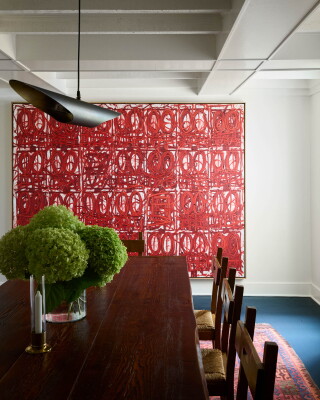
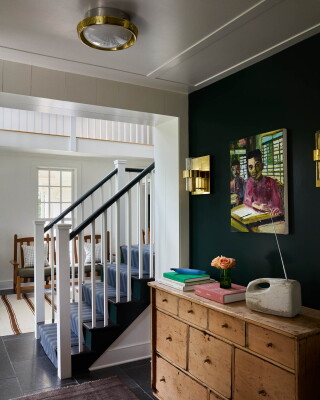
For many of his clients, a key part of Stilin’s job is to help build an art collection or show one off to its advantage. Here, his friends took care of all that. In the entry hall, Isa Genzken’s wryly dystopian radio, “Weltempfänger (World Receiver)” (2015), is nestled onto a Shaker-style chest beneath a sharply observed oil portrait by Maia Cruz Palileo. Around the corner, one of Rashid Johnson’s looping oil paintings from his “Anxious Red” series occupies prime wall space in the beamed dining room. It’s an important piece for Canizares—he and Johnson worked together when Canizares was a partner at Johnson’s gallery, Hauser & Wirth, and Johnson is now a client of Artist Legacy Bureau, the agency that Canizares opened in May 2026. This summer the couple joined Johnson in Menorca for the opening of the Residency at Casa Gràcia, a retreat for artists and writers that Johnson co-founded with artist Sheree Hovsepian.
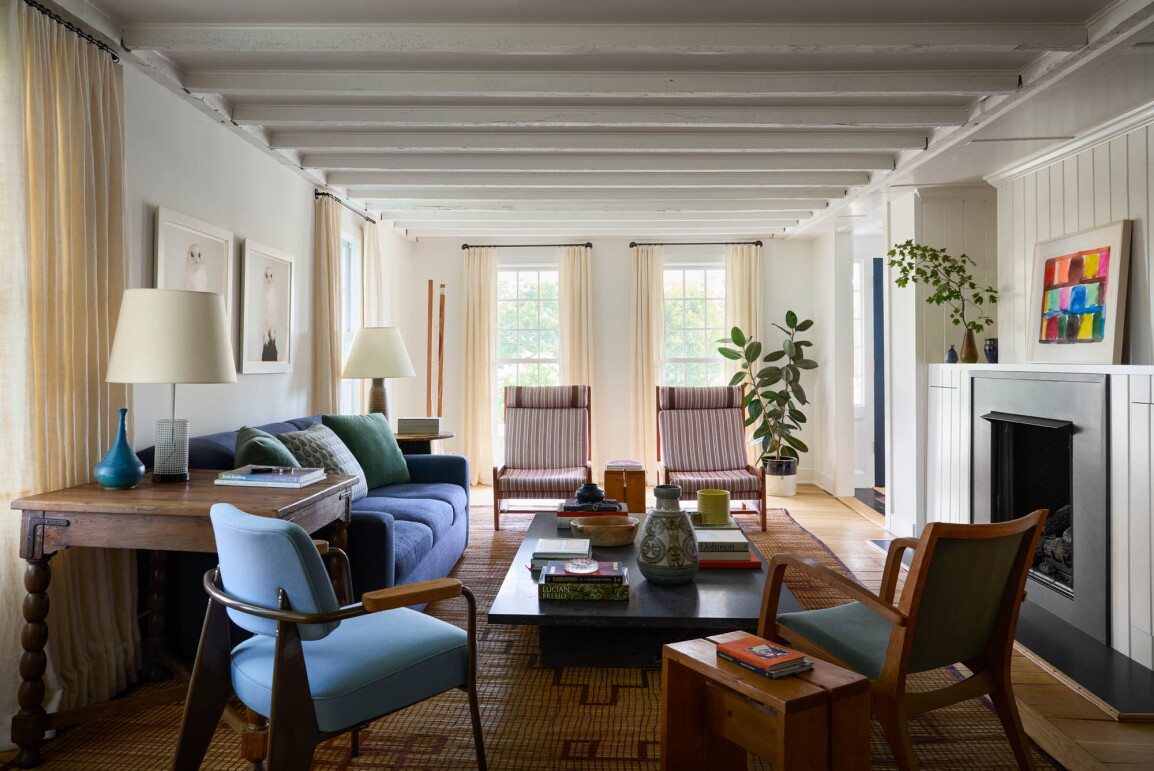
An untitled 2020 Stanley Whitney work is perched on the living room fireplace, with Roni Horn’s photographic diptych “Dead Owl,” 1997, displayed over the sofa and Marc Swanson’s 2009 sculpture “Untitled (Golden Crate)” in the far corner.
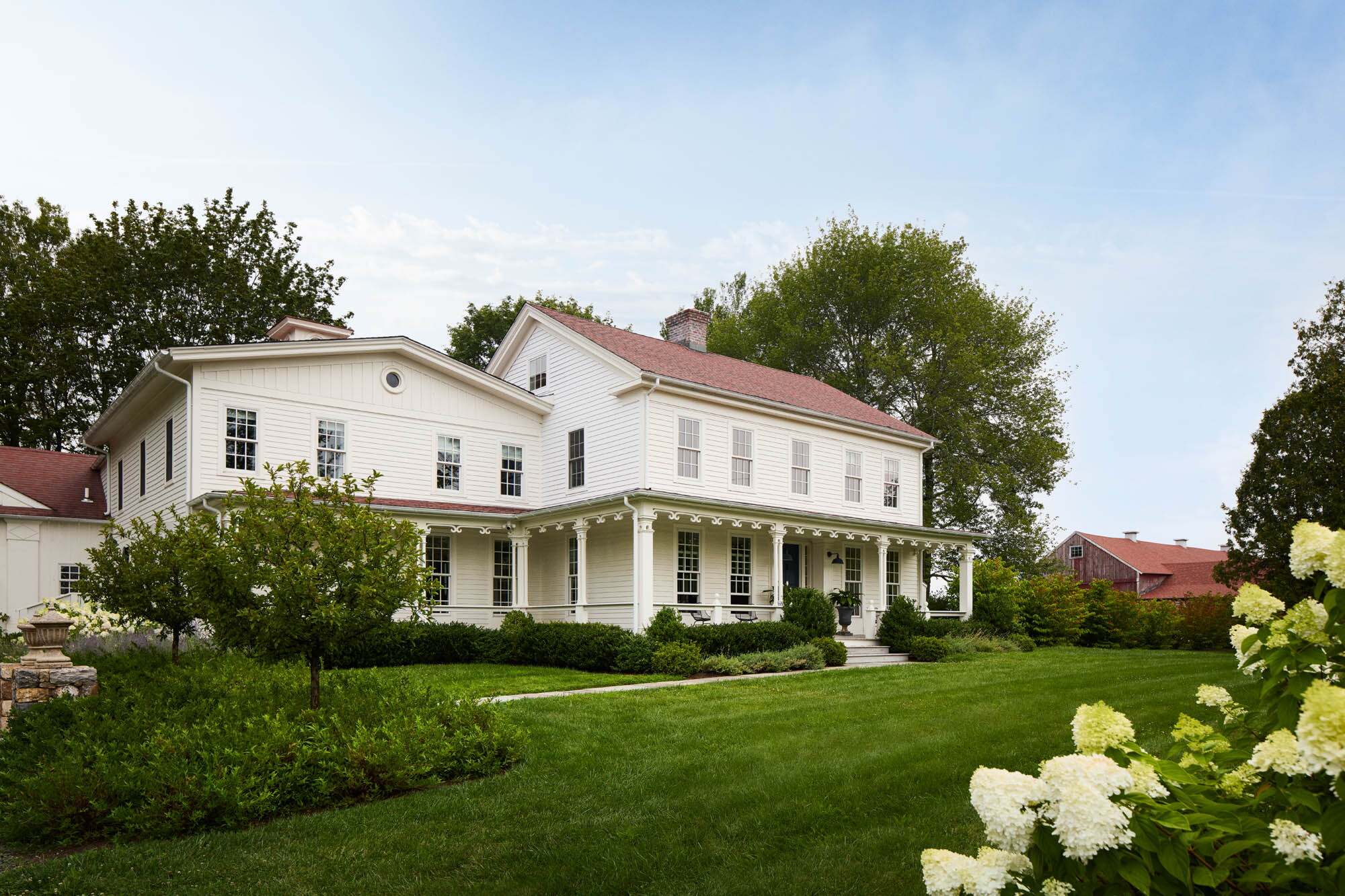
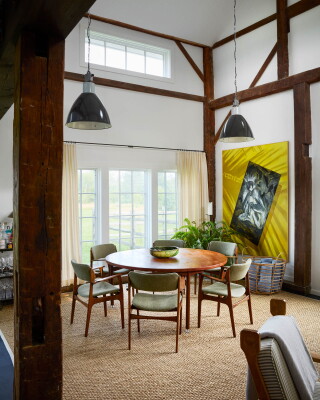
Friedman describes the Connecticut house as “a rambling-over-the-centuries kind of story,” in this case one centered on an 1850s farmhouse pushed up against an 1870s schoolhouse and later joined, via an alleylike mudroom, to an 1890s tobacco barn. You can barely tell where the three were stitched together thanks to several adept renovations, including this one. Because two of the structures are modestly sized, the rooms often have facing windows, catching the sun as it glides across Stilin’s urbane, lived-in decorating. “It’s a country house that’s not too country,” he observes. “And their taste is definitely masculine, but with a little granny chic mixed in.” Editing the couple’s extensive furniture collection to suit the house became his focus, Stilin says.
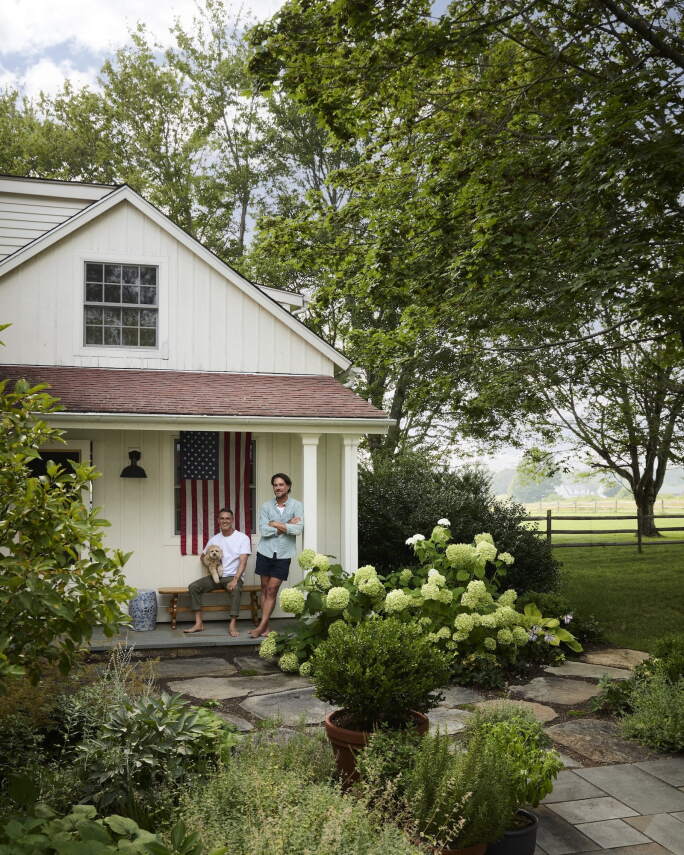
Cristopher Canizares (left) and Dan Friedman on their front porch
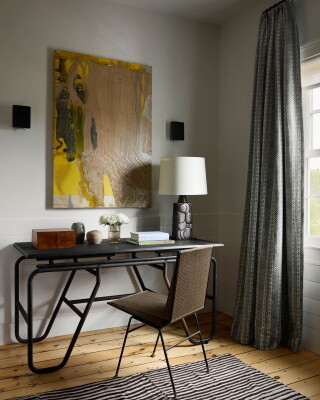
“I think he’s probably underselling his contribution,” Canizares suggests. “Robert made some spectacular and incredibly satisfying additions.” He mentions a French metal desk with grasshopper-style legs from the 1960s, holding its own in a guest room beneath a Frank Bowling painting, and a pair of industrial-style stools pulled up to an oval wine-tasting table in the library. Stilin’s acumen for sourcing vintage factory lighting has blown them away, Friedman adds.
The couple’s own contributions tend toward mid-century European pieces hovering between stylish and practical—appropriate for a farmhouse that sees frequent weekend guests—if not exactly burnished by provenance. “That’s something we’ve learned to appreciate from Robert,” Canizares says. “Beautiful design doesn’t necessarily have to be famous.” Stilin’s grounded approach has gone a long way with the couple, who like to shop the flea markets when they travel to, say, Paris for an art fair. “Cristopher has an addiction to buying furniture there, and at auction,” says Friedman, who’s chosen the garden as his domain. “I’m kind of curious where all of it is living, actually.”
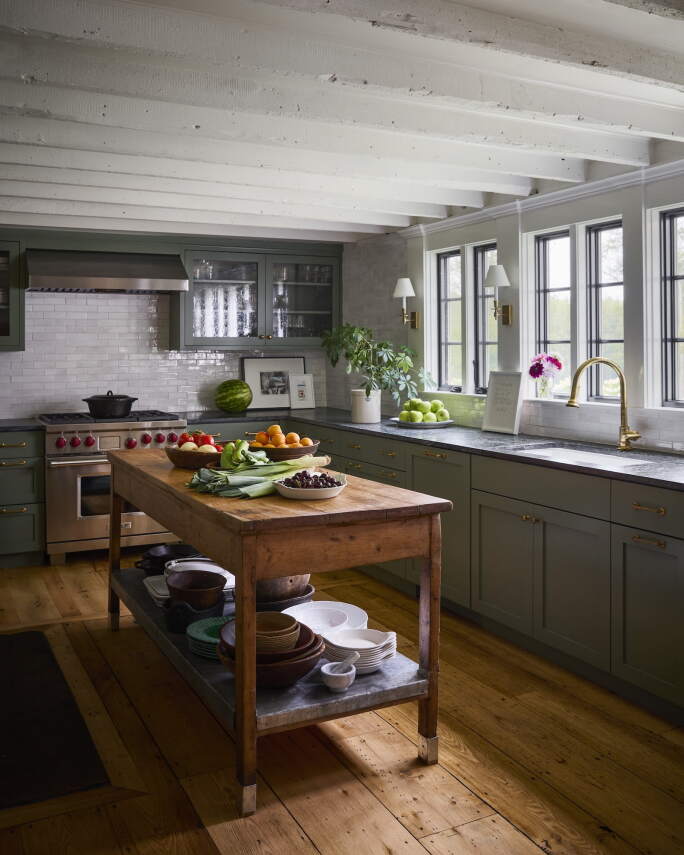
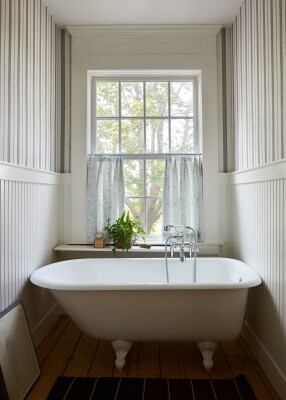
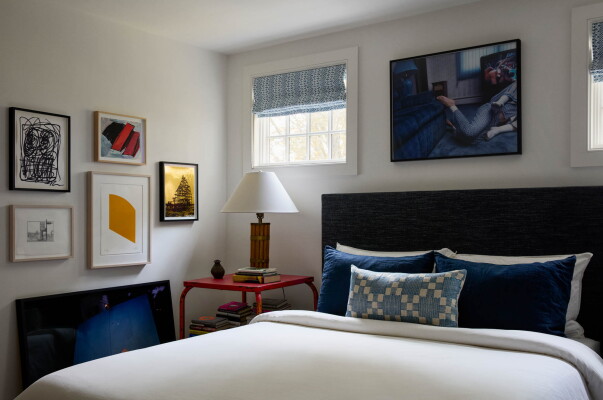
Clockwise from bottom left: Near the staircase, Maia Cruz Palileo’s “Red Camisas,” 2019, is mounted over a 2015 Isa Genzken sculpture titled “Weltempfänger (World Receiver)”; a Jeff Grant drawing on mylar leans against the bathroom wall; fresh produce on the kitchen island; a bedroom with drawings by Rashid Johnson, Phyllida Barlow, Matthew Day Jackson and Peter Cain, a print by Ellsworth Kelly, and photographs by Nan Goldin and Melanie Willhide; Frank Bowling’s “Repose for SO,” 1976, overlooks a desk.
“There’s always an opportunity to own things that are not on view,” Canizares jokes. He’s been in the art business since high school, joining Hauser & Wirth in 2010 after a decade at Matthew Marks and Richard Gray and progressing to partner there before leaving last spring.
“I’ve always found working with artists on long-term career development to be the most gratifying part of my job,” Canizares says. However, fitting in those searching, ongoing conversations alongside more immediate gallery priorities proved next to impossible. “So I decided that now, a quarter-century into my career, seemed like a good time to rebalance.”
Artists’ representatives have existed in one guise or another for decades now, but lately a number of upstart agencies have been looking towards the film, fashion and sports ecosystems for new business models and revenue streams—from collaborations, sponsorships and brand partnerships to anything else an artist might dream up at 4 a.m.
“Those are valuable tools to have in one’s toolbox,” Canizares says. “But my approach is probably much more consistent with the orthodoxy of the way that artists’ careers develop. I think the main business of an artist is to make art. And most of the artists I know want to be in the studio.” He’s taking on the fundamentals, he says; unsexy but essential things such as coordinating international gallery representation, strengthening institutional relationships, building a publishing program and establishing a legacy plan, whether that takes the form of a foundation or something else. Less Hollywood-style deal-brokering, then, more everyday career management.
Agencies like his, Canizares believes, are cracking open new opportunities not just for artists but also for galleries, “who have a million different things on their plate,” he says. “This is a chance for the art world to embrace a more advanced level of specialization.” And maybe a chance for one of its own to shape a new vision of the future, starting from his Connecticut kitchen table.