I n the often codified world of bibliophily, Georgette Salles stands apart. An unconventional collector, she was guided by a single principle: personal pleasure. “I am a housewife,” she once quipped to an overly inquisitive bookseller, playfully asserting her independence from established circles. Her collection reflects this rare freedom.
Georgette Salles, Bibliophile
A passionate reader and discerning amateur of illustrated books -Picasso and Derain among them - Georgette Salles was equally drawn to the art of bookbinding. As a result, her library brings together many of the foremost binders of the 20th century, from Pierre Legrain to Jean de Gonet, alongside Pierre-Lucien Martin, Monique Mathieu, and Paul Bonet. Paradoxically, the most significant work in the collection remains unbound: La Prose du Transsibérien, preserved in a cover enriched with an original painting by Sonia Delaunay.
Illustrated Books, Drawings and Manuscripts
The most important work in the collection remains La Prose du Transsibérien by Sonia Delaunay and Blaise Cendrars, preserved in its original painted parchment cover, an artwork in its own right. Other major illustrated works include L’Enchanteur pourrissant (Derain), Parallèlement (Bonnard), Les Murs (Dubuffet), and Picasso’s Le Miroir du Merveilleux and Les Yeux fertiles.
Several volumes are further distinguished by original works on paper. Particularly noteworthy is the exceptional drawing by Picasso for Dora Maar. Jouve’s striking panther served as the model for a binding by Gruel, while a gouache by Schmied enriches a superb copy of the Song of Songs bound by Pierre Legrain. Additional works feature drawings by Geneviève Asse, Bellmer, Bissière, Fautrier, and Valentine Hugo. Among the René Char holdings, two original manuscripts, L’Âge cassant and L’Effroi la joie stand out. In another register, Simone de Beauvoir’s 1959 manuscript on Brigitte Bardot represents one of her most widely recognised feminist texts. The collection also includes entirely handwritten works, such as Éluard’s Blason des fleurs et fruits, produced in just fifteen copies.
Read LessJean de Gonet
Among contemporary binders, Jean de Gonet stands as both the most celebrated and the most innovative, having profoundly redefined the practice of bookbinding. He is also the most extensively represented in the Salles library. Beyond acquiring works already bound by him, Georgette Salles entrusted him with numerous volumes in their original state.
Nearly fifty bindings illustrate the full breadth of his practice, reflecting a close and enduring relationship. From early lettrist works to more recent creations, the collection encompasses an exceptional diversity of techniques and materials: monotype-decorated bindings, painted surfaces, wooden structures as well as bindings incorporating unconventional elements, including animal hair. His Révorim bindings are also well represented, embodying his research into more accessible materials, whether in unique works or series. He likewise produced bindings in series for publishers.
Read LessDistinguished Provenance
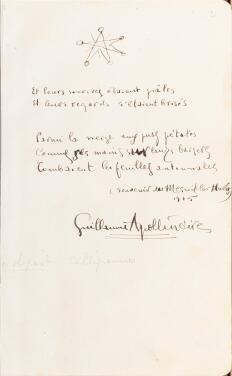
A discerning bibliophile, Georgette Salles attached equal importance to content, form, and provenance. Many works in the collection are distinguished by prestigious ownership or significant inscriptions. Highlights include the deluxe copy of Calligrammes from Jacques Guérin’s collection, enriched with an autograph poem by Apollinaire; the copy of Œillades ciselées en branche from Max Ernst and Leonora Carrington; the Barthou copy of Parallèlement bound by Séguy; and René Char’s Artine, inscribed to Nusch Éluard. The celebrated Prose du Transsibérien from the Matarasso library is also present, alongside Éluard’s annotated copy of Poésie ininterrompue.
Several works originate from the library of Dora Maar, notably an exceptional copy of La Chèvre-feuille accompanied by a large original Picasso drawing, as well as Non vouloir illustrated by Miró and Les Yeux fertiles. Additional provenances include the collections of Henri Paricaud, Jean-Pierre Guillaume, Jean Hugues, and Daniel Filipacchi.
Read LessInnovative and Unusual Bindings
If artistic bookbinding emerged in the 19th century, it was in the 20th century that it reached its full expressive potential. Technical innovation expanded dramatically, embracing materials such as cloisonné enamel, shagreen, ray, shark and reptile skins, as well as wood, metal, plastic, and plexiglass. These bindings reflect the broader artistic movements of their time. A copy of Philippe Burty’s Émaux cloisonnés is preserved in a striking Japonist binding by Charles Meunier, incorporating cloisonné enamels. Jean de Gonet, in turn, adapts seamlessly to the triangular format of Samuel Beckett’s Four Songs.
The range of materials is equally remarkable: straw marquetry in Dix filles dans un pré illustrated by Marie Laurencin; polycarbonate, explored with ingenuity by the binder Frère Claes; Altuglas favoured by Henri Mercher; alongside the diverse woods and experimental materials employed by Jean de Gonet.
Among the most singular examples is the audacious binding by Knoderer for Michaux’s Affrontements, evoking the form of a revolver, a work Georgette Salles herself wryly described as one “you would have to be mad to acquire.”
Read LessEarly Bindings: 17th to 19th Century
While the collection places particular emphasis on 20th and 21st century bindings, Georgette Salles’ curiosity naturally extended to earlier periods. A notable example is a superb copy of the third volume of Blaeu’s Cités italiennes (1663), devoted to the kingdoms of Naples and Sicily, with finely hand-coloured plates. Its ivory vellum binding, richly gilt, stands as an exceptional example of 17th-century Dutch craftsmanship.
The following centuries are represented by leading figures in French bookbinding, including Bozerian, Bradel, Simier, and Thouvenin. Among the highlights are La Grammaire des grammaires, bound by Bradel for the Duchess of Berry, one of the most celebrated bibliophiles of the 19th century, and a refined copy of the first edition of Chateaubriand’s Martyrs, enriched with wash drawings by Desenne and elegantly bound by Thouvenin. Two “cathedral” bindings - one by Purgold, the other attributed to Thouvenin - further illustrate the troubadour aesthetic of the early 19th century. A richly gilt binding by Simier adorns a fine copy of Paul et Virginie, a landmark of Romantic illustration.
Read Less