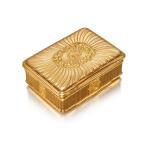
A Queen Ann silver sugar box , Pierre Platel, London, 1713
No reserve
Auction Closed
November 6, 07:36 PM GMT
Estimate
6,000 - 8,000 EUR
Lot Details
Description
octagonal with a molded border, body and cover engraved with a crest, with a baluster finial, engraved with scratch-weight '19-3' underneath, fully marked
13cm, 5 ⅛in. long
578gr., 18½oz
Presumably Matthew Forde (1675-1729) of Seaforde, co. Down and Coolgreany, co. Wexford,
Christie's, London, 11 July 1990, lot 194,
Christie's, London, 7 July 2016, lot 319
The crest is that of Forde of Seaforde, presumably for Mathew Forde (1675-1729) of Seaforde, co. Down and Coolgreany, co. Wexford.
Mathew Forde (1675-1729)
Mathew Forde of Seaforde, co. Down and Coolgreany, co. Wexford, was the son of Mathew Forde (d.1709) of Coolgreany, M.P. for Wexford. Through his mother he was related to the Earls of Abercorn and the Dukes of Ormonde. The family had settled in Ireland in the late 16th century having originated from Wales. The estates of Seaforde and Coolgreany entered the family’s possession in 1637. Mathew (d.1729) succeeded his father, having married Anne, daughter of William Brownlow of Lurgan in 1698. He served as M.P. for Downpatrick from 1703 until 1714. It was Mathew who built the family seat at Seaforde, which was remodelled in the early 19th century.
Pierre Platel (c.1664-1719)
One of the most celebrated Huguenot silversmiths, Pierre Platel came to England in 1688 as part of the Protestant exodus from France caused by King Louis XIV's revocation of the Edit of Nantes in 1685. He travelled from his home in Lorraine via Lille to Flanders accompanied by his father Jean-Baptiste Bertrand Platel du Plateau and his brother Claude.
They arrived in England by 1688 as part of the entourage of William of Orange. They took out letters of denization in 1697. This process, which by swearing allegiance to the crown and on payment of a fee, gave them the right to remain in the country and to own property. Pierre was made free by redemption by order of the Court of Alderman in June 1699 and in the same month registered his first maker's mark with the Goldsmiths' Company.
Although his career was not long he produced many of the most impressive and finely worked pieces of the time. Much of his work was for aristocratic families closely associated to King William III. For the Duke of Portland, he supplied a magnificent toilet service and for the 1st Duke of Devonshire a gold ewer and basin in 1701.
He is remembered for having been the master of Paul de Lamerie, the most celebrated London silversmith of the 18th century. The renowned early 20th century silver academic P. A. S. Phillips credits Platel as the 'great craftsman that Paul de Lamerie owed all his knowledge of his trade', (Paul de Lamerie, His Life and Work, London, 1935, p.15). Phillips comments that Platel 'could not have been a better teacher', which 'can be incontrovertibly shown by the existing beautiful examples of the goldsmith's art that came from Platel's workshop'. Phillips further cites Platel's work as evidence for his skills as a great craftsman with 'a profound knowledge of the medium in which he worked'. He called him 'a superb artist'. In relation to his celebrated apprentice, he writes 'Platel's beauty of line and delicacy of detail, and his finish in execution, were, in all instances I can recall, beyond cavil, and it is no wonder that, under such a master, Paul de Lamerie gained a complete understanding and appreciation of the art in which later years he was to excel'. The 'beauty of line and delicacy of detail' are clearly visible in the architectural form of the Forde sugar box and the exceptional gauge of the silver.
You May Also Like