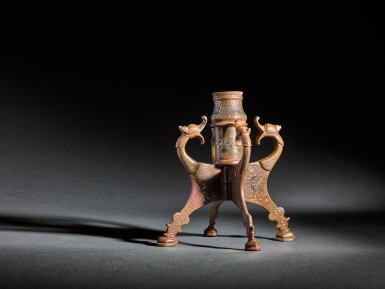
A gold and silver-inlaid bronze portable candlestick, probably Mosul, Mesopotamia, 13th century
Auction Closed
October 25, 04:59 PM GMT
Estimate
60,000 - 80,000 GBP
Lot Details
Description
in three parts, the legs with dragon head terminals and hoof feet, with central panels inlaid with standing figures and arabesques, the neck inlaid with a band of arabesques flanked above and below by a plaited frieze, the mouth inlaid in gold with an inscription in naskh on a ground of arabesques
20.6cm. height
inscriptions:
… muluk al-quzat wa al-[hukkam] fakhr al-millah wa al-[d]in muhammad … al-qazwini
'… of the kings of judges and [governors] Fakhr al-Milla wa al-Din Muhammad … al-Qazwini’
The unusual form of this rare candlestick finds a parallel in one published example from the fourteenth or fifteenth century in the Türk ve Islam Müsezi, Istanbul (inv. no.4017, Roxburgh 2005, pp.125 and 396, no.75). Cast in three separate parts, the candlestick is intended to be portable, allowing the user the disassemble and reassemble it for easy transportation.
During the thirteenth century, Mosul was first under the control of the Ayyubids, followed by the Ilkhanids until 1262 when it fell to the Mongols. Visual arts surviving from the thirteenth century demonstrate the high quality of Mesopotamian metalwork production and the persisting concern for objects that were both opulent and functional (Carboni and Adamjee 2003). Some items were intended as palace furnishings, while others, such as this candlestick, were produced for the luxurious tents during periods of travel.
The form of this candlestick is inherently functional, but the artist has taken great care to decorate it elaborately with silver inlay. The courtly imagery displayed on the body of the candlestick relates to the decorative repertoire of Mosul metalwork that followed on from the Ayyubid tradition of the first half of the century. Similar standing courtly figures inlaid atop a ground of scrolls are found in the form of a figural frieze adorning a thirteenth century tray in the Cleveland Museum of Art (inv. no.1945.386). The figures on the Cleveland tray are similarly formed to those of this candlestick with many positioned with one leg raised and the foot slightly pointed. A Mosul incense burner in the Khalili collection is decorated with comparably formed figures and stands on three pronounced feet. Similar to the present lot, the feet are formed with a pronounced ridge around the base and a further ridge around the ankle (inv. no.MTW 1663, Spink 2022, p.725, no.515).
The Mongols captured Mosul in 1262 but the conquest did not prevent the flourishing artistic milieu from continuing and Mosul remained a centre of high-quality metalwork into the fourteenth century. The Mongols were known for the portable means in which they demonstrated their wealth and status, through luxurious garments and portable objects. It is possible that this candlestick was produced in the period following the Mongol conquest of Mosul and was made in response to their nomadic way of life.
The Mongols in particular incorporated motifs derived from the Chinese artistic tradition into their own decorative repertoire as a result of their numerous conquests and the subsequent resettlement of artists. Motifs such as dragons, cloud bands, lotuses and peonies feature heavily in their artistic tradition and it is likely that the dragon heads on this candlestick are related to the inspiration the Mongols took from Chinese artists. In the entry for the candlestick in the Türk ve Islam Müsezi mentioned above, which has similarly arranged dragon heads framing the mouth, the dragons are said to portray the creatures swallowing the dark moon and bringing with them sun, light and fertility (Roxburgh 2005, pp.125 and 396, no.75).
You May Also Like