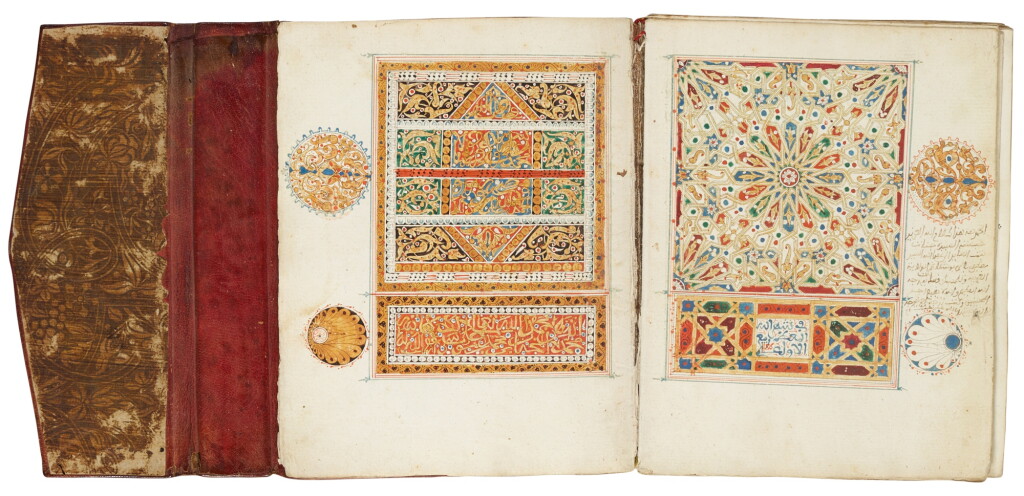
An illuminated Qur'an, North Africa, Algeria, dated Rabi' al-Awwal 1188 AH/May-June 1774 AD
Auction Closed
October 25, 04:59 PM GMT
Estimate
50,000 - 70,000 GBP
Lot Details
Description
Arabic manuscript on paper, 188 leaves, plus 6 fly-leaves, 21 lines to the page written in Maghribi in black ink, keywords and phrases picked out in red, blue, green and yellow and in larger script, ruled in red and blue, verses separated by polychrome florets, surah headings in large cursive or ornamental Kufic with marginal medallions, further text divisions marked by a variety of polychrome marginal medallions, double-page illuminated frontispiece and finispiece with colophon, signed and dated, a further illuminated page within the text, in brown leather binding, with flap, floral paper doublures, in brown leather case
text panel: 17 by 12.8cm.
leaf: 24.2 by 18.6cm.
Ex-private collection, Bonn.
A note in the upper margin of the opening bifolio written by Ahmad ibn al-Tunisi in 1188 AH, the year the Qur’an was completed, states that the Qur’an was endowed by al-Sayyida Jannat, daughter of al-Sayyid Mustafa Bay Bushlaghim. Mustapha Bouchelaghem, known as Bey Bouchelaghem, was elected as Bey of the Western Beylik in 1686.
The endowment note allows us to situate the production of this manuscript within Algeria. The manuscript is elaborately decorated with double page illuminated frontispiece and finispiece, illuminated surah headings of diverse styles and a rich variety of verse markers. The elegant Maghribi script is aligned with the extensive decorative scheme with key sections of the text picked out in multi-coloured ink of various sizes. The distinct form of floriated Kufic used in several of the surah headings, where the gaps between letters have been carefully filled in polychrome, recalls the illumination of a sixteenth century Moroccan Qur’an produced for the Sharifian Sultan of Morocco, Mawlay ‘Abdallah ibn Muhammad, now in the British Library (inv. no.1405, Blair 2008, p.67, fig.5.6). The similarities indicate the persisting styles in North African manuscript production which remained clearly linked to the earlier tradition. However, the interpretation is less formalised and demonstrates a considerably more polychromatic interpretation than their predecessors. It is fitting that a manuscript of this quality, extensively illuminated throughout, would have been owned by the daughter of the Bey.
You May Also Like