Property of a New York Collector
Adams, John | "A more disagreable Situation than mine no Man ever held in Life"
Lot Closed
July 20, 07:28 PM GMT
Estimate
40,000 - 60,000 USD
Lot Details
Description
Property of a New York Collector
Adams, John
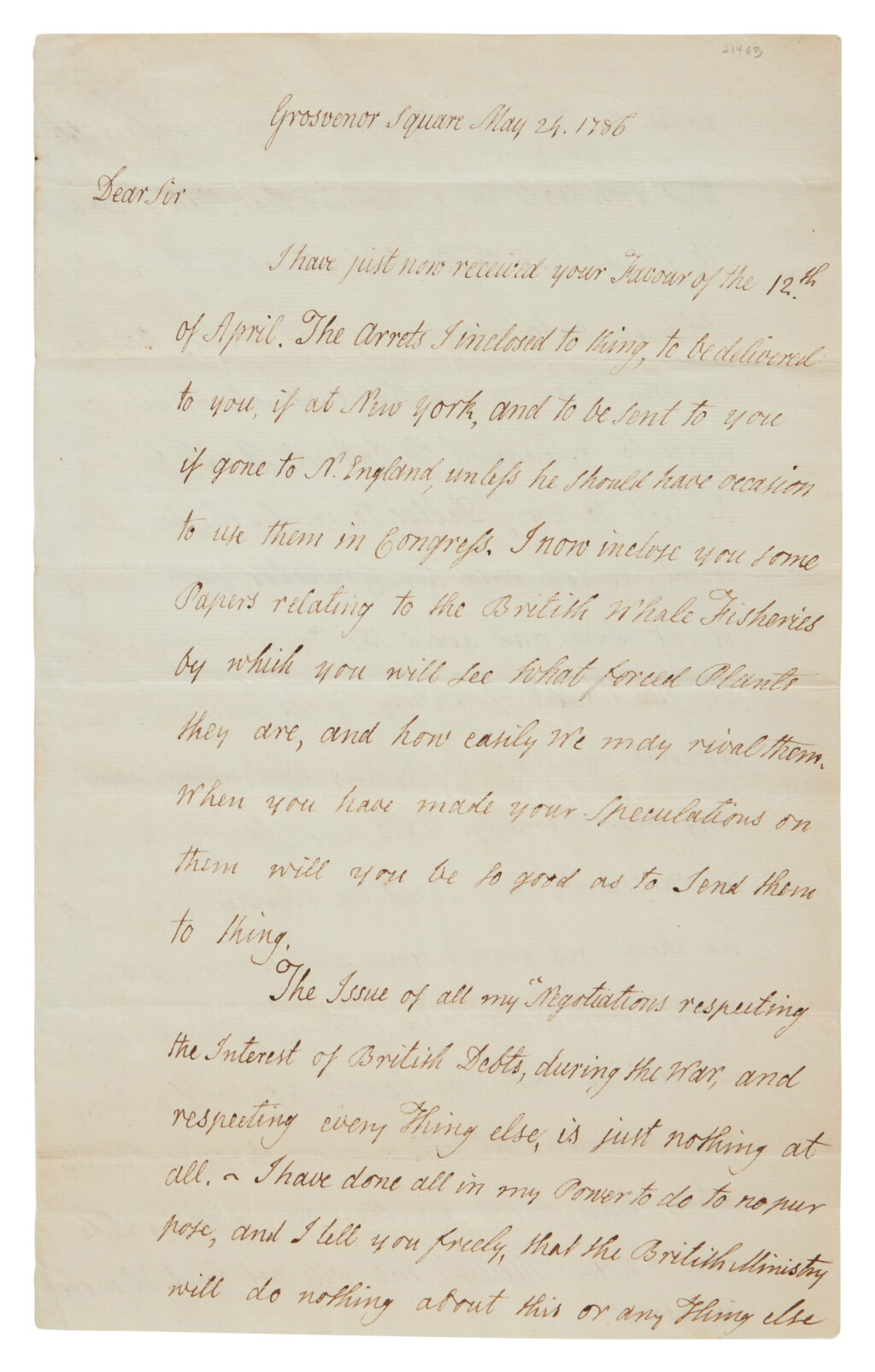
Autograph letter signed ("John Adams") as first United States Minister to Great Britain, to Elbridge Gerry, expressing his frustrations in representing America's interests under the Articles of Confederation
4 pages (325 x 202 mm) on a bifolium (watermarked C Taylor | seated Liberty), Grosvenor Square, written in a fine, unusually large hand, London, 24 May 1786, reception docket in margin of final page ("London Lettr | His Excy. Mr Adams | 24 May 1786"); separated at central fold, light discoloration at a few fold creases, short marginal separations and repair at one fold crease.
"A more disagreable Situation than mine no Man ever held in Life and whoever succeeds me, will not find it more pleasant." Adams vents to one of his closest political allies, Elbridge Gerry, a fellow signer of the Declaration of Independence from Massachusetts, about his inability to successfully negoiate a commercial treaty with the British ministry because the not-fully-united states were not strong enough to support their own credit and regulate their own trade. In a foreshadowing of his celebrated 1787 attack on the Articles of Confederation, Defence of the Constitutions of Government of the United States of America—which was prompted by the ineffectual confederated response to Shays' Rebellion—Adams here analyses the weaknesses of the American financial system under the Articles.
After a preliminary summary of arrêts and other enclosures sent by Adams to Rufus King and Gerry, the main theme of the letter—the shortcomings of the American financial system—is introduced with a phrase quoted from Gerry's 12 April 1786 letter to Adams: "The issue of all my 'Negotiations respecting the Interest of British Debts,['] during the War, and respecting every Thing else, is just nothing at all.—I have done all in my Power to do to no purpose, and I tell you freely, that the British Ministry will do nothing about this or any Thing else until the States Shall Support their Credit, and regulate their own trade, in a manner that shall shew them that it is not left to British Merchants and Politicians to manage as they please. Nor then in my opinion will they ever intermeddle, or agree to relinquish the Interest. It will finally be left to every Debtor to make the best agreement he can with his Creditor, or to dispute it at Law, and avoid the Payment of the Interest by the Verdict of a Jury. If the juries give it against our Merchants, they will never find any other Remedy. As to any Clamour that may be raised by my concealed competitors, it will do them no good nor me any harm, if they want my Place, and Congress give it them it will be with my hearty consent, without any Clamour at all. A more disagreable Situation than mine no Man ever held in Life and whoever succeeds me, will not find it more pleasant."
Adams next turns to his critics in Congress, confidently, even eagerly, offering to step aside if anyone cares to replace him and comparing his lot to the Israelite slaves laboring on the pyramids: "If any one thinks he can do better in mercy, let him put up, and if anybody thinks of any other who can do more let him vote for him in the name of freedom. Old as I am, I had rather draw Writs and Pleas in abatement than do suffer what is now my Lot. Making brick without Straw, which has been my Employment ever since I have been in Europe, and is more so now than ever, was never reckoned an easy, or pleasant Task, from the Days of the Israelites in Egypt to this moment. Untill I came to England I was as little apprised as you of the Extent of this evil of Interest. It was too carefully concealed, by American Debtors, until it was past a Remedy. The time is long since perfectly past, for doing any Thing in the Country, and another opportunity will never arrive, until after a long and arduous Struggle."
The letter takes a lighter turn, with Adams teasing Gerry and their mutual friend Rufus King for "marrying the two finest Girls in New York"—and he initmates that their wealthy wives have put Gerry and King "in a way to make fœderal Ideas, grow, and may they prosper untill Congress shall have the Power and the Will, to form a System, which shall bring this Country to think." Gerry and King would, in fact, both attend the Constitutional Convention in Philadelphia the following summer, the product of which would replace the Articles as the governing charter of the United States. (Gerry, however, declined to sign the Constitution.)
But Adams's darker humor returns, and he ends the letter by railing against the futility of his efforts because of the weakness of the Articles of Confederation. His final phrase reiterates that he is fully willing to quit his position: "You may depend upon it every Man who expects any Thing from my Negotiations will be disappointed. I am not an Idler. My whole Time is employed to the utmost of my Strength and Capacity, and to no more purpose, than if I were at Horse Races or State Plays, and this will assuredly continue to be the Case, until the Trade and Revennue of the Country shall be made to feel the Effect of the Conduct of Congress and the States in regulating their Trade..— if it is not thought worth while to continue me here, untill that Event takes Place, I am myself fully to that mind, and am quite prepared to be recalled."
REFERENCE:
Papers of John Adams, ed. Lint, et. al, 18:308–310
PROVENANCE:
Christie's New York, 3 December 2007, lot 95 (Property of a Private Collector)
You May Also Like
![Darwin and Wallace | On the Tendency of Species to form Varieties ... [1858–1859], in: Journal of the Proceedings of the Linnean Society, Vol. III, No. 9., 1859, Darwin announces the theory of natural selection](https://sothebys-md.brightspotcdn.com/dims4/default/0ae5d5e/2147483647/strip/true/crop/2000x2000+0+0/resize/150x150!/quality/90/?url=http%3A%2F%2Fsothebys-brightspot.s3.amazonaws.com%2Fmedia-desk%2Fwebnative%2Fimages%2F18%2F98%2Fd0ba6d9f4fada55611b512c2635f%2Fn12451-bkh45-t1-01.jpg)

![Kepler, Johannes | Harmonices Mundi Libri V, Linz, 1619, first edition, [bound with:] Prodomus dissertationum cosmographicum …, Frankfurt, 1621–1622](https://sothebys-md.brightspotcdn.com/dims4/default/d54d010/2147483647/strip/true/crop/2000x2000+0+0/resize/150x150!/quality/90/?url=http%3A%2F%2Fsothebys-brightspot.s3.amazonaws.com%2Fmedia-desk%2Fwebnative%2Fimages%2F63%2F0b%2Fa27794664ee78085e15afe3c5535%2Fn12451-58tmv-t1-05.jpg)

![Pliny, the Elder | Historia naturalis [Italian], Venice, 12 September 1489](https://sothebys-md.brightspotcdn.com/dims4/default/9db2168/2147483647/strip/true/crop/2000x2000+0+0/resize/150x150!/quality/90/?url=http%3A%2F%2Fsothebys-brightspot.s3.amazonaws.com%2Fmedia-desk%2Fwebnative%2Fimages%2F7e%2F0c%2Fa8f2c8eb4fe384efbf7f5fb1128c%2Fn12451-b8s5d-t2-02.jpg)