
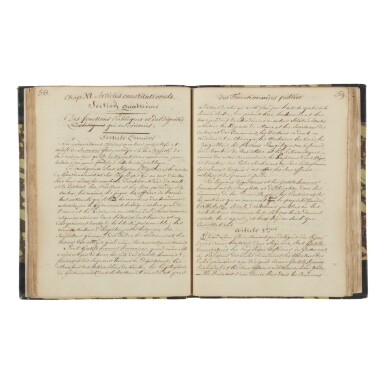
DuPont de Nemours, Pierre Samuel | A "lost" manuscript on constitutional theory, sent to Thomas Jefferson for review
Auction Closed
April 14, 05:34 PM GMT
Estimate
20,000 - 30,000 USD
Lot Details
Description
DuPont de Nemours, Pierre Samuel
"[Mémoire] aux républiques équinoxiales, et a celles qui leur seront naturellement conféderées"
Manuscript treatise on government, in French, 153 pages (256 x 200 mm) with original manuscript pagination (1–138) of main text in manuscript, which is preceded by a dedicatory epistle to Manuel Palacios-Fajardo and followed by an index, written in several clerical hands, colophon dated with autograph signature, "Paris 13 Mars 1815. DuPont (de Nemours)," numerous emendations and corrections; lightly browned, bit of foxing. Original plain brown wrappers bound into later nineteenth-century half green morocco over marbled boards, gilt morocco label on front board, binder's ticket of "J.T. Heald, 127 Market Street, Wilmington, Delaware"; extremities rubbed. Half blue morocco slipcase gilt, chemise.
An important manuscript treatise on constitutional theory, and a proposed system of government for the new republics emerging from the independence movements of South America, by French-American writer, economist, publisher, government official, and aristocrat Pierre Samuel DuPont de Nemours. DuPont wrote numerous influential treatises on political and economic theory. This, his last major work, was never published and evidently only survives in the present manuscript. This is almost certainly the manuscript DuPont loaned to Thomas Jefferson for his comments and advice in the spring of 1816. This particular manuscript represents a second (or possibly third) authorial recension of the text of Républiques équinoxiales. This is evidenced not only by the frequent revisions and corrections throughout, but also by a statement DuPont makes in the manuscript’s prefatory letter to Don Manuel Palacios, wherein he remarks on the superiority of this present state of the text: "J’ignore si la premiere copie du Memoire ici joint a pu vous parvenir, et je vous envoie une seconde en peu corrigee."
DuPont first came to prominence with his major economic treatise, Physiocratie, ou, Constitution naturelle du gouvernement le plus avantageux au genre humain, written in 1768, in which he coined the term "physiocracy." He went on to become an economic advisor to Jacques Necker and King Louis XVI, serving as Inspector General of Commerce. Although he initially supported the French Revolution with other moderates like Lafayette, he soon became its victim, and was awaiting execution in 1794 when the Terror ended with the downfall of Robespierre. Still at odds with the French government, he emigrated to the United States in 1799 with his son, Eleuthere Irenee DuPont, who there founded E.I. DuPont de Nemours & Co., creating one of the great family dynasties in America.
Pierre Samuel DuPont continued to write important works of political theory, and became a friend and correspondent of many leading figures in the United States, most notably Thomas Jefferson, whom he had first encountered in Paris in the 1780s. Between 1800 and 1817 they exchanged dozens of letters on various topics, including this manuscript. In 1800, at Jefferson’s request, he drew up plans for a national educational system. In 1802 he returned to France, where he was an important promoter of the Louisiana Purchase. He remained in France and took an active part in the restoration of the monarchy in 1814. In the spring of 1815 he fled Paris during Napoleon’s Hundred Days and returned to the United States, where he remained until his death in 1817.
DuPont’s last major work, the Républiques équinoxiales was never published, and until the emergence of this manuscript from the estate of a DuPont descendant, was only known through references in his correspondence, particularly in an exchange of letters he had with Thomas Jefferson in 1815 and 1816. In December 1815, DuPont visited Monticello and left a manuscript of the Républiques équinoxiales with Jefferson for his perusal. DuPont had asked Jefferson on several earlier occasions to proofread and critique his latest writings, but only shortly after its dispatch, he asked Jefferson to return the manuscript, so that it could be given to Don Pedro Gual, a representative of New Granada. By early spring 1816, DuPont had returned the manuscript to Jefferson. Jefferson evidently sent the manuscript back to DuPont with a lengthy letter of 24 April 1816 that praised the work while maintaining that the author's proposed "Constitution for your Equinoctial republics" would not work in the United States.
The overall scope and narrative content of this newly rediscovered manuscript demonstrate that it must be the formerly “lost” treatise. It is clear that the chapter headings in the present copy (as outlined below) conform to DuPont’s more general interests and views on agriculture, economics, constitutional theory, and anthropology; these were themes which he discussed with an unwavering consistency throughout his other works.
The body of the manuscript consists of sixteen chapters (several having complex groupings of subsections). The chapter headings are as follows: 1) "Objet et motifs de cet ouvrage"; 2) "Apperçu général"; 3) "Principes de la société"; 4) "Application de ces principes aux nouvelles républiques américaines"; 5) "Des mâitres et des esclaves"; 6) "Des engagés pour dettes"; 7) "Avantages de la liberation des esclaves"; 8) "Dignité et droits des propriétaires des terres et de mines"; 9) "Obligations attachées a la haute dignité des propriétaires des terres"; 10) "Principes des finances"; 11) "Des rapports entre les différentes classes d’hommes et de citoyens—articles de la constitution"; 12) "Hierarchie des administrations publiques inférieures"; 13) "De la représentation nationale"; 14) "De quelques institutions nécessaires"; 15) "De la grande confédération américaine"; 16) "Résumé de ce travail."
A monumental political work by the progenitor of the DuPont family, a work thought lost for almost 200 years.
PROVENANCE
Fanny E. duPont (signature on front flyleaf) — Alexis & Elizabeth duPont (armorial bookplate) — A. G. Dupont (signature on front blank) — presumably continued descent in the family until sold at Freeman's, 22 October 2015, lot 210
REFERENCE
Celebration of My Country 160; cf. Gilbert Chinard, The Correspondence of Jefferson and DuPont de Nemours (Paris, 1931) and The Papers of Thomas Jefferson, Retirement Series, vols. 8–10, passim
You May Also Like
![(Hamilton, Alexander, James Madison, and John Jay) | Bushrod Washington's Federalist, praised by George Washington as a "work [that] will merit the notice of Posterity"](https://dam.sothebys.com/dam/image/lot/8ec02b17-38b4-4269-8039-d4830cd55431/primary/extra_small)


