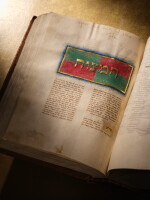
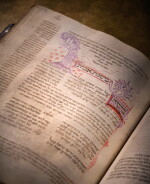
Vitruvius, De architectura libri decem, Venice, 1496, contemporary calf over wooden boards
Auction Closed
July 9, 02:57 PM GMT
Estimate
80,000 - 100,000 GBP
Lot Details
Description
Vitruvius Pollio, Marcus. Hoc in volumine haec opera continentur. L. Vitruvii Pollionis de Architectura libri decem. Sexti Iulii Frontini de Aquaeductibus liber unus. Angeli policiani opusculum: quod Panepistemon inscribitur. Angeli Policiani in priora analytica praelectio. Cui titulus est Lamia. Venice: [Christophorus de Pensis, de Mandello], 13 November 1495
Second edition. Vitruvius’ De architectura holds the distinction of being the only surviving architectural treatise from antiquity, whose influence on architectural theory and practice across Renaissance Europe is immense. The treatise provides a codified body of theoretical terms, underpinned by the principle of proportion, as modelled in an ideal form by the dimensions of the human body. With the first edition appearing in 1486 or 1487, it was not quite the first architectural treatise to be printed in Europe; that distinction is instead held by Alberti’s De re aedificatoria of 1486, though Alberti’s work emulates Vitruvius’ ten book structure, and is built on a foundation of Vitruvian principles. (For editions of Alberti’s treatise, see lots 424, 426, 427, 429, 430-432). Editions of Vitruvius are “among the earliest fully illustrated printed books” (Hart and Ricks, Paper Palaces). The earliest editions only include text, but the first fully illustrated edition appeared in Venice in 1511 (lot 642).
The present copy is a second edition, with the text based upon that of the first edition, with revisions according to the consultation of at least one manuscript of Vitruvius by an anonymous editor. "A curiosity in the bibliography of this edition is that there are two colophons, that on the final page of De architectura dated Florence, 1496, and at the end of the Panepistemon dated Venice, 13 November 1495" (BAL RIBA).
Folio (317 x 213 mm). Roman type, 43 lines plus headline. collation: π2 A-I6 K-L4 a-b6 aa6 bb4: 86 leaves. 2 woodcut diagrams and 4 small geometrical figures. (Wormed at beginning and end, dampstaining at foredge, heavier on title-page and following leaves).
binding: Contemporary ?Northern Italian brown calf over wooden boards (328 x 225 mm), two concentric panels formed from repeated blind-tooled stamps, remains of 4 clasps, spine with later vellum covering, plain edges, in a modern brown cloth drop-backed folding box. (Binding somewhat wormed, joints cracked, a few areas of loss, metal centrepieces removed, later pastedowns; otherwise a completely unsophisticated copy.)
provenance: "Doppio" (duplicate), lettered in manuscript at head of upper cover — German bookseller's price code, circa 1900-1930 — W. Gedney Beatty (1869-1941, of New York, American architect, brother of Alfred Chester Beatty, and collector of Renaissance books on architecture as well as Greek, Etruscan, and Roman engraved gems, who bequeathed his collections to the Metropolitan Museum of Art, his books to the Department of Prints, 1941) — Metropolitan Museum of Art, bequest bookplate with duplicate stamp, sale, Christie's New York, 3 December 2007, lot 343, $120,000 hammer, to Lardanchet for — Jacques Bemberg, gilt booklabel, sale, Alde, Paris, 6 March 2014, lot 4. acquisition: Purchased at the preceding sale. references: BAL RIBA 3490; Fowler 391; ISTC iv00307000
You May Also Like