Property from the Collection of Barbara and Brian Wolfowitz
Mano or Dan-Gio Mask, Liberia or Côte d'Ivoire
Auction Closed
December 12, 04:12 PM GMT
Estimate
40,000 - 60,000 EUR
Lot Details
Description
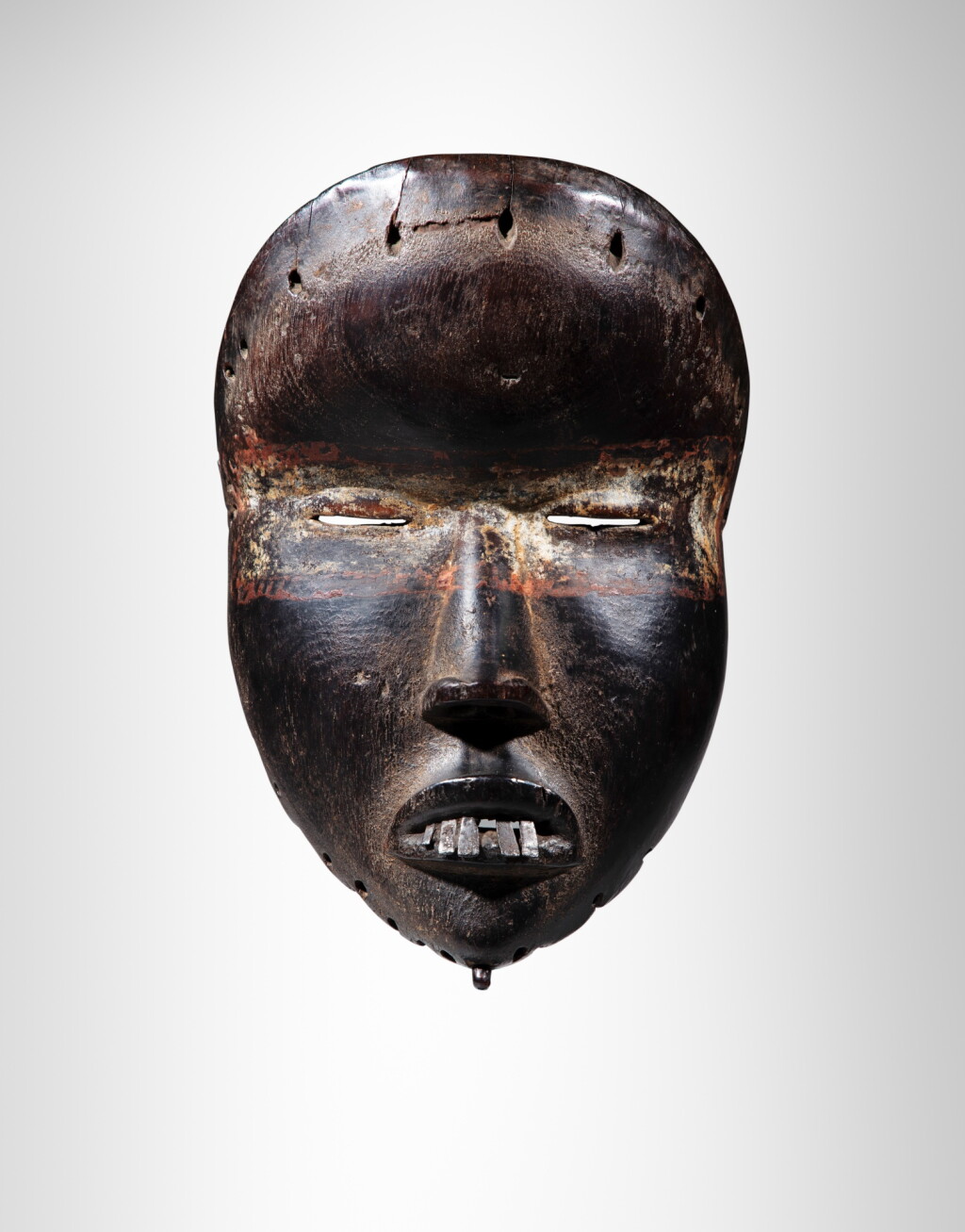
Mano or Dan-Gio Mask, Liberia or Côte d'Ivoire
Height: 8 ⅝ in (22 cm)
Reportedly Pierre Verité, Galerie Carrefour, Paris, 1929
Olivier Le Corneur (1906-1991), Paris, reportedly acquired from the above in 1929
Ben Birillo (1928-2020), New York
Private Collection, Los Angeles, acquired from the above
Sotheby's, New York, Important Tribal Art, November 9, 1993, lot 68, consigned by the above
Barbara and Brian Wolfowitz, acquired at the above auction
By Bertrand Goy
Moving up the Cavally River, from the Guinea Coast to its source, in a vast area that knows no borders, between the Saint John and Sassandra rivers, Côte d'Ivoire, Republic of Guinea and Liberia have always been the stage for spectacular masquerades. Racing masks, dancing masks, wicked masks, angry masks, mendicant masks, vengeful masks... “Some bring peace, others worry”, they take part in all the important events of village society, whether sad or happy, funereal or festive, threatening or peaceful, largely public or strictly private.
While the exact “birthplace” of this mask from the Wolfowitz collection is unknown, we can nevertheless trace its storied life, which started in the hands of Pierre Vérité, who began as a “primitive” art dealer in Montparnasse in the 1920s. Its next owner, Olivier Le Corneur, had a gallery on the boulevard St Germain in the 1950s onwards, and was known for his taste and discernment. The mask was finally acquired by the protégé of the famous Léo Castelli, the painter Ben Birillo, considered to have been one of the proponents of pop art. He was an astute collector of classical African and Oceanic art, sourcing from renowned dealers such as John Klejman.
The pronounced curvature of the mask, the rounded forehead forming a convex angle with the bottom half of the face, the attachment holes for the traditional, plant fiber headdress and possibly cowrie shells, the cylindrical stud on the chin, the metal teeth, the upturned nose, and the wide-set eyes all suggest that this mask was carved by a Liberian Gio or Mano sculptor. With the exception of the missing, protruding ears, this mask meets all the criteria that, according to Dr. Monni Adams, help differentiate a female Mano mask - which she indicates are rarely found in private collections - from that of the Dan of Côte d'Ivoire [1].
A former curator at Harvard's Peabody Museum, Dr. Adams was able to support her theory thanks to the extensive documentation available at the institution, which holds the collection of hundreds of photographs taken in 1929 by missionary and ethnologist George Schwab. Moreover, Dr. Adams would have at her disposition the 247 masks collected by her colleague George Harley, a Methodist missionary who arrived in Liberia in 1925 and lived for 35 years in Ganta, in the Giomano region.
Harley collected several examples similar to the one in the Wolfowitz collection, including one [2] found in Be Town, east of Ganta, which also bears traces of white pigment depicting a sort of band covering the eyes. Vittorio Mangio, an antique dealer in Monrovia in the 1960s, also owned a similar example, which he also attributed to the Mano. It is often unclear what function masks from this culture served as they often donned different roles: for Vittorio Mangio, the mask might have been used to facilitate female fertility; for Harley, its name, “Yei dia” (Laughing all the time), suggests a different use.
Nevertheless, the mask is most likely representing a female subject, judging by the numerous photographs, taken by George Schwab among others, of acrobatic dances in which “snake men” throw a small girl in the air, whose eyes are similarly painted with a white band. However, the choreography performed by the Liberian “snake man” is similar to the “Simbo” dance performed by the Dan of Côte d'Ivoire, the former’s sister culture. Other traces of red pigment around this mask’s eyes do not further confirm the object’s origins as this pigment was commonly used by sculptors in the three bordering countries.
Once again, if the function of this mask remains a mystery, as well as a slight doubt as to its exact origins on either side of the Cavally River, it's clear that this sculpture is of remarkable quality, and that its age is attested to by the brilliant brown patina on its face and the superb lacquer on its reverse.
[1] Adams, M., “Locating the Mano Mask”, African Arts, Los Angeles, 2010, vol. 43, n° 2, pp. 16 - 37
[2] Peabody Harvard Museum, masque clan Somi, inv. n° 37-77-50/2791
You May Also Like