Property from the Collection of Barbara and Brian Wolfowitz
Dan Mask, Côte d'Ivoire
Auction Closed
December 12, 04:12 PM GMT
Estimate
80,000 - 120,000 EUR
Lot Details
Description
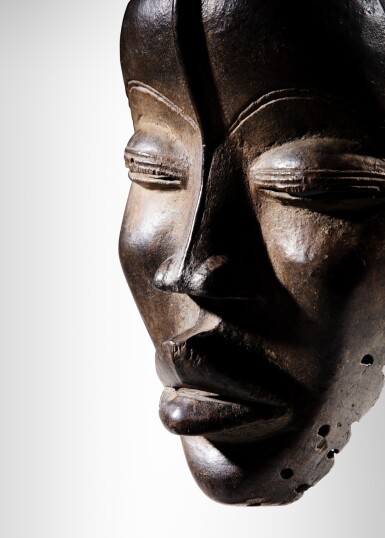
Dan Mask, Côte d'Ivoire
Height: 9 ¼ in (23.5 cm)
Lucien Van de Velde, Antwerp
Lance Entwistle, London, acquired from the above in 1983
Private Collection, New York, acquired from the above
Sotheby's, New York, Important Tribal Art, May 8, 1989, lot 32, consigned by the above
Barbara and Brian Wolfowitz, acquired at the above auction
By Bertrand Goy
This other mask from the Wolfowitz Collection belongs to the corpus of harmonious, figurative representations, shared by the Mande-speaking peoples of Guinea (Konor), Liberia (Gio and Mano) and Côte d'Ivoire (Dan). Artists from these cultures have produced a wide range of naturalistic portraits that stand in stark contrast to the objects made by their Kru-speaking neighbors, the Wé and Kran, who are better known for their more expressionist masks.
It is difficult to determine the exact social function this mask and similar ones assumed, as each object is unique, endowed with its own identity - which can be freely modified - its own name, and its own soul. It would therefore be misleading to rely merely on the form or style of these versatile objects to deduce the functions they fulfilled. Although ethnologists have been able to establish a nomenclature, they nevertheless have struggled to clearly connect a mask’s form or style with a specific use [1], a connection which often only interests art lovers if its use suggests the age of the object. This is the case with this mask, whose prolonged use is confirmed by the beautiful glaze on its reverse, where a dancer's face once rested, and the second row of holes on certain parts of its outer rim, made to hang adorning fibers, cowrie shells, or hair, drilled after the wear of the original holes.
Although the exact function of this mask remains unclear - one can rule out the possibility of its use in masked races during which only masks with round, open eyes could be functionally worn - its geographic origins are clear. Its evident similarities with a mask collected in 1933 [2] by the famous Antwerp anthropologist Frans Olbrecht confirms that it is from Flampleu. Located in the Eighteen Mountains region of Côte d'Ivoire, on the road between Danané and Man, this village is part of the “nuclear Dan style” center, a term coined by Pieter Jan Vandenhoute, a student of Olbrecht, when he visited the region five years later.
Of virtually equal size, the perfect oval faces of Wolfowtiz Dan mask and the Olbrecht Dan mask bear too many similarities to be considered coincidental, starting with the rendering of the eyes; they both seem to be emerging from a long slumber, partly closed by heavy, puffy eyelids, stripped with three parallel lines. The curved shape of their eyes is mirrored by the similar arch of the eyebrows. On both masks, a straight, sharp-edged nose widens at its tip, bearing flared nostrils which heighten the sensuality of the well-defined philtrum and the full, finely traced lips. The Oldfieldia wood from which the masks were probably carved have absorbed the “oiling” of the objects over time, resulting in an attractive, shiny brown patina.
With due deference to the Africa Museum, home of the Olbrecht Dan mask, the Wolfowitz Dan mask is a masterpiece of its type and stands apart because of the masterful precision of its proportions, the virility of the face only heightened by its prominent cheekbones, the characteristic keloid line on the forehead extending the rib line of the nose, and the precise carving marks visible on the inside, testifying to the sculptor's confident hand... The gifted artist who carved this portrait of the “handsome boy” with such enticing features, imbued it with both his own ideal of masculine grace and universal beauty.
[1] « L’apparence du masque ne dit souvent rien sur sa fonction », in Himmelheber, H., Negerkunst und Negerkunstler, Braunschweig, Klinkhart & Biermann, 1960, p. 159
[2] AfricaMuseum, Tervuren (inv. n° EO.1967.63.118)
You May Also Like