
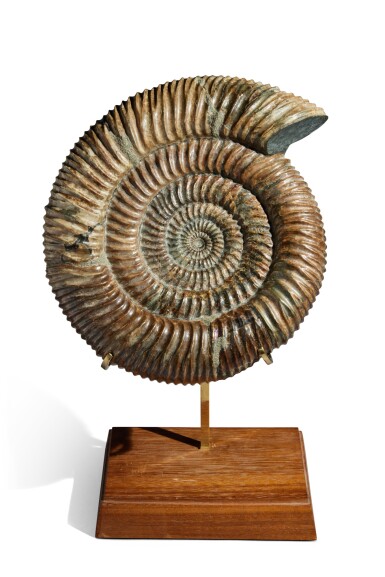
Mounted Cretaceous Ammonite
Early Cretaceous (approx. 130 million years ago), Volga River, Ulyanovsk Oblast, Russia
Auction Closed
July 14, 07:13 PM GMT
Estimate
4,000 - 6,000 USD
Lot Details
Description
Mounted Cretaceous Ammonite
Speetoniceras versicolor
Early Cretaceous (approx. 130 million years ago)
Volga River, Ulyanovsk Oblast, Russia
14 x 11¾ x 4 inches (35.6 x 29.8 x 10.2 cm), 19 inches (48.3 cm) tall on stand. 28 pounds (12.7 kg).
This ammonite specimen is complete beautifully cleaned and in very good condition. Speetoniceras versicolor shells are characterized by distinctive ribbing patterns that bifurcate on the outer whorl and tightly arranged in the inner circles.
Alongside trilobites and dinosaurs, ammonites are among the most iconic fossils. Ammonites swam the seas freely during the Jurassic and Cretaceous Periods, evolving rapidly and leaving abundant examples in the fossil record. Ammonites were cephalopods, a taxonomic class that includes today's nautilus, octopus, and squid. They used a long, tubular organ known as a siphuncle to fill or empty their chambers with water and thus move up or down in the water column. Apart from the siphuncle, the animal lived solely in the outermost chamber.
The outermost layer of ammonite shells was made up of aragonite, a type of calcium carbonate, which provided strong protection and allowed ammonites to fossilize much more readily than animals that either had a soft shell or lacked a shell. This large Speectoniceras fossil from the Volga River has been exquisitely preserved, featuring a pearlescent outer shell with areas of golden, shimmering pyrite that filled in gaps in the shell during fossilization and millions of years of deposition.