Pierre-Antoine Quillard
The Dance
No reserve
Lot Closed
June 10, 01:53 PM GMT
Estimate
15,000 - 20,000 EUR
We may charge or debit your saved payment method subject to the terms set out in our Conditions of Business for Buyers.
Read more.Lot Details
Description
Pierre-Antoine Quillard
Paris 1701 - 1733 Lisbon
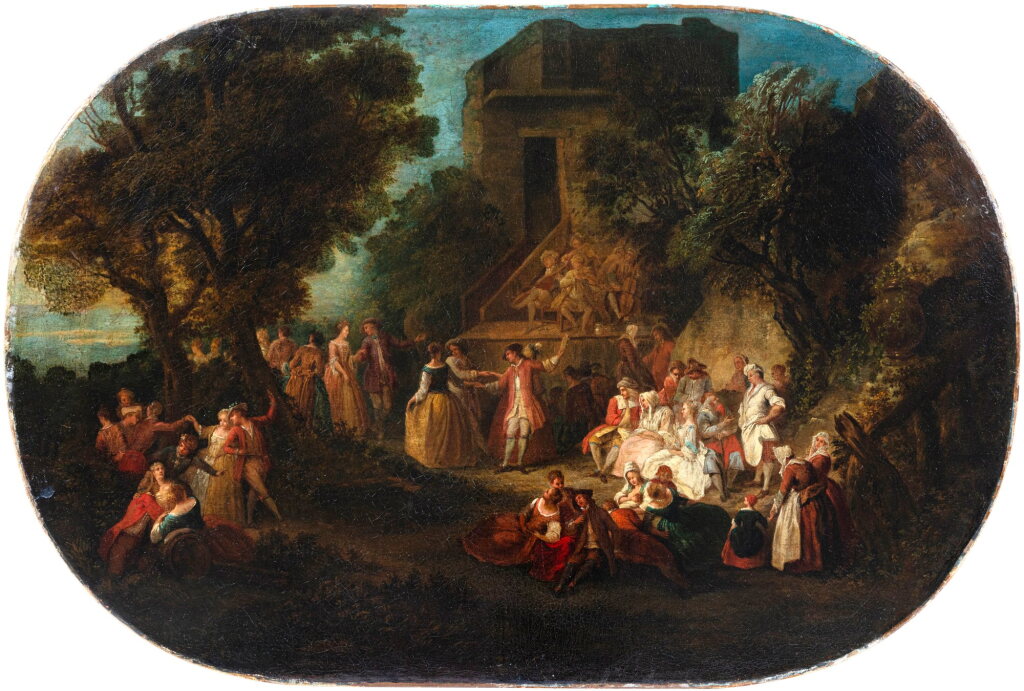
The Dance
Oil on canvas, oval
Bears an inscription lower left on a log J.B. Pater.
53 x 78,2 cm ; 20⅞ by 30¾ in.
Collection Wilhelm Hack, Cologne;
German Private Collection, since 1986.
M. Eidelberg, A Watteau Abecedario, website, as Pierre Antoine Quillard (titled Festivities Outside a Country Inn, notice entered in March 2022, revised in April 2022).
In an article published in April 2022, Martin Eidelberg attributed this Peasant dance as ‘without doubt executed in the style of Quillard’, despite the fact that it had been sold several times as an autograph work by Jean-Baptiste Pater (‘Expanding Quillard’s Œuvre’, watteauandhiscircle.org). It does indeed appear that the signature was added later. The original version of the composition is in the National Gallery of Ireland in Dublin assigned to Pierre-Antoine Quillard (Wedding Festivities, inv. NGI. 564), while a second variant was sold on the Paris art market in the 1950s (M. Eidelberg, ‘Autour du nom de Quillard’, in Bulletin de la Société de l’histoire de l’art français, 1979, p. 133). The pose of the central couple is an emblematic element of this artist’s work, repeated in many of his paintings, with a particular fondness for the male figure with his chin tilted upwards. As with all of Watteau’s disciples, the painting’s colours are influenced by the Venetian School and Rubens. This type of image also owes much to Netherlandish genre painting, relying on iconographical codes established by artists such as David Teniers. His village celebrations include singing, dancing, musicians and feasts shared by adults and children in a joyfully tumultuous vein; the idea has been revisited here, but adapted to the aesthetic norms of the eighteenth century (M. Eidelberg, Watteau et la fête galante, exh. cat., Valenciennes, 2004, p. 216).
Pierre-Antoine Quillard was probably one of the assistants in Watteau’s studio in about 1712–1715. He went to Portugal as a natural history illustrator and here found the recognition that had eluded him in his homeland. He became painter to John V of Portugal in 1727 and worked for the Portuguese aristocracy. He continued to produce fêtes galantes and pastoral scenes, as well as large altarpieces and official court portraits (M. Eidelberg, 2004, op. cit., p. 278). His career was tragically ended by illness, and much of his work was destroyed in an earthquake in Lisbon in 1755.
You May Also Like