Adolphe Appian
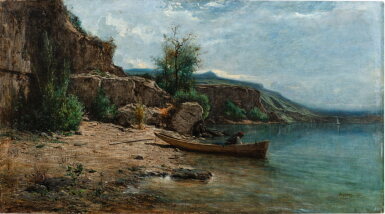
Lake Bourget near Châtillon
Auction Closed
June 9, 01:57 PM GMT
Estimate
20,000 - 30,000 EUR
Lot Details
Description
Adolphe Appian
Lyon 1819 - 1898
Lake Bourget near Châtillon
Oil on canvas
Signed and dated lower right Appian. 1866
69,7 x 125,5 cm ; 27½ by 49⅜ in.
Napoléon III;
Anonymous sale, Me Tual, Paris, Hôtel Drouot, 20 November 1882, lot 29;
Anonymous sale, Me Couturier, Paris, Hôtel Drouot, 27 January 1912, lot 46.
Salon de Paris, 1866, no. 34;
Exposition Universelle, Paris, 1867, no. 5 (as belonging to S. M. l'Empereur).
L. Harambourg, Dictionnaire des peintres paysagistes français au XIXe siècle, Neuchâtel 1985, p. 32;
P. Miquel, L’école de la nature, Maurs-la-Jolie 1985, vol. IV, pp. 18-19;
M. Audin and E. Vial, Dictionnaire des artistes et ouvriers d’art de la France - Lyonnais, Lyon 1992, p. 18 (as belonging to Princess Mathilde).
Shore of the Lac du Bourget near Châtillon is one of Adolphe Appian’s most famous works. Recognizing its quality, the Ministère de la Maison de l’Empereur et des Beaux-Arts bought it at the 1866 Salon, where it featured prominently. At that same Salon, Princess Mathilde, the Emperor’s cousin, bought The village of Chanaz in Savoie. These prestigious purchases and the display of the Shore of the Lac du Bourget near Châtillon at the 1867 Exposition Universelle in Paris, where it was described as ‘property of the Emperor’, established Appian’s reputation and ensured his enduring success.
The painting is one of the best examples of the large composed landscapes, offering a panoramic view opening out into the distance, at which Appian excelled. Instead of a finished, meticulously smooth appearance, he was interested in the effects of perspective, matter and texture. Shore of the Lac du Bourget near Châtillon is characterized by the ruggedness of rocks, the variety of vegetation and the transparent blue tones of the water. Composed, balanced and harmonious, the scene is illuminated with a soft light. An impression of peace and calm imbues the painting with a poetic and soothing atmosphere.
Originally from Lyon, Appian always remained attached to the region of his birth and lived there all his life, although he often set up his easel in Fontainebleau – alongside other artists including his friend Daubigny – and in several other parts of France, such as the Midi. He stayed frequently in Savoie between 1862 and 1866, and in 1865 he explored the environs of the Lac du Bourget.
In 1885, the bulletin of the Société Industrielle de Mulhouse, which managed the Musée des Beaux-Arts, incorrectly reported that the State had given the museum a painting by Adolphe Appian titled Shore of the Lac du Bourget near Châtillon, exhibited at the Salon in 1866. The Mulhouse painting retained this incorrect title, which had become traditional over the years, until very recently, when research concluded that the painting in the Musée de Mulhouse was actually titled A rock in the Communaux de Rix while the present work is in fact Shore of the Lac du Bourget near Châtillon.
Although Adolphe Appian is undeservedly forgotten, he was one of the most able representatives of the young landscape school that developed around Corot and Daubigny. He also belonged to the group of young artists in Lyon who were passionate about painting landscapes, such as Ravier, whom he met at Royat in 1839. Little known before 1866, his success that year brought him fame that continued to grow as well as commissions from abroad. In 1868, he received the first of the fourteen gold medals he was awarded.
You May Also Like