Ary Scheffer
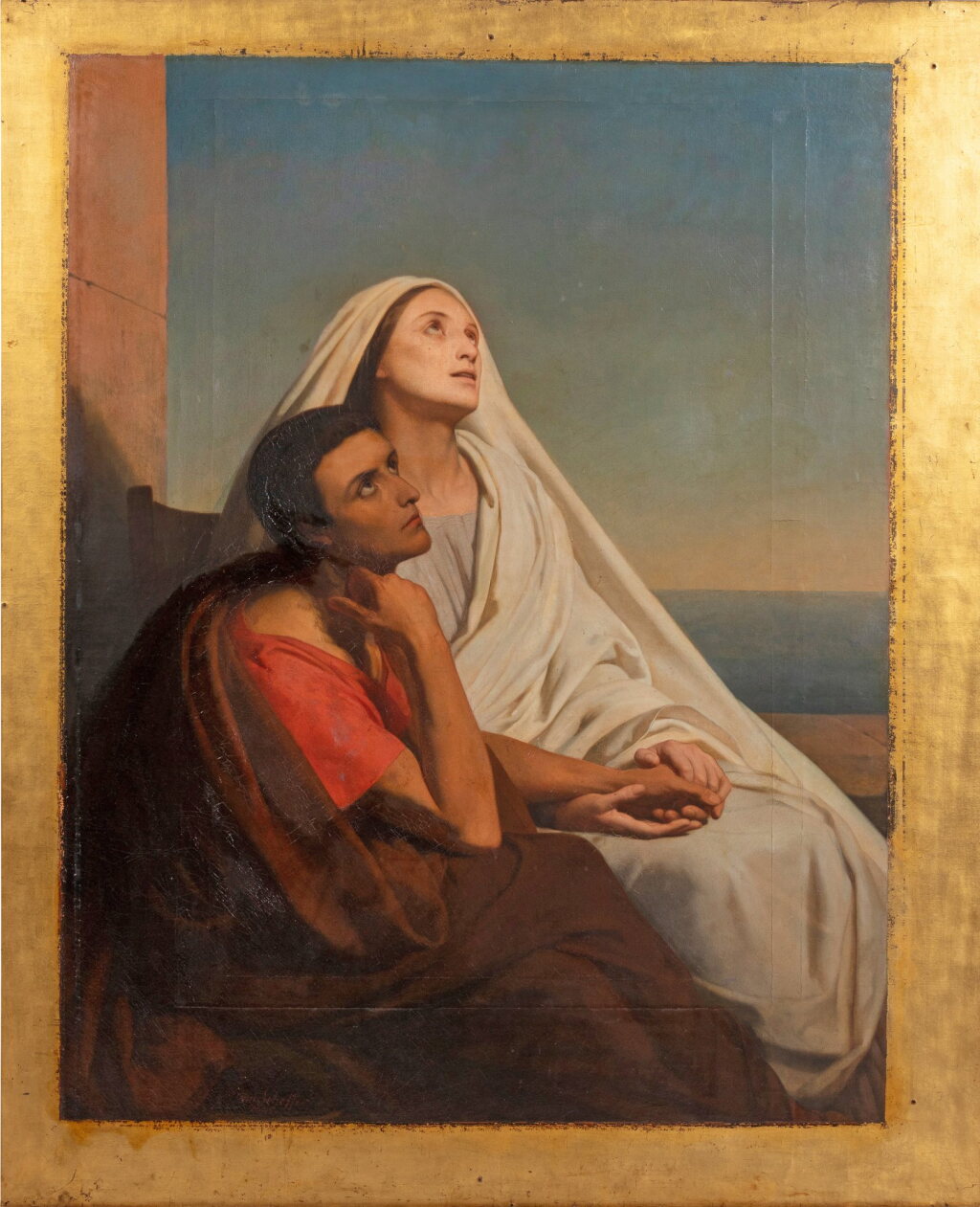
Saints Augustine and Monica
Auction Closed
June 9, 01:57 PM GMT
Estimate
150,000 - 250,000 EUR
Lot Details
Description
Ary Scheffer
Dordrecht 1795 - 1858 Argenteuil
Saints Augustine and Monica
Oil on canvas
Signed and dated lower left Ary Scheffer. / 1845.
167,7 x 141,2 cm ; 66 by 55⅝ in.
Commissioned by Queen Marie-Amélie (1782-1866; her stamp on the reverse of the canvas);
By whom bequeathed to her son, Duke of Montpensier (1824-1890);
Bequeathed to his son, Don Antonio de Orléans (1866-1930);
Bequeathed to his son, Don Alfonso, Palace of Sanlucar de Barrameda (1886-1975);
From whom, acquired by the father of the present owner, in 1973;
Spanish private collection.
Salon de Paris, 1846, no. 1601 (as belonging to S. M. la Reine).
Anonymous, L’Illustration, 1846;
A. Houssaye, 'Le Salon de 1846', in L’Artiste, 22 March 1846, 3rd book, p. 39;
A. de Faniez, 'Le Salon, tableaux religieux', in L’Artiste, 4th serie, tome 6, 5 May 1846, p. 141;
Mrs Grote, Memoirs of the life of Ary Scheffer, London 1860, pp. 66-67;
T. Thoré, Salon de 1846. Les Salons, Paris 1868, p. 278;
L. Wellisz, Les amis romantiques, Ary Scheffer et ses amis polonais, Paris 1933, p. 56;
M. Kolb, Ary Scheffer et son temps, Paris 1937, pp. 375-376;
G. and J. Lacambre, Champfleury, le Réalisme, Textes choisis, Paris 1973, mentioned p. 100;
Equivoques, exh. cat., musée des Arts décoratifs, Paris 1973 (several articles from the period);
C. Baudelaire, 'Salon de 1846', in Œuvres complètes, Paris 1976, tome II, pp. 474-475;
Ary Scheffer, exh. cat. ,Institut néerlandais, Paris, October-November 1980, pp. 24 and 67;
L. Ewals, Ary Scheffer. Sa vie et son œuvre, The Netherlands, thesis, 1987, pp. 83-84 and 303-305, no. 77 (repr.);
L’atelier d’Ary Scheffer, exh. cat., musée de la vie romantique, Paris, September 1991-January 1992, mentioned p. 46;
Ary Scheffer, exh. cat., musée de la vie romantique, Paris, April-July 1996, mentioned p. 80, under no. 58;
Paris romantique : 1815 - 1848, exh. cat., musée du Petit Palais, musée de la vie romantique, Paris, May-September 2019, mentioned p. 151.
With its royal provenance, St Augustine and St Monica is one of Ary Scheffer’s most famous works. Commissioned by Queen Marie-Amélie, it was exhibited at the Salon in 1846, accompanied in the catalogue by the following note: ‘We were conversing alone very pleasantly and forgetting those things which are past, and reaching forward toward those things which are future. We were in the present – and in the presence of Truth (which thou art) – discussing together what is the nature of the eternal life of the saints: which eye has not seen, nor ear heard, neither has entered into the heart of man.’ (St. Augustine, Confessions, book IX, ch. X).
Scheffer shows the moment when St Augustine shares a divine vision with his mother St Monica, shortly before her death at Ostia in 387. The composition is extremely austere. The closeness of the mother and son is underlined by two diagonals that unite them, forming a triangle. St Monica, draped in a white robe, stands out against the blue sky. Already belonging to the spiritual world, she is ready to reach out to God and lifts her beautiful pale face towards him in ecstasy. In his mother’s shadow, St Augustine, recently converted, is clothed in red and brown – alluding to his recent attachment to terrestrial passions. He is not yet ready for absolute communion with the divine, and turns his eyes to heaven with a gaze full of humility.
The painting expresses the aspiration for the elevation of the soul with a sincerity from which all artifice is absent, which undoubtedly contributed to the huge popularity of the painting at the Salon. Scheffer received enthusiastic letters and several well-known figures, including Chateaubriand, expressed their admiration. Some critics were rapturous, such as the anonymous writer published in Illustration in 1846: ‘The most important painting of the exhibition. Never before has religious ecstasy illuminated a more gentle and engaging episode.... St Monica’s head is sublime. This is asceticism at the height of ecstasy with the infinite...’. Others, more reserved, reproached its lack of energy, its sweetness and its sentimentality. Baudelaire’s reaction was harsh: for him, the idea of depicting a vision, in other words something that was in its essence invisible, was absurd (Baudelaire, 1976, op. cit.). Scheffer was a believer. A tormented and melancholic man, he found comfort and consolation in religion. He was so hurt by the unkind comments that he never again exhibited at the Salon.
Scheffer made several replicas of St Augustine and St Monica, sometimes with his studio’s collaboration. In 1849, he painted a version for himself, giving St Monica the face of his own mother, who had died in 1839. It is very likely the one now in the Dordrecht Museum. The Musée de la vie Romantique, the Musée du Louvre in Paris and the National Gallery in London each own a replica. There are also versions in a small format as well as numerous preparatory or replica drawings and watercolours. Copies are equally plentiful. Gustave Doré made one. Between 1893 and 1916, the Louvre version was copied twenty-four times.
The very first preparatory drawing, dated 1840, differs greatly from the final composition, with the figures turned towards the left and placed at almost exactly the same height. The recent death of his mother had a lasting impact on Scheffer and must have inspired this scene of communion between a mother and her son. He returned to the subject some years later at the request of Queen Marie-Amélie, grief-stricken after the death of her eldest son in 1842.
Ary Scheffer was idolized by the public for his ability to generate strong emotions with great simplicity of means. For Lamartine, he was the ‘painter of the soul’, ‘the inventor of a new genre of painting, the painting of expression, spiritualist painting, the painting that comes from the soul, addresses the soul, and moves the soul...’ (exh. cat. Lamartine, op. cit.). It was this talent that brought the painter so much popularity and meant, in the early twentieth century, that St Augustine and St Monica was regarded as Scheffer’s most important painting and one of the masterpiece of the nineteenth century.
You May Also Like