Gustave Courbet and Studio
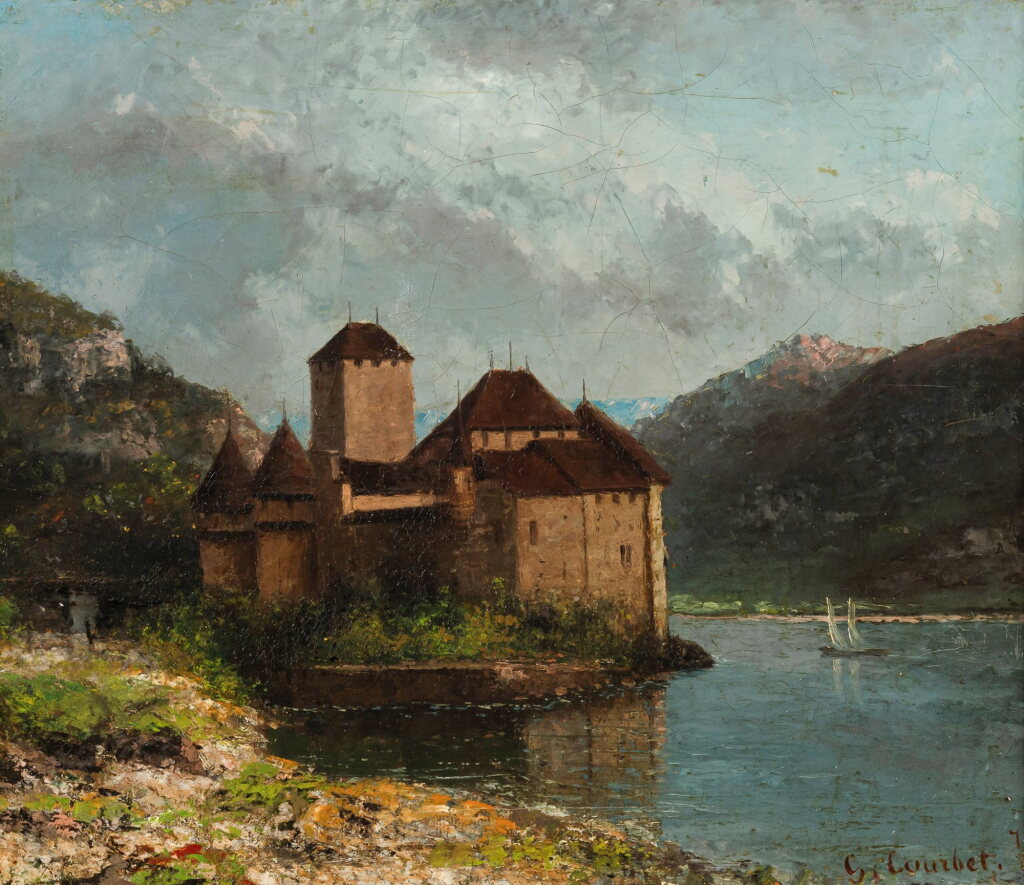
A view of the Château de Chillon
Auction Closed
June 9, 01:57 PM GMT
Estimate
50,000 - 70,000 EUR
Lot Details
Description
Gustave Courbet and Studio
Ornans 1819 - 1877 La Tour-de-Peilz
A view of the Château de Chillon
Oil on canvas
Signed and dated lower right G. Courbet. 75
45 x 52,7 cm ; 17¾ by 20¾ in.
We would like to thank the Association des Amis de Gustave Courbet at the Institut Gustave Courbet, Ornans for kindly endorsing the attribution of this work to Gustave Courbet and Studio after first-hand inspection.
The painting will be included in the forthcoming catalogue raisonné of the artist as by "Gustave Courbet et collaboration".
The Château de Chillon is a medieval fortress, documented as early as the first half of the twelfth century. Overlooking Lake Geneva, it is in the commune of Veytaux, in Switzerland. It was already a popular tourist destination by the nineteenth century, appearing regularly on postcards and in travel journals. Its aspect and its history appealed to the Romantic artists, with their enthusiasm for the medieval period. After his travels in Switzerland in 1802, Turner featured the Château in several of his works. Inspired by François Bonivard’s years of captivity between 1532 and 1536, when he was chained up in the dungeon, Lord Byron’s The Prisoner of Chillon (published in 1819) renewed its popularity.
In his catalogue raisonné of 1978, Robert Fernier mentions nearly twenty-one versions of this motif painted by Courbet between 1873 and 1876, mostly now in museums around the world (R. Fernier, La vie et l’œuvre de Gustave Courbet, 1978, vol. II, pp. 192–197, p. 214, p. 232). In 1873, in order to avoid ruin after the affair of the Vendôme Column, the artist went into exile in La Tour-de-Peilz, just a few miles from the Château. He died there in 1877. Although the viewpoints vary, his various depictions of the Château share a sense of enduring calm: this landscape seems possessed of eternal tranquillity. In the view of Dominique de Font-Réaulx, the repetition nevertheless expresses the profound sense of imprisonment felt by the artist in exile (Gustave Courbet, exh. cat., The Metropolitan Museum of Art, New York, 2008, p. 422).
You May Also Like