Property from a Private Collection, Belgravia
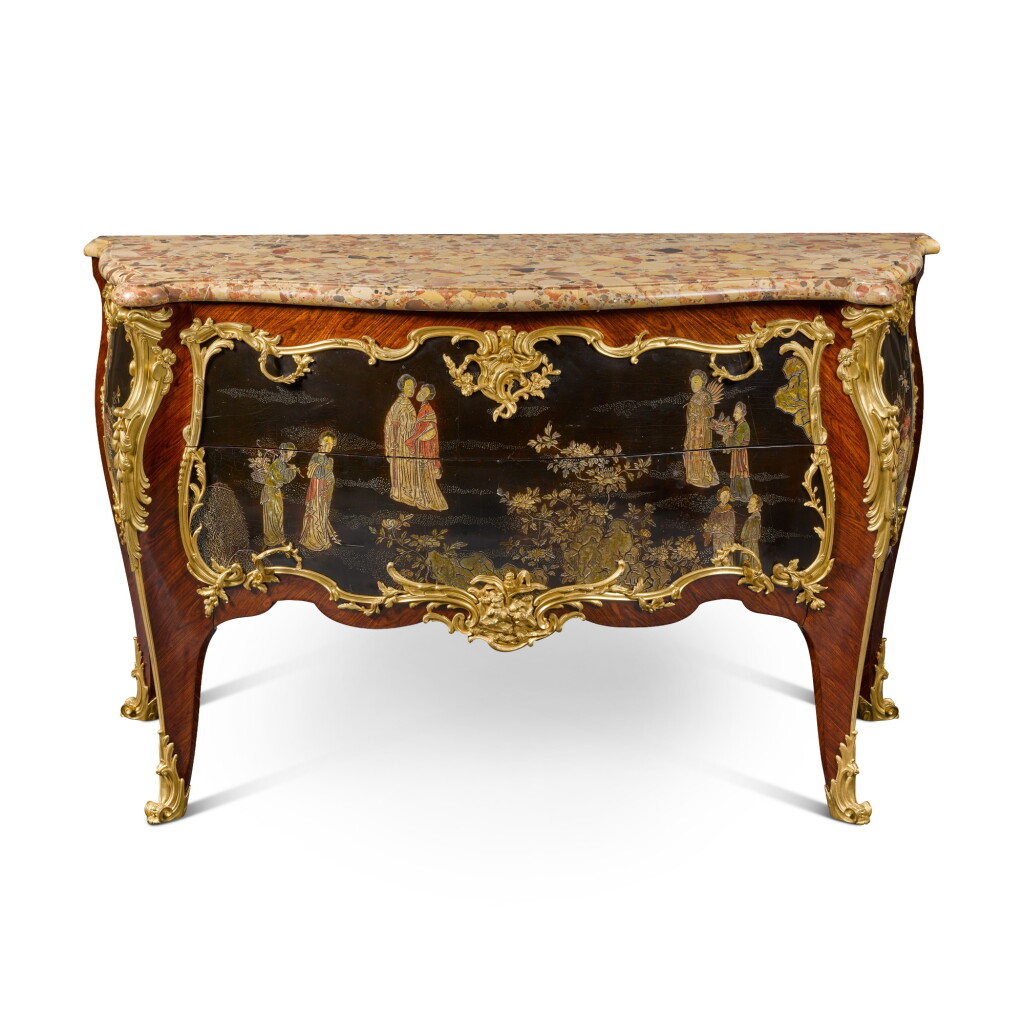
A Louis XV style gilt-bronze-mounted coromandel lacquer and rosewood commode by Paul-Charles Sormani, Paris, early 20th century
Lot Closed
June 9, 01:07 PM GMT
Estimate
30,000 - 50,000 GBP
We may charge or debit your saved payment method subject to the terms set out in our Conditions of Business for Buyers.
Read more.Lot Details
Description
with a brèche d'Alep top above two long drawers sans traverse, stamped 'SORMANI PARIS' twice to the carcass at the front corners and once 'SORMANI / 134 Bd Haussmann Paris' to the lock of top drawer
94cm high, 155cm wide, 59cm deep; 37in., 61in., 23 ¼ in.
Acquired from Adrian Alan, London, 2017.
This elegant commode exemplifies the refined taste for exotic materials incorporated into ornate gilt‑bronze mounted furniture, a style the workshops of Paul Sormani mastered with exceptional finesse as is the case here. Emerging from a desire to emulate the marchands‑merciers who, from the mid‑18th century onward, popularised the use of luxurious materials like lacquer, a select group of highly skilled 19th‑century cabinetmakers succeeded in reviving -and at times even rivaling- the splendour of ancien régime craftsmanship.
This commode was possibly inspired by the work of the royal cabinetmaker Bernard Vanrisamburgh (maître in 1735), see a commode with almost identical mounts, stamped B.V.R.B. was formerly in the collections of Jean-Baptiste de Machault d’Arnouville (1701-1794) - illustrated in Vincent Pruchnicki, Arnouville, 2013, p.51.
Paul Sormani
Born in Northern Italy in 1817, Paul Sormani was in Paris by 1847 and quickly became one of the leading luxury ébénistes of the Second Empire, supplying the court of Napoléon III and the Empress Eugénie and participating in the Expositions Universelles of 1855 and 1867. His workshop was located at 10 Rue Charlot in the Marais district, and after his death in 1877 was taken over by his widow and son, Paul-Charles, under the name Veuve Sormani & Fils à Paris until the early 20th century when the premises were transferred to 134 Boulevard Haussmann in partnership with Thiébaux, trading until 1934.
The fascination for lacquer
Coromandel lacquer, originating from South China in an area called Wenzhou (Zhejiang province), consisted of applying to the board a thick paste ground, called Urushi, into which the chosen pictoral design is carved and then filled with coloured pigmented pastes.
Carolyn Sargentson in her book Merchants and Luxury Markets: The Marchands Merciers of Eighteenth-Century, Paris, 1996 (pp. 79-90), describes how the marchands-merciers enlarged their market by adapting imported Chinese lacquer to French furniture forms. They removed lacquer panels from cabinets, chests and screens and re-used them on a multitude of different pieces of furniture. In fact, André Jacob Roubo detailed, in 1772, the process whereby the panels could be removed and re-used on shaped carcasses. Thus was established a new aesthetic, luxurious surface decoration adapted to European forms and often framed with elegant ormolu mounts, framing the landscape scene according to the Louis XV taste.
The fascination for lacquer continued well into the 19th century and 20th century since the appeal of lacquer and the decorations associated with the technique never ceased to loose charm and elegance. Cabinetmakers such as Henri Dasson, Sormani, Beurdeley, Zwiener and Linke took part in the promotion of the genre and showcased their skills through their renditions in the Louis XV and Louis XVI style.